Sait Abasiyanik - A Useless Man
Здесь есть возможность читать онлайн «Sait Abasiyanik - A Useless Man» весь текст электронной книги совершенно бесплатно (целиком полную версию без сокращений). В некоторых случаях можно слушать аудио, скачать через торрент в формате fb2 и присутствует краткое содержание. Год выпуска: 2015, Издательство: Archipelago, Жанр: Классическая проза, на английском языке. Описание произведения, (предисловие) а так же отзывы посетителей доступны на портале библиотеки ЛибКат.
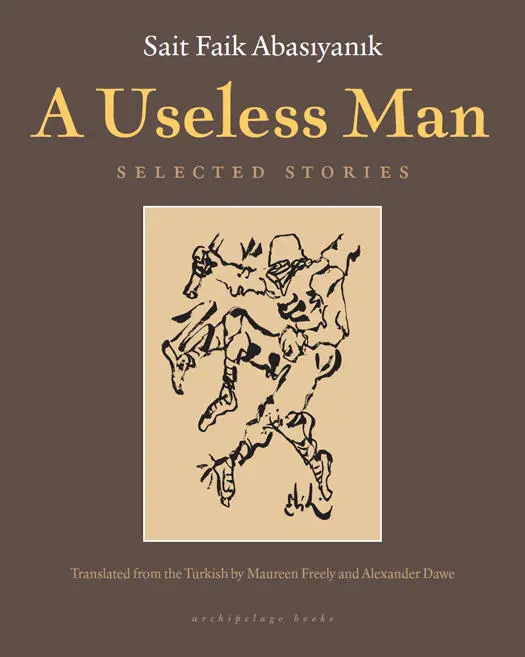
- Название:A Useless Man
- Автор:
- Издательство:Archipelago
- Жанр:
- Год:2015
- ISBN:нет данных
- Рейтинг книги:3 / 5. Голосов: 1
-
Избранное:Добавить в избранное
- Отзывы:
-
Ваша оценка:
A Useless Man: краткое содержание, описание и аннотация
Предлагаем к чтению аннотацию, описание, краткое содержание или предисловие (зависит от того, что написал сам автор книги «A Useless Man»). Если вы не нашли необходимую информацию о книге — напишите в комментариях, мы постараемся отыскать её.
Sait Faik donated his estate to the Daruşafaka foundation for orphans, and this foundation has since been committed to promoting his work. His former family home on Burgazada was recently restored, and now functions as a museum honoring his life and work. He is still greatly revered: Turkey's most prestigious short story award carries his name and nearly every Turk knows by heart a line or a story by Sait Faik.
A Useless Man — читать онлайн бесплатно полную книгу (весь текст) целиком
Ниже представлен текст книги, разбитый по страницам. Система сохранения места последней прочитанной страницы, позволяет с удобством читать онлайн бесплатно книгу «A Useless Man», без необходимости каждый раз заново искать на чём Вы остановились. Поставьте закладку, и сможете в любой момент перейти на страницу, на которой закончили чтение.
Интервал:
Закладка:
It’s evening. I know it is when the lady shuts the wooden blinds over her patisserie windows. There’s a soft yellow light inside. She’s switched on the electricity. Salomon puts a candle on his crate of oranges and the man who sells salted bonito plugs in a three hundred watt bulb. He slices red onions; they are the color of cyclamen and they shimmer as alluringly as lipstick or nail polish. Salted bonito! They conjure up the inner thighs of a voluptuous, olive-skinned Greek woman!
When ladies of the night want to be left alone, they step out of the meyhane with their misfortune and slip into my street to sidle up to me. Oh my miserable street!
There are two meyhane with live Turkish music on Street Number One. Taxis idle outside while drivers and prostitutes wander between the cars. Someone once told me that car antennae aren’t really lightning rods put there to take a sudden bolt, but I was still fooled when I first saw them, the bright metal rods flashing white like lightning in the rain.
That tiny little tail on the back of an enormous beast of an automobile; I love that menacing and maniacal twitching. In the rain I stop in front of my tripe soup restaurant, pull my hat down over my ears and watch with what I imagine must be baleful eyes the people passing, and I pretend I have just been dropped into this neighborhood from a distant land without women, and am now searching for the one with whom I can share my sorrows.
Ten minutes later a man much older than me walks past. He’s a burly fellow with a gray moustache, and though he has a full head of hair, it’s gone gray. A driver spots him and says:
“Hey there. What’s up?”
“Hello there, boys,” he says.
Then he rattles off a few lines of dusty verse. When he’s moved on, a driver says:
“He’s an educated man, but twisted. Has a weakness for the young ladies. The younger and more wretched the better … What a fool!”
The educated man heads for the nightclub across the street. A little later, I head in after him. He walks toward the musicians and sits down right in front. He’s a clean, well-dressed man, his hands, his hair, and his moustache are immaculate. He can’t be more than fifty. There are one, two, three, four, five women in his booth. The sugar daddy levels his eyes on the youngest. They have her order him a drink and they bring him a pomegranate cooler with four or five drops of rubbing alcohol. They bring him one more. The man calls out to a coy girl with sweet round eyes and whispers into her ear before he begins to drop off. He falls asleep, his elbow propped on the table, but every now and then when the violinist in dark glasses strikes up a solo in a screeching that blends perfectly with the band, cutting through the soft chatter of the women, he moans, “Allah, Allah.” The waiter Bekir told me how he rests his head on the chest of the girl he’ll eventually leave with and how until then he sleeps there and weeps and sings and recites verse. Never more than these five things (for example, he never laughs). Then he goes back to sleep. Now he’s deaf to the cries of the infamous brute from who knows which part of town, who flashes into the joint like lightning and screams at I don’t know whom; he’s still fast asleep when the meyhane proprietor — who hails from the Black Sea — moves in on two gangsters, throws them into the street and smashes the window front of a rival club. Some nights he even misses the young goliath who barges into the place with the rain and the snow, and (out of courtesy, perhaps, or just to make himself look important) sets up one of the chairs reserved for the tired, old singers to button up the trousers of a plump horn player, whose cheeks and neck and hair and moustache and coat collar are all soaked in sweat, who then proceeds to produce the most god awful screech on his thin little horn. The horn player is the last act with the band. He comes out around eleven, heaving his body about on two thick, short, fat legs. He takes off his velvet coat, tosses it in a corner of the room and salutes the blind violinist. The drummer whispers something to the blind violinist who cuts off the horn player’s salute. And the zither player’s taut, freshly shaved and alum-smeared face, hardly visible behind the singer, suddenly collapses into a million crinkles. The horn player sits down. Shouldn’t there be buttons on his pants? Or have they popped off because he’s so fat? The tassels on his green scarf dangle out of his fly. Some notice and laugh and the nightclub proprietor signals to him with a wink and a nod. Embarrassed, the horn player stands up, turns his back to the audience, takes a few moments to adjust his pants, sits back down, looks around the room, then pulls a cigarette case out of his pocket. It seems like he might roll a cigarette — but no, he pulls a reed out of one of his horns and puts it away. Then he takes out another one, surely the best one, or rather he pretends to be taking the best one out just for this night. That’s when I always leave.
I haven’t been anywhere else in Istanbul for seven years apart from this street. I’m afraid. I’m worried that I might get beaten up if I go further afield, or robbed, or lynched, and who knows what else — just the thought of leaving these streets fills me with confusion. Anywhere else, and I feel out of my depth. Everyone looks so frightening. I wonder who they all are, these people on the streets. The city is so huge, and everyone’s a stranger. Why do they even make these cities to pack in this many people, when people don’t like each other anymore? I just don’t understand. Is it so that people can deceive and humiliate and murder each other? How can it be that so many strangers would wish to live in the same space?
If nothing else, a neighborhood is still a neighborhood. My shop could burn down, and I could go hungry. But somehow I have confidence that the man who sells me tripe soup with lots of lemon every afternoon will serve me until I die. And Saloman will keep handing me a bruised orange or two when I pass by, and to the half-dressed Jewish children on the street. My clothes might be old and ragged by then, they might not let me in, but the lady will still serve me a coffee at the door.
These are pipedreams, I know, but they show you how much I love my neighborhood. I don’t want to see anyone else anymore, most particularly old acquaintances. Sometimes I run into one of them passing through my neighborhood.
“So finally! So this is where you’ve been hiding, is it?”
I lower my head and look down as if to say, what’s the problem with that?
“People always said you could have ended up anywhere …”
The former friend will add:
“But damn it, you’re still drifting, aren’t you?” It’s not about giving up the idle life, it’s about giving up altogether, but I can’t explain that to him. Some say:
“I know the deal, you rascal. You’re chasing someone …”
The truth is, I’ve even stopped chasing after myself. But I still love that dark Jewish girl, the carpenter’s friend, the one with the dark spot eyes, and the voluptuous hands. I can only dream of the other warm and sweet-scented corners beyond her legs.
Yesterday I decided for no reason to venture outside the neighborhood. I went to Unkapanı and then up to Saraçhane. Istanbul had changed so much since I’d last seen it. I was dumbstruck. But enjoying myself, nonetheless.
Clean asphalt, broad avenues … What a splendid aqueduct — from a mile away, it looked almost like the Arc de Triomphe from a whole mile away! The Gazanfera? Madrasah just beside it: so bright and white and charming. I visited one park after another, to take refuge under the trees. And as I wandered fearfully through the city, I saw people, people everywhere. I walked as far as Kıztaşı. I started down the hill from Fatih. Now I was in Saraçhane. I looked up and saw workmen on the top of a building they were demolishing. There used to be a hamam around here. That must be the building they were tearing down. I felt an overwhelming desire to go to a hamam.
Читать дальшеИнтервал:
Закладка:
Похожие книги на «A Useless Man»
Представляем Вашему вниманию похожие книги на «A Useless Man» списком для выбора. Мы отобрали схожую по названию и смыслу литературу в надежде предоставить читателям больше вариантов отыскать новые, интересные, ещё непрочитанные произведения.









Обсуждение, отзывы о книге «A Useless Man» и просто собственные мнения читателей. Оставьте ваши комментарии, напишите, что Вы думаете о произведении, его смысле или главных героях. Укажите что конкретно понравилось, а что нет, и почему Вы так считаете.