Sait Abasiyanik - A Useless Man
Здесь есть возможность читать онлайн «Sait Abasiyanik - A Useless Man» весь текст электронной книги совершенно бесплатно (целиком полную версию без сокращений). В некоторых случаях можно слушать аудио, скачать через торрент в формате fb2 и присутствует краткое содержание. Год выпуска: 2015, Издательство: Archipelago, Жанр: Классическая проза, на английском языке. Описание произведения, (предисловие) а так же отзывы посетителей доступны на портале библиотеки ЛибКат.
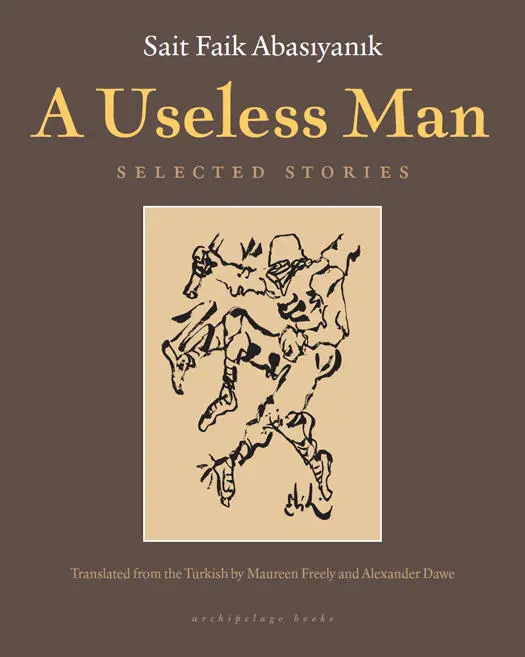
- Название:A Useless Man
- Автор:
- Издательство:Archipelago
- Жанр:
- Год:2015
- ISBN:нет данных
- Рейтинг книги:3 / 5. Голосов: 1
-
Избранное:Добавить в избранное
- Отзывы:
-
Ваша оценка:
A Useless Man: краткое содержание, описание и аннотация
Предлагаем к чтению аннотацию, описание, краткое содержание или предисловие (зависит от того, что написал сам автор книги «A Useless Man»). Если вы не нашли необходимую информацию о книге — напишите в комментариях, мы постараемся отыскать её.
Sait Faik donated his estate to the Daruşafaka foundation for orphans, and this foundation has since been committed to promoting his work. His former family home on Burgazada was recently restored, and now functions as a museum honoring his life and work. He is still greatly revered: Turkey's most prestigious short story award carries his name and nearly every Turk knows by heart a line or a story by Sait Faik.
A Useless Man — читать онлайн бесплатно полную книгу (весь текст) целиком
Ниже представлен текст книги, разбитый по страницам. Система сохранения места последней прочитанной страницы, позволяет с удобством читать онлайн бесплатно книгу «A Useless Man», без необходимости каждый раз заново искать на чём Вы остановились. Поставьте закладку, и сможете в любой момент перейти на страницу, на которой закончили чтение.
Интервал:
Закладка:
Your son ,
Celil
A Useless Man

I’ve been feeling odd lately. I prefer to keep myself to myself, and I don’t want anyone knocking on my door, not even mailmen, the nicest men in the world. But I’m happy enough with my neighborhood. What if I told you I hadn’t left it in seven years? Or that none of my friends know where I am? For seven years now, I haven’t strayed beyond these four streets, except to walk down to Karaköy at the end of each quarter, to collect the rent from our store.
There are three parallel streets, and one that cuts across, and then there is my street, cut off from all the others and so short and narrow you might not even consider it a street. I have named the other streets One, Two, Three, and Four, in order of importance. But my street doesn’t have a number. I just couldn’t bring myself to do it.
A milkman lives on the ground floor of my building, and there are two carpenters across the street. I’d never been to a carpenter before. I’d always wondered how they got by. The ones on my street never stop working. They remind me of the gulf between me and other people: in forty years I haven’t once needed a carpenter, that’s just the way it is. It always surprises me when an Istanbullu actually goes to a carpenter. But who knows how many carpenters are doing business in this city of ours?
Once out of bed, I head straight for the café. It’s a clean and tidy place with seven or eight tables, with customers who come and go without so much as a word, unless they retire to the corner to play King or Bezique or chess. The owner is a French-Jewish lady. The nicest woman in the world.
“Bonjour Madame,” I say the moment I step inside.
“Bonjour Monsieur. Comment allez-vous?” she says.
I give all the right answers. But she knows better. She gives me what I think are honeyed words in French. I only understand a few. When I need to, I throw in the odd oui , and then a few nons to balance out the ouis . We get on really well. She tucks a French magazine under my arm and I sit down to look at the pictures. I jot down a few new words to look up in the dictionary when I get home, and when I read the magazine the next morning I say, Goodness, who would have thought it?
The madame: “Un cappuccino?”
Me: “Of course.”
Then I throw down a c’est ça to keep it going in French. The lady is really pleased. She starts explaining how to make a cappuccino, in German.
And I listen.
Toward eleven I climb up the little street to the tramway line, turn left, and in just five steps I’m in front of a bookstore where I buy a few more illustrated French magazines. Stepping out with the magazines under my arm, I hurry back to my street. Ah! Such relief once I’m there. The people here are different, nothing like the ones near the tramway line. They scare me.
These days I’m hardly ever hungry, but there’s a man who makes tripe soup in our neighborhood. He’s an honest man and he makes good soup, and his place isn’t anything like those filthy tripe soup restaurants in other parts of the city. His soup’s as white as snow and he serves it in antique bowls.
“You like it seasoned, Mansur Bey?”
“Yes Bayram, I would,” I say.
Maybe he’s called Bayram or maybe Muharrem, but for me every man who sells tripe soup is called Bayram.
“Should I throw in a little vinegar and garlic, Mansur Bey?”
“Not today. It upset my stomach the other day, gave me gas. Have your waiter go fetch a lemon. Give it a quick squeeze of lemon instead.”
“But we’ve saved the other half of the lemon we got for you the other day.”
“Really?”
I was as happy as a child to hear about that half lemon. And Bayram was like a child, happy that I was happy and happy that he’d set the half lemon aside for me.
“Should I squeeze out the full half lemon, Mansur Bey?”
“Squeeze it dry, Bayram! Let’s have it extra sour.”
After finishing my extra sour soup, I go back up to my little apartment. With my French dictionary beside me, I fall asleep before I have even started translating the captions in the French magazine I bought earlier that day. I wake up at exactly four-thirty. Then I go out for a stroll. I leave my building, turn right, cross Street Number One and hurry along the sidewalk left of the tramway line before I dive into Street Number Two, which is parallel to Street Number One.
It’s a narrow, seedy street. Caked with mud. There’s a bar on the right, then a real estate agent, then a restaurant. I always get the feeling they serve forbidden fruit with their food. The same sad women go there every night with the same strange men; they could be eating frogs, or mice, or crows, or cats, or dogs, or even humans. I’m at the head of my street now. I’m just passing by. I turn to my right to say hello to the woman who sells dried fruit on the street. “Hello, sir,” she says. She has the most exquisite eyes. I hesitate before I turn right … Why?
I’ll explain. Now this happened on one of my evening strolls. When most people go out for a stroll, they will pause now and again, if not to look into someone’s eyes or a shop window, then just to take in their surroundings. Such things are beyond me. As I approach the street in question I begin to walk faster, eyes glued to the ground — all this to give the impression that it angers me to have to walk through it all. Why? Well let me explain.
The truth, sir, is that a true devil of a little Jewish girl lives in a house on that street, with a face that older ladies would describe as all in place (though she does have a spot in one eye, but what’s the harm in that?) and gargantuan breasts that undulate in dark olive waves beneath her low-cut dress and hands plump enough to set a hazelnut on top. She sits at a window with winged shutters, absently sewing. But sometimes she lingers at the front door for hours, looking up and down the street, striking up conversations with every man who wanders by. Her full and strong legs keep her firmly on the ground, but olive-skinned Jews are the most beautiful of them all, and, oh, if only I could kiss those legs, just once.
Now, one day when I found myself ambling down that infamous street, the Jewish girl was at her door and the carpenter was standing at his door, which was just opposite. As I made to pass between them, the carpenter stepped out into the street, planting himself square in front of me.
“I’ve had enough from you — do you hear? You come by here one more time, I’ll sock you in the eye.”
From that day on I was tormented by the desire to walk down that street again. Oh the palpitations I suffered struggling to stifle that desire on my next few evening strolls. I knew the carpenter’s threats weren’t empty — he would come straight out and punch me in the eye! Oh what difficult days those were. For years I forced my heart to shut down from the moment I sensed the first flutter. For days my heart wouldn’t allow so much as an extra beat. I’d check it: always sixty-three, always sixty-three, though sometimes it might drop to sixty-two. “It should settle into its normal rhythm when you’re walking,” a doctor friend of mine told me. But I couldn’t just stop in the middle of the street and take my pulse! But I could sit down and relax and order a coffee and, throwing a glance left and right to see if anyone happened to be looking, I could discreetly pull out my watch to check: sixty-three. Even if a woman looked me in the eye, even if the price of oranges jumped from five kuruş to twenty-five, I refused to be moved. If they were selling for five, I’d eat them; if the price had gone up to twenty-five then it was goodbye to oranges. So back in the days when Street Number Three was a no-go area, like the rest of Istanbul, my evening strolls weren’t so pleasant. I was trapped inside two streets. But I was never bored. In fact it was a quiet neighborhood, quiet but also vibrant. How could a Levantine-Jewish neighborhood not be vibrant? The Jews especially. What wonderful, warm, vibrant people. The neighborhood Jews weren’t from the rich cut of society, and I’d no business with the rich anyway. When the local orange seller — that’s Saloman — got more than forty kuruş out of me, he was the loveliest man in the world. When his oranges were too expensive and I didn’t buy them, he didn’t throw me dirty looks when I walked away or grumble when I offered him an impossible price. But just the opposite — he knew that I had every right.
Читать дальшеИнтервал:
Закладка:
Похожие книги на «A Useless Man»
Представляем Вашему вниманию похожие книги на «A Useless Man» списком для выбора. Мы отобрали схожую по названию и смыслу литературу в надежде предоставить читателям больше вариантов отыскать новые, интересные, ещё непрочитанные произведения.











Обсуждение, отзывы о книге «A Useless Man» и просто собственные мнения читателей. Оставьте ваши комментарии, напишите, что Вы думаете о произведении, его смысле или главных героях. Укажите что конкретно понравилось, а что нет, и почему Вы так считаете.