Marina Cramer - Roads
Здесь есть возможность читать онлайн «Marina Cramer - Roads» весь текст электронной книги совершенно бесплатно (целиком полную версию без сокращений). В некоторых случаях можно слушать аудио, скачать через торрент в формате fb2 и присутствует краткое содержание. Город: Chicago, Год выпуска: 2017, ISBN: 2017, Издательство: Academy Chicago Publishers, Жанр: Историческая проза, на английском языке. Описание произведения, (предисловие) а так же отзывы посетителей доступны на портале библиотеки ЛибКат.
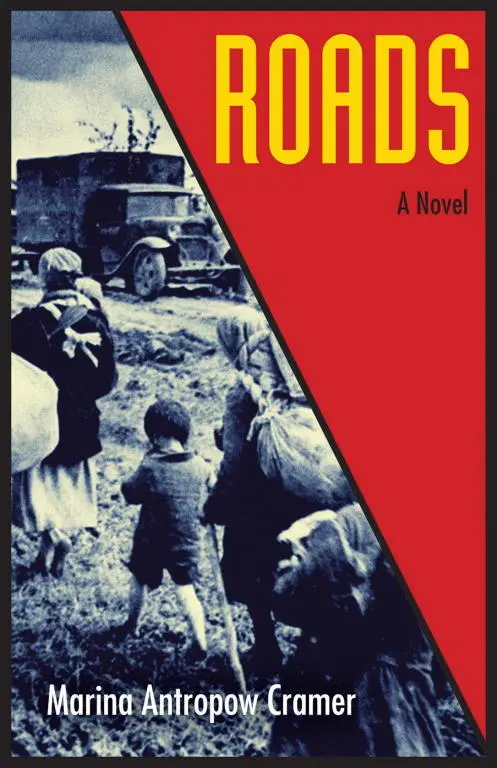
- Название:Roads
- Автор:
- Издательство:Academy Chicago Publishers
- Жанр:
- Год:2017
- Город:Chicago
- ISBN:978-1-61373-558-9
- Рейтинг книги:5 / 5. Голосов: 1
-
Избранное:Добавить в избранное
- Отзывы:
-
Ваша оценка:
Roads: краткое содержание, описание и аннотация
Предлагаем к чтению аннотацию, описание, краткое содержание или предисловие (зависит от того, что написал сам автор книги «Roads»). Если вы не нашли необходимую информацию о книге — напишите в комментариях, мы постараемся отыскать её.
By winter 1945, Allied air raids destroy strategic sites; Dresden, a city of no military consequence, seems safe. The world knows Dresden’s fate.
Roads
Roads — читать онлайн бесплатно полную книгу (весь текст) целиком
Ниже представлен текст книги, разбитый по страницам. Система сохранения места последней прочитанной страницы, позволяет с удобством читать онлайн бесплатно книгу «Roads», без необходимости каждый раз заново искать на чём Вы остановились. Поставьте закладку, и сможете в любой момент перейти на страницу, на которой закончили чтение.
Интервал:
Закладка:
And then the man sneezed. Filip took advantage of his loosened grip, rolled away, and lay facedown, barely breathing, his left arm pinned under his body, the right covering his head in a childlike pose of submission. “Get up!” the men yelled. “Get up! Use your gun!”
Filip didn’t hear them. He was only aware of his opponent kneeling over him, pressing the barrel of Filip’s own gun against his temple. Then nothing.
“Let’s go, malysh .” Two men were lifting him off the ground, their tone both derisive and strangely affectionate. “They can use you in the kitchen.” Malysh . Little one. His gorge started to rise at the insult, but he was too embarrassed to take serious offense.
“ Ach , ja ,” he heard one of the German guards remark, laughing, to another when he limped past. “Send that one to fight for Comrade Stalin. We have nothing to fear from such a soldier.”
Let them laugh , he thought. When it came time to talk or decipher documents, no one in this camp knew both languages better than he. I’ll show them yet. All of them.
The kitchen assignment didn’t last. Filip proved as useless at peeling potatoes as he was at hand-to-hand combat, and soon returned to his clerical duties.
Among the German camp personnel, after the initial taunts, no one mentioned his ignominious failure, at least in his hearing. Did they expect no more from a Slav, a member of a race they considered inferior beyond contempt? But I am not all Slav , he argued, addressing an imaginary interlocutor. My mother is Greek. They gave the world some epic warriors, in their day. Also scientists, mathematicians. Thinkers. That’s part of my legacy, too.
The only one to mention the incident was Becker, the young lieutenant in charge of office administration. Not much older than Filip, he treated him with something close enough to respect to put them at ease with each other. “A man can’t know his limits until he is faced with the thing he cannot do,” Becker said a few days after the training episode. “I asked for you. I know this is work you can do well.” He gestured around the office, the desks, files, typewriter—even the telephone Filip was not permitted to touch. “Here. I got two letters from home last week. Do you want the stamps?”
“Thank you. Danke .” Filip felt the blood rise to his face. He was touched by the officer’s candid remark. Maybe I can’t fight, but surely we can get along with Germans like these, work together toward ending this war? Maybe joining the ROA was not such a bad idea.
He was truly grateful for the stamps. Since leaving home, adding to his collection had become nearly impossible. What should have been a bounty of exemplars from many more countries than ever before became the source of a nagging frustration. Whether traveling with Galina’s family or cooped up in barracks with other detainees, he was never alone, never able to sort the collection he carried so faithfully from one place to the next. There was never any money for new stamps, or time to pore over the exquisite miniature images, to wish or to daydream.
He missed the faraway days of his boyhood, the hours spent reading catalogs, sorting, pasting, admiring his stamps, laying aside duplicates to trade for wonderful new acquisitions. He knew now that in those moments, with his mother nearby offering fresh pastry, he had been completely happy. Why was it when others suffered shortages and derivations, she always had a bit of sugar for his tea?
Of course, he understood; his father was a Party member. His position in the postal service gave him privileges, like higher rations for everything from bread to shoes. He wasn’t sure why his mother chose to drink her tea unsweetened. It must have been her religion, which he knew to be based on sacrifice, atonement, self-denial, full of saints and martyrs and a strict moral code driven by guilt, with good behavior receiving its sweet reward in some mystical promised land.
She had insisted on having him baptized. It was, as far as he knew, her single act of defiance against his father. It was 1925, the fervor of the revolution still fresh enough to those who could feel its benefits in their own lives. “Would you deny your son the possibility of divine protection?” she had argued. “Are you sure the Party can save his soul?” And his father had assented, defeated, perhaps, by some deeply buried seed of doubt, and by his love for his young wife. Or so the story had come down to Filip, who felt no need of celestial mercy but loved his mother even more for her fierce demands on his behalf. How are you, Mama? he wondered. How are things with you now?
2
THEN ONE MORNING in late April, the Germans were gone. The most glaring sign, aside from the missing sentry at the gate, was the absence of trucks.
“They must have rolled them out without starting the engines,” someone speculated, “or we would have heard them.”
It was a clean sweep. Every piece of Nazi correspondence, down to supply requisitions and copies of weekly reports, was gone. A quick look around confirmed they had taken everything easily portable, including the civilian cook and all the provisions. What had happened? Why the stealthy disappearance?
Some men did not wait to find out. They gathered up their things and set out of the camp gates without a backward glance. “It could be a trick.” Grisha removed his glasses and polished the lenses on his shirtsleeve. “They could be waiting to pick us off around a bend in the road.”
“Why?” Filip argued. “They could have starved or beaten us right here, without wasting bullets. No one would know what happened, not for a long time. This makes no sense. We should go.”
“We promised them our support,” Ilya, sitting on a bench in the kitchen, rested his arms on his knees. “An army does not kill its own soldiers.”
“We accepted their support in our struggle,” Grisha corrected. “It’s not the same thing. We’re fighting not for Fascism but against the tyranny in our own homeland. So we need to stay together as a unit. We’re no good to anyone spread out over the countryside.”
“No one but ourselves. And I don’t see anyone doing any fighting.” Filip walked around, peering into sacks and boxes, opening cupboards, rummaging in drawers. “What’s for breakfast?”
They managed to cook up a porridge from whatever edible remnants they found—a grayish unappetizing sludge of which each man had to eat, thankfully, only a small portion.
For the rest of that day and the next, Grisha organized some training exercises and the men went along, for the most part for lack of anything better to do. Others went out to scavenge for food. They came back with several rabbits and a scrawny rooster; no mean feat for hunters armed with sticks and a hastily improvised slingshot. The Germans, of course, had taken all the guns.
A foray into the darkest recesses of the root cellar turned up half a sack of seed potatoes. “We should plant some, now that it’s spring,” Ilya suggested. But the hungry men ignored him.
“We won’t be here long enough to harvest them. Use them sparingly, though,” Grisha decreed. “ Make them last a few days.” The resulting stew, seasoned with wild onions and the first early dandelion greens, was palatable enough.
“What happens when we run out of rabbits?” someone asked, giving voice to the general concern. “I doubt the locals will want to feed us.”
“How many are we?” Grisha looked around, took a rough count. “Fifty, give or take a few.” More men had left that afternoon, but some who had gone earlier had come back to the relative safety of the camp. “Once I make contact with a larger unit, we can combine forces, go where we’re needed.”
Читать дальшеИнтервал:
Закладка:
Похожие книги на «Roads»
Представляем Вашему вниманию похожие книги на «Roads» списком для выбора. Мы отобрали схожую по названию и смыслу литературу в надежде предоставить читателям больше вариантов отыскать новые, интересные, ещё непрочитанные произведения.








Обсуждение, отзывы о книге «Roads» и просто собственные мнения читателей. Оставьте ваши комментарии, напишите, что Вы думаете о произведении, его смысле или главных героях. Укажите что конкретно понравилось, а что нет, и почему Вы так считаете.