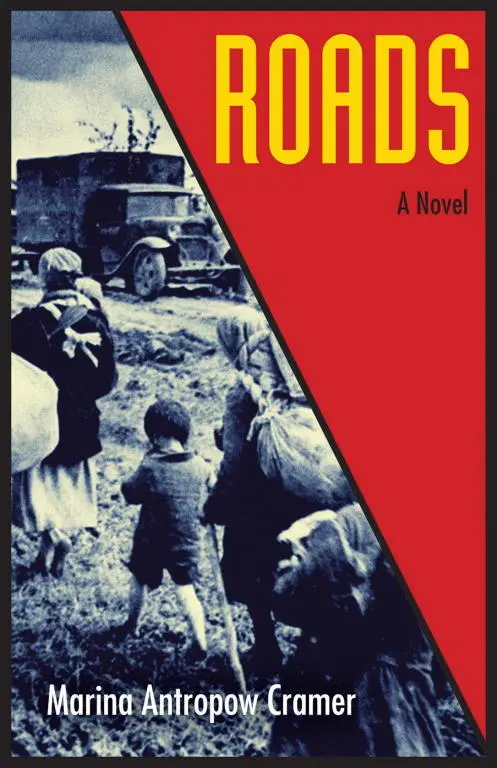
Marina Cramer - Roads
Здесь есть возможность читать онлайн «Marina Cramer - Roads» весь текст электронной книги совершенно бесплатно (целиком полную версию без сокращений). В некоторых случаях можно слушать аудио, скачать через торрент в формате fb2 и присутствует краткое содержание. Город: Chicago, Год выпуска: 2017, ISBN: 2017, Издательство: Academy Chicago Publishers, Жанр: Историческая проза, на английском языке. Описание произведения, (предисловие) а так же отзывы посетителей доступны на портале библиотеки ЛибКат.
- Название:Roads
- Автор:
- Издательство:Academy Chicago Publishers
- Жанр:
- Год:2017
- Город:Chicago
- ISBN:978-1-61373-558-9
- Рейтинг книги:5 / 5. Голосов: 1
-
Избранное:Добавить в избранное
- Отзывы:
-
Ваша оценка:
Roads: краткое содержание, описание и аннотация
Предлагаем к чтению аннотацию, описание, краткое содержание или предисловие (зависит от того, что написал сам автор книги «Roads»). Если вы не нашли необходимую информацию о книге — напишите в комментариях, мы постараемся отыскать её.
By winter 1945, Allied air raids destroy strategic sites; Dresden, a city of no military consequence, seems safe. The world knows Dresden’s fate.
Roads
Roads — читать онлайн бесплатно полную книгу (весь текст) целиком
Ниже представлен текст книги, разбитый по страницам. Система сохранения места последней прочитанной страницы, позволяет с удобством читать онлайн бесплатно книгу «Roads», без необходимости каждый раз заново искать на чём Вы остановились. Поставьте закладку, и сможете в любой момент перейти на страницу, на которой закончили чтение.
Интервал:
Закладка:
Was I to blame? After months of dormancy, the question rose once again in his mind, surfacing like a drowned cadaver suddenly freed from weedy depths, rolling grotesquely with unseen underwater currents. What an idiotic thing to say— How’s life in the woods, Borya? Finding any mushrooms? —on a crowded street in the middle of the day. But had anyone heard, or paid attention? “Surely not,” he said out loud, as if in answer to Ksenia’s question, forcing the thought away.
The day was bright and chilly. Patches of powdery snow lay here and there on the ground, sliding down the eaves of red-tiled roofs to trim their edges with lacy ice. A fine mist hung over the river, swirling and rising in gentle waves toward the same sun that made the ghostly vapor vanish into the morning air.
“A change in the weather,” Ilya said. “Snow is coming.”
“How do you know, Papa?” Galina challenged him, smiling. “What do any of us know about snow, except how beautiful it is, and how cold?”
“Well, the temperature is dropping, and my bones ache from the humidity,” he replied, matching her smile. “And one of the other people said so.”
“Then we must cross the bridge and see what we can see, right away.” She took his arm and they set off, leading the rest of the group toward the sentry at the far end.
“ Papiere .” The man was not young, and clearly bored with the monotony of his duties. He cast a disinterested glance at the passports and work papers each person proffered like a charitable offering, standing single file, not moving until passed through by a careless wave of the soldier’s hand. “Twenty-four hours,” he repeated, stamping each passport with a red-inked date. “Twenty-four hours.”
Filip stopped. “What does that mean, twenty-four hours?”
“It means you transients cannot stay in Dresden more than one day.” He looked up, frowning like an irritated schoolmaster. “One day, or there will be consequences.”
“Where do we go then?”
“Go where you want. Back where you came from, but not here.” The guard pushed them on, already reaching for the passport of the next person in line.
“Consequences,” Filip muttered. “What the hell does that mean? Why would they care where we stay? Everyone knows the war is not going well for Germany.”
“That’s true,” one of their traveling companions chimed in. “But between the Red Army approaching from the east and American and British air raids, where is a safe place for us if not here? It’s just that there are too many of us for a city this size.”
“Why safe? What makes Dresden different?” Galina turned to ask. They were standing at the foot of the bridge, at the top of wide stone stairs leading down to the main square, the city’s streets laid out before them.
“No strategic targets. Why waste bombs on a cigarette factory or porcelain warehouse?”
“What about the river bridges? And the railroad,” another man said. “They can’t fight if they can’t move.”
“True enough. But see, the railroad station is still standing, and the tracks appear undamaged. If it was so important, the Allies would have hit it long ago.”
By noon they had walked well into the town, down a wide avenue lined with shops, small hotels, and multistory apartment buildings, the cobblestones smooth as bread loaves beneath their feet. Some went to see about gallery seats for the afternoon circus performance; one couple headed for the art museum.
On the street, people moved briskly, with worried looks—the only sign, it seemed, that here, too, life was not entirely normal, touched by the war’s shortages and anxieties. But there was still ersatz coffee and real tea, they saw in passing the glass doors of numerous cafés, and a tray of soft buns in a bakery window.
“Oh,” Galina exclaimed, unable to ignore her hunger or to stifle her desire for the luxury of fresh bread.
“Wait.” Ilya sat down on a bench facing the bakery door, pulled a small spool of wire and his ever-present pliers from his pocket. Within minutes, he had looped DRESDEN 1945 in fluid script out of the pliant coil, then added the name of the shop and a curlicue for garnish underneath. A few more snips and twists to attach a sharpened prong to the back, and the pin was done.
He entered the bakery, pin in hand, removed his cap and approached the woman at the counter. She looked up. They saw a shadow pass over her face when she took in his impoverished condition. She was pretty, past the bloom of youth but not yet middle-aged, with short curly hair and a large-breasted, well-proportioned figure. The group watched in silence, seeing the woman shake her head and begin to turn away, then stop, her head inclined attentively while Ilya worked the pliers on another length of wire.
“Give me a cup,” he said to Ksenia, poking his head out of the shop, his expression triumphant. A few minutes later he emerged, holding a newspaper cone filled with buns. “Breakfast,” he announced. “And this is for you, little mother.” He handed Galina a cup filled with steaming milk.
“All this for a Dresden pin?” Galina held the cup with both hands, taking long, grateful sips.
“And her name. Also her sister’s and two godchildren’s. I will need to find more wire now.”
They ate, chewing slowly to savor the bread’s fresh goodness, knowing it would be gone all too soon, while the hunger, their constant companion, would reappear like a whiny stray dogging their existence with maddening regularity.
“Thank you, God, for this bounty,” Ksenia said, crossing herself when she had done.
“And thank human vanity, too,” Galina added, wiping the inside of the cup with the last of her bun.
“Where shall we go, then? We have only this day.” Filip was glad he had not shared his thoughts with anyone. At least he was spared the humiliation of having his splendid plans fall apart for all to see.
“The circus?” Galina pointed to a colorful poster pasted to the outside wall of a news kiosk. Plumed horses shared the ring with dogs, acrobats, and clowns; a lone elephant held a young woman in the curve of its upturned trunk. “No, that would cost too much,” she said quietly before anyone could object. “But there’s a sign for the zoo.”
“First we must see about the train, for tomorrow.” Ksenia looked at her daughter kindly, with a shadow of a smile.
They pooled their money, hoping there would be enough to buy standing-room passage out of the city. “Maybe I can earn a little more,” Ilya proposed, pocketing the sum. “The day is young.”
They followed the stream of refugees to the train station—people with hungry eyes, bedraggled like themselves, sunken-cheeked and none too clean, clutching their pathetic bundles, their stuffed cardboard suitcases bulging with items too precious to leave behind.
What do you take on a journey into the unknown when the door to your homeland closes behind you, and the prospect of returning is more frightening than the flight? Your wedding ikona , with tarnished silver filigree around the Madonna’s halo? Photographs, heirloom jewelry, no matter how gaudy, a favorite toy, your grandmother’s shawl? Each bag a struggle between nostalgia and practicality, with an instinctive eye to items that can be traded or sold: these embroidered pillowcases, stitched by your mother’s hand but also useful—a souvenir of home, a touch of beauty, a bargaining token against the difficulties of a hazardous meandering journey.
The cavernous waiting hall, full to bursting when they arrived at the railroad station, was a veritable Babel. The air was thick with languages: Russian, Polish, Czech, Serbian, Tatar, and other tongues they could not name floated in a frenzy of communication, while children raised the universal wail of the lost and confused. Galina took hold of Filip’s arm, her eyes wide. “ Skol’ko naroda ! How can so many people leave in one day?”
Читать дальшеИнтервал:
Закладка:
Похожие книги на «Roads»
Представляем Вашему вниманию похожие книги на «Roads» списком для выбора. Мы отобрали схожую по названию и смыслу литературу в надежде предоставить читателям больше вариантов отыскать новые, интересные, ещё непрочитанные произведения.




Обсуждение, отзывы о книге «Roads» и просто собственные мнения читателей. Оставьте ваши комментарии, напишите, что Вы думаете о произведении, его смысле или главных героях. Укажите что конкретно понравилось, а что нет, и почему Вы так считаете.