Derek Robinson - War Story
Здесь есть возможность читать онлайн «Derek Robinson - War Story» весь текст электронной книги совершенно бесплатно (целиком полную версию без сокращений). В некоторых случаях можно слушать аудио, скачать через торрент в формате fb2 и присутствует краткое содержание. Город: London, Год выпуска: 2011, ISBN: 2011, Издательство: Quercus, Жанр: Историческая проза, prose_military, на английском языке. Описание произведения, (предисловие) а так же отзывы посетителей доступны на портале библиотеки ЛибКат.
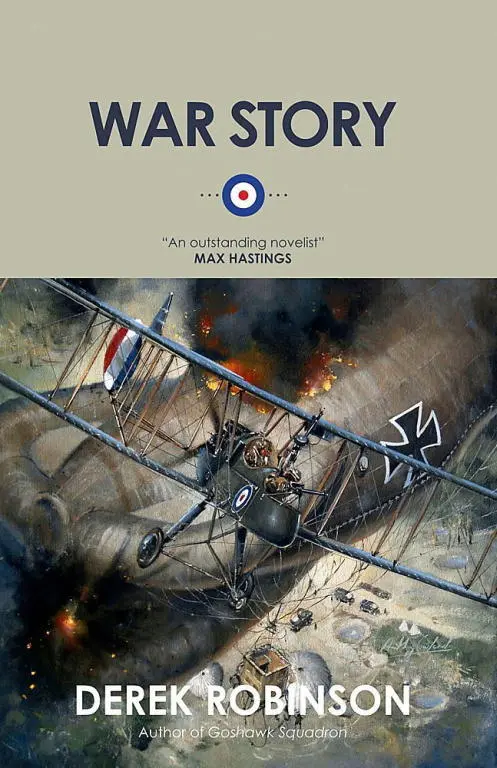
- Название:War Story
- Автор:
- Издательство:Quercus
- Жанр:
- Год:2011
- Город:London
- ISBN:978-0-857388-483-0
- Рейтинг книги:4 / 5. Голосов: 1
-
Избранное:Добавить в избранное
- Отзывы:
-
Ваша оценка:
War Story: краткое содержание, описание и аннотация
Предлагаем к чтению аннотацию, описание, краткое содержание или предисловие (зависит от того, что написал сам автор книги «War Story»). Если вы не нашли необходимую информацию о книге — напишите в комментариях, мы постараемся отыскать её.
Five days later, he crash-lands at his destination, having lost his map, his ballast and every single plane in his charge. To his C.O. he’s an idiot, to everyone else—especially the tormenting Australian who shares his billet—a pompous bastard.
This is 1916, the year of the Somme, giving Paxton precious little time to grow from innocent to veteran.
War Story — читать онлайн бесплатно полную книгу (весь текст) целиком
Ниже представлен текст книги, разбитый по страницам. Система сохранения места последней прочитанной страницы, позволяет с удобством читать онлайн бесплатно книгу «War Story», без необходимости каждый раз заново искать на чём Вы остановились. Поставьте закладку, и сможете в любой момент перейти на страницу, на которой закончили чтение.
Интервал:
Закладка:
“Don’t hang about here. Get over the other side and make a nuisance of yourselves.”
The new magneto worked. The cloud ceiling turned out to be less than a thousand feet, which was far too low for Goss’s peace of mind. He kept climbing until they popped into sunshine. This was pleasant. Goss went up a few thousand feet, cruised idly from nowhere to nowhere and waited for business.
Nothing happened. Once or twice he thought he might have seen something but it was less than a dot, it was a pinprick and it vanished. After an hour he was getting sunburn and cramp and he wasn’t at all sure that he knew where he was. Henley seemed to have gone to sleep, and then maybe died peacefully in his sleep.
Goss cut back the engine until it was ticking over and let the weight of the machine carry it down in an easy dive. Slicing into the cloud looked like falling into a bed of melting snow. The first thing he realised when they dropped into dull daylight was that the cloud base had gone a long way up in the past hour. The second thing was they were five miles behind the German Lines. He knew this because he could see three German observation balloons flying in the north: podgy, sausage-shaped bags tugging amiably at their cables. Goss opened his throttle. He probably couldn’t get near enough to destroy any of them but he could make a bloody nuisance of himself. Henley was awake now, testing the Lewis gun with a brief burst.
Already the nearest balloon was on its way down. The Germans had high-speed winches and well-trained crews: in the time it took Goss to arrive, the balloon would be on the ground. Gunfire was flashing and flickering all around the balloon site and the sky was dirty with a protective barrage. The FE wallowed through the fading, acrid remains of a shellburst and Goss turned steeply away. The gunners chased him. There was nothing to do but fly the plane up to the cloud cover, but all the way he could feel sweat coating the ribs under his arms.
He flew north above the cloud for three minutes and circled for three minutes more to give them time to forget about him. Then he went straight down, as fast as he could. They had not forgotten about him. There was a balloon less than a mile off. He turned to it and frightened it but at the same time tracer began streaking up so he kept turning and saw the third balloon in the distance. Goss did a quick reckoning. He’d panicked two balloons and annoyed a mob of gunners To go for a third balloon would be reckless and idiotic. He felt reckless and lucky. He went for it. The winch crew began winding it down within twenty seconds. Goss laughed aloud. It was like driving fat cattle: you shouted and they ran. Quite bloody right, too. Teach them not to snoop.
He turned and flew east, away from the groping, barking archie, and climbed through the cloud yet again.
Nothing interesting happened on the way home. He found Pepriac, landed rather more neatly than usual and taxied to the hangars. As usual, Henley seemed to have gone to sleep, but appearances were misleading. Henley was dead. He had a firm grip of his Lewis gun and his eyes were open. He’d been killed by a burst of heavy machine-gun fire that came up through the floor. Dando took four bullets out of his chest.
Chapter 10
After ten minutes’ walking along the lane Paxton had done enough saluting for one day. The roads around Pepriac were amazingly busy. He opened the first gate he found and set off across the fields.
Once, when Paxton first got his commission, saluting had been the greatest fun; he’d walked about town, seeking out private soldiers who must salute him or, if they failed, be reprimanded, which was almost more satisfying. But now, here, with so many units on the march, saluting had become a chore, no more exciting than inspecting the men’s latrines, which he had already done.
He avoided an infantry camp, went past a silent and apparently deserted Casualty Clearing Station, and paused to examine a large hole, freshly dug, about the size of a tennis court. An experimental trench? Wrong shape. Something to do with latrines, perhaps? Unlikely. Paxton finally decided it was intended to be a swimming pool. He walked on, skirted a wood that was packed with stores, and passed an artillery battalion in camp.
By now it had stopped raining. The air was warm; steam was rising from the rows of khaki bell-tents. Paxton got a whiff of horse-dung. Somewhere out of sight, a blacksmith was making his anvil ring. A row of guns could be seen, lined up as if ready to fire a salute. Just the sight of them excited Paxton. He could visualize the flash from the muzzle, the recoil, the smoke blowing over the half-naked gunners slinging shells to each other, the distant flowering of an explosion as the enemy’s position disintegrated in flying gobs of blood and mud. What fun! What simply ripping fun!
He walked on, and was leaning on a gate and thinking how pleased his parents would be when he won a medal (his father was an architect, and Oliver had always pitied him for leading such a dull life) when an elderly major came along. “You weren’t thinking of crossing that field, were you, laddy?” the major said. “You might get your head chopped off if you do.” His manner was distant rather than critical.
“Chopped off for thinking it, or for doing it, sir?”
The major lit a pipe and carefully broke the match in two. “You’re Flying Corps, aren’t you?”
“Yes, sir.”
“Try not to be as big a bloody fool on the ground as you are in the sky.”
“Very good, sir.” Paxton felt too bouncy to be squashed. “Is something about to happen here, sir?”
“Cavalry charge. Ever seen a cavalry charge? No, of course you haven’t. You were a dribbling infant in 1914.” He pointed with his pipe. “There stands the enemy, that double line of stakes.” They were about six feet high and each had a turnip stuck on top. “Any moment now a detachment of the Third Dragoon Guards will appear to my left. Then watch out.”
Paxton glanced at him. The major’s chin was thrust forward and his lower lip was twitching with eagerness.
The cavalry suddenly appeared, cresting a rise that Paxton hadn’t noticed, in a solid-looking column of fours. At first the drumming of hooves was felt as a vibration, then it was heard. The column fanned out and formed two lines abreast, one well behind the other. Now Paxton could see clods of earth sent flying as the gallop began and the drumming was a soft, insistent thunder. Steel flickered along the line. Swords! “Golly!” Paxton said and wished he hadn’t, but the old major was deaf and blind to anything except the Third Dragoon Guards. The first line swept past, tall men on big horses. Swords fell and hacked at the turnips on the poles, the line charged on. “I say!” Paxton said. The second line carried lances. Their targets were the fallen hunks of turnip. As each trooper bore down and thrust he gave a long rising whoop of triumph that did strange things to Paxton’s testicles. “I say!” he said. The drumming faded. “What an absolutely splendid stunt!”
“That’s what you’d call it, would you? A stunt?” The major carried a crop stuffed down the side of his right boot. He pulled it out and whacked his leg several times. “That stunt, as you call it, is going to cut the German army to ribbons and win this war in half a trice, if only we’re given half a chance.”
They climbed over the gate and walked to the scene of the charge. The major picked up half a turnip. “That’s what Master Boche will look like after the Dragoon Guards have parted his hair,” he said. “All we need is half a chance.”
“I’m sure you’re right, sir,” Paxton said daringly,”but aren’t there rather a lot of Huns?”
“Not just the Dragoons. Life Guards. Royal Horse Guards. Lancers. Hussars.” The major ran out of fingers on his left hand, so he began prodding Paxton in the chest with his crop. “Second Indian Cavalry. That’s the Deccan Horse, Hodson’s Horse, Poona Horse. Canadian Cavalry. My God, man, we could finish the job with half that number. Just given half a chance.” He gave Paxton the half turnip.
Читать дальшеИнтервал:
Закладка:
Похожие книги на «War Story»
Представляем Вашему вниманию похожие книги на «War Story» списком для выбора. Мы отобрали схожую по названию и смыслу литературу в надежде предоставить читателям больше вариантов отыскать новые, интересные, ещё непрочитанные произведения.


Обсуждение, отзывы о книге «War Story» и просто собственные мнения читателей. Оставьте ваши комментарии, напишите, что Вы думаете о произведении, его смысле или главных героях. Укажите что конкретно понравилось, а что нет, и почему Вы так считаете.