Derek Robinson - War Story
Здесь есть возможность читать онлайн «Derek Robinson - War Story» весь текст электронной книги совершенно бесплатно (целиком полную версию без сокращений). В некоторых случаях можно слушать аудио, скачать через торрент в формате fb2 и присутствует краткое содержание. Город: London, Год выпуска: 2011, ISBN: 2011, Издательство: Quercus, Жанр: Историческая проза, prose_military, на английском языке. Описание произведения, (предисловие) а так же отзывы посетителей доступны на портале библиотеки ЛибКат.
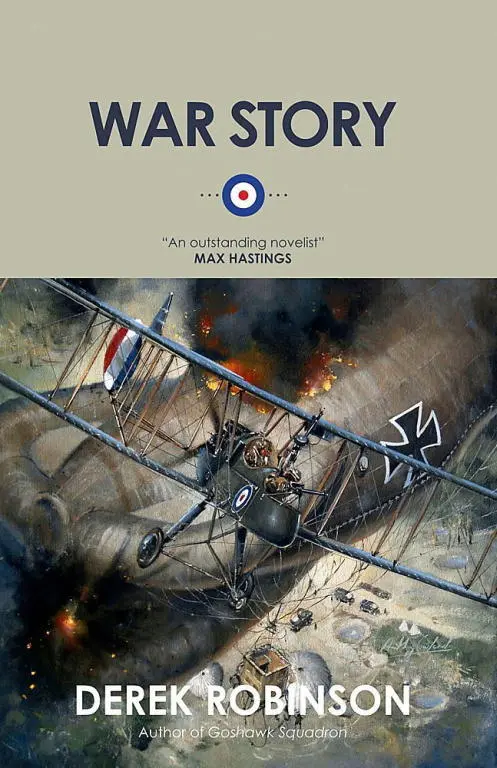
- Название:War Story
- Автор:
- Издательство:Quercus
- Жанр:
- Год:2011
- Город:London
- ISBN:978-0-857388-483-0
- Рейтинг книги:4 / 5. Голосов: 1
-
Избранное:Добавить в избранное
- Отзывы:
-
Ваша оценка:
War Story: краткое содержание, описание и аннотация
Предлагаем к чтению аннотацию, описание, краткое содержание или предисловие (зависит от того, что написал сам автор книги «War Story»). Если вы не нашли необходимую информацию о книге — напишите в комментариях, мы постараемся отыскать её.
Five days later, he crash-lands at his destination, having lost his map, his ballast and every single plane in his charge. To his C.O. he’s an idiot, to everyone else—especially the tormenting Australian who shares his billet—a pompous bastard.
This is 1916, the year of the Somme, giving Paxton precious little time to grow from innocent to veteran.
War Story — читать онлайн бесплатно полную книгу (весь текст) целиком
Ниже представлен текст книги, разбитый по страницам. Система сохранения места последней прочитанной страницы, позволяет с удобством читать онлайн бесплатно книгу «War Story», без необходимости каждый раз заново искать на чём Вы остановились. Поставьте закладку, и сможете в любой момент перейти на страницу, на которой закончили чтение.
Интервал:
Закладка:
Mayo grunted and went back to the paper.
Jimmy Duncan heaved himself out of an armchair, and stretched. “The old man went west last evening,” he said.
“East, actually,” Goss said,”and then west. Collision.”
“Bad luck,” Gerrish said.
“He wasn’t very well,” Goss said. “Tummy trouble… Okay, everyone, stand by for Temptation Ragl” He lowered the needle. Dando watched Gerrish stir his tea and tap his foot, slightly missing the beat all the time, and he saw Goss click his fingers and strut around the gramophone, and he realised that nobody would mourn Rufus Milne. People came and went. While they were here they mattered, more or less; once they’d gone they mattered not at all, so it was bad form to make a fuss about them. Foster had got it right, when he’d put the bits back in the bag and said, “That’s that, then.” That was that. Now this is this. Very English. Very sensible.
“I hear you’ve been sacked, Uncle,” Piggott said. “Is it true?”
Appleyard nodded. He took down a framed photograph of a group of polo players and laid it carefully in a suitcase. “Surplus to requirements, old chap.”
“But that’s ridiculous. The old man must have given you a reason, for God’s sake.”
“Wheels within wheels.” Appleyard tapped the side of his nose. “Ours not to reason why.” He opened a drawer and searched it thoroughly. Piggott could see that it was empty. “My shoulders are broad, old boy,” Appleyard said. “I’ll carry the can, don’t worry.”
“Well, if you’re definitely going, I thought I’d better collect that fiver you borrowed.”
Appleyard closed the drawer and patted him on the arm. “I hope you profit from my example, old chap,” he said. “Never do anyone a favour unless you’ve got it in writing. And witnessed.” He took the photograph out of the suitcase and studied it, his head nodding. “This sort of thing wouldn’t have happened when Brendan Lucas had the regiment. That’s him in the middle.”
“Yes… Can you let me have that fiver, Uncle?”
“Yes, yes, of course, of course… You’ve no idea how awkward they’ve made it for me. It makes a chap wonder just what’s going on, it really does.” He took out his fountain pen and unscrewed the cap and looked at the nib.
“What is going on, Uncle?”
Appleyard put the pen away and sat on the bed. He sighed, and looked glumly at Piggott. “Politics, old chap,” he said. “Politics. Sometimes you have to run fast just to stay in the same place, as the White Rabbit said. I couldn’t run fast enough.”
“I think it was the Red Queen said that.”
Appleyard blew his nose.. “I didn’t have your educational advantages,” he said. “Just a simple soldier, me.”
“I really could do with that fiver, Uncle.”
“Nobody ever said I don’t honour my debts. It’s as good as paid.”
“Yes, but… I meant now.”
“Tell you what…” Appleyard took out his pen again. “I’ll send you a cheque, backdated to… to whatever today’s date is.” He put the pen away and stood up. He looked under the bed and pulled out a cardboard box. Bottles clinked. He shoved it back. “Politics,” he said. “I should have seen it coming. Too trusting by half, that’s my trouble.”
Piggott felt defeated. “You’ll come and have a drink before you go, won’t you?”
Appleyard shook his head. “Shakespeare understood,” he said. “To everything there is a season, and so on.”
“Yes. Isn’t that the Bible?”
“You know best. Simple soldier, me.”
On his way back to the mess Piggott met Binns and Mayo, who had only just heard the news. Appleyard owed them money, too. While the three men were talking, Duncan appeared. “I thought I was the only one,” he said. “What on earth has he spent it on?”
“Politics,” Piggott told him. “Maybe he’s bought a peerage.”
Chapter 9
Appleyard vanished. A month later there was a rumour that he had been reduced to the rank of second lieutenant and posted to a particularly tough Pioneer battalion, a dump for all the thugs and wreckers in the British Army; a month after that there was a rumour that his platoon had beaten his head in one night and left his body in No-Man’s-Land after an argument over the rum ration; but by then there was hardly anyone left in Hornet Squadron who remembered him.
A new adjutant arrived. His name was Brazier and it was obvious that he too had recently been demoted: you could see the unfaded shape of a major’s crown on his epaulettes, which now carried a captain’s stars. He wore the ribbons of the DSO and MC, which were enough to silence the squadron for a start, plus various other ribbons that nobody could identify. He was six foot four and very broad-shouldered. Doorways were sometimes a problem, and he had developed a slight stoop to keep his head down to conversational level. He had the sort of face you see on a Roman coin, all chin and nose, but his eyes were bright blue, very disconcerting at first. According to Corporal Lacey, who looked him up in the Army List, Captain Brazier was forty-nine. At first he was rarely seen in the Mess. “He eats broken bottles for breakfast,” Mayo said. “I’ve seen the corks in his out-tray.” The truth was that he was busy trying to straighten out all the nonsense that Appleyard had left behind; but his absence made him seem even loftier. “Spud called him Uncle,” Mayo said,”and he tore Spud’s arm off, didn’t he, Spud? It’s in the goulash tonight.”
“Anything’s better than mutton,” Foster said.
“You can tell it’s Spud’s by the dirty fingernails,” Mayo said.
“If you don’t like them,” Ogilvy told him,”leave them on the side of your plate.”
“Is that what they taught you at Eton?”
“Nobody gets taught at Eton,” Foster said. “A certain amount of assisted learning takes place, when games allow, but nothing as crass as teaching.”
Binns overheard this. “What’s twelve times nine?” he asked him.
“I don’t intend to go into trade, so it’s of no consequence,” Foster said.
Binns found that amusing. “What do you intend to do when the war’s over?”
“James and I will form some kind of partnership,” Foster said.
Yeo yawned and stretched. “No we shan’t,” he said.
“Partners in what?” Binns asked.
“Oh… lots of things. Motor-racing, perhaps. Or we might set up a film studio. Or maybe a jazz band. We haven’t decided yet.”
“I have,” Yeo said, opening a magazine. “I’m going to stay in the Army. I like the Army.”
“Nonsense. You’d be wasted in the Army.”
Yeo threw down the magazine. “I’ve told you before,” he said. “Don’t nag.”
That killed all conversation for a moment. Then Binns decided he had been patronised by Foster, and so he said: “The answer’s a hundred and eight. Just thought I’d tell you, now you haven’t got a partner to count on.”
“Remind me,” Foster said, peering at Binns as if through fog. “Which school did you go to?”
“Clifton College.”
“Clifton… In the West Country, isn’t it? Last stop on the GWR. No tradition but excellent plumbing.”
“Cor blimey,” Yeo said bleakly, staring at Foster,”you’re a right toff, you are, guvner, strike me pink if you ain’t.” Again, the conversation died. After a few seconds he left the room, leaving Foster looking far from happy.
At first, nobody knew quite what to make of Cleve-Cutler. Now that ‘B’ Flight was back, there was rarely an hour of daylight when somebody wasn’t flying, and the CO often led a patrol, even if it was only an escort for a bit of artillery observation. He knew his stuff, and anyone flying with him had to stay alert. Once, when O’Neill and Duncan were coming home with him at the end of a long patrol, Cleve-Cutler’s machine suddenly disappeared.
Читать дальшеИнтервал:
Закладка:
Похожие книги на «War Story»
Представляем Вашему вниманию похожие книги на «War Story» списком для выбора. Мы отобрали схожую по названию и смыслу литературу в надежде предоставить читателям больше вариантов отыскать новые, интересные, ещё непрочитанные произведения.


Обсуждение, отзывы о книге «War Story» и просто собственные мнения читателей. Оставьте ваши комментарии, напишите, что Вы думаете о произведении, его смысле или главных героях. Укажите что конкретно понравилось, а что нет, и почему Вы так считаете.