Derek Robinson - War Story
Здесь есть возможность читать онлайн «Derek Robinson - War Story» весь текст электронной книги совершенно бесплатно (целиком полную версию без сокращений). В некоторых случаях можно слушать аудио, скачать через торрент в формате fb2 и присутствует краткое содержание. Город: London, Год выпуска: 2011, ISBN: 2011, Издательство: Quercus, Жанр: Историческая проза, prose_military, на английском языке. Описание произведения, (предисловие) а так же отзывы посетителей доступны на портале библиотеки ЛибКат.
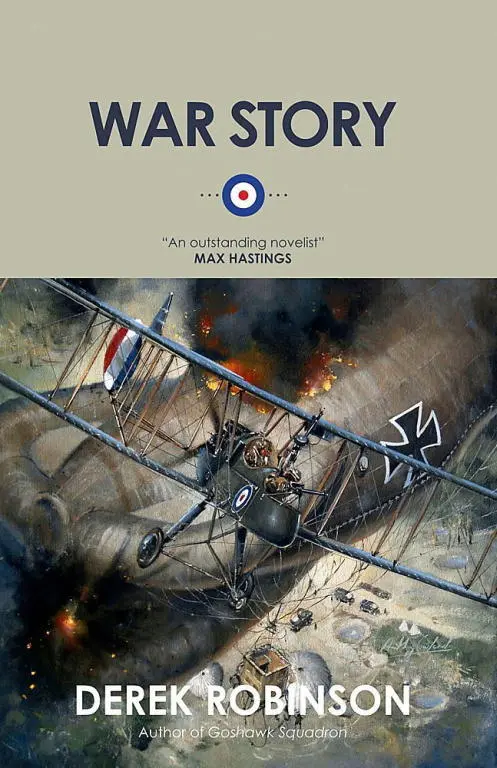
- Название:War Story
- Автор:
- Издательство:Quercus
- Жанр:
- Год:2011
- Город:London
- ISBN:978-0-857388-483-0
- Рейтинг книги:4 / 5. Голосов: 1
-
Избранное:Добавить в избранное
- Отзывы:
-
Ваша оценка:
War Story: краткое содержание, описание и аннотация
Предлагаем к чтению аннотацию, описание, краткое содержание или предисловие (зависит от того, что написал сам автор книги «War Story»). Если вы не нашли необходимую информацию о книге — напишите в комментариях, мы постараемся отыскать её.
Five days later, he crash-lands at his destination, having lost his map, his ballast and every single plane in his charge. To his C.O. he’s an idiot, to everyone else—especially the tormenting Australian who shares his billet—a pompous bastard.
This is 1916, the year of the Somme, giving Paxton precious little time to grow from innocent to veteran.
War Story — читать онлайн бесплатно полную книгу (весь текст) целиком
Ниже представлен текст книги, разбитый по страницам. Система сохранения места последней прочитанной страницы, позволяет с удобством читать онлайн бесплатно книгу «War Story», без необходимости каждый раз заново искать на чём Вы остановились. Поставьте закладку, и сможете в любой момент перейти на страницу, на которой закончили чтение.
Интервал:
Закладка:
Private Collins was at the bar, ladling out glasses of a blood-red drink from a small brass-bound keg. Frank Foster took a glass and sniffed it. “What’s in here, Collins?” he asked.
“I’m allowed to mention the plum brandy, port, eggs, Cointreau, Cognac and linseed oil, sir, but not the special secret ingredients, I’m afraid.”
“Why not?”
“Bombay curry and vodka, sir. You might develop a bias if you knew about them.”
Foster took a sip. His eyebrows came together like shutters being closed. “Jesus wept,” he muttered. “What a wallop.”
“That’ll be the rum, sir.”
When everyone had a glass, Cleve-Cutler stood on a chair. “There is a very ancient squadron tradition which I have just thought of,” he announced. “This drink must always be drunk with both feet off the ground to the words ‘Hornet’s Sting’.” There was much scrambling onto chairs and sofas and tables. Cleve-Cutler raised his glass. Everyone shouted: “Hornet’s Sting!” and drank. Mayo said later that it was like swallowing a whizzbang, only noisier. Douglas Goss fell off his chair, but that was normal, nobody paid any attention. He complained that he had broken his shoulder. Nobody paid any attention to that, either.
After lunch the new CO interviewed the officers one at a time. The interviews were short.
“Brigade want me to put up one of our flight commanders to be CO of another scout squadron,” he said to Foster. “You seem to qualify.”
Foster kept the shock from his face but Cleve-Cutler saw it in his eyes. “No thank you, sir,” he said.
“Why not? Major Foster. Colonel Foster. Brigadier, even. Sky’s the limit in this Corps.”
“I honestly don’t think the war will last that long, sir. One big push and the Boches will crack.” Foster found it hard to breathe properly. He might get posted whether he liked it or not. Today, even.
Cleve-Cutler held his resolutely cheery smile until Foster had to blink. “This Etonian Flight of yours,” Cleve-Cutler said. “Awfully cosy, isn’t it? I’d better break it up, hadn’t I? Then there’s no risk of your chums trying to take advantage of you. Right?”
Foster hunched his shoulders as if to protect himself from further blows. “You must do as you think fit, sir,” he said. “I can only say that I rate the value of friendship very highly.”
“So do I. Just wanted to see how the idea struck you. Personally I think it stinks. If a chap can’t keep his chums, what can he keep? Send in the next customer, will you?”
For a moment Foster’s face tightened with resentment. Then he nodded and almost smiled, and went out.
Several interviews later, O’Neill was facing Cleve-Cutler.
“Australian,” the CO said. “Waltzing Matilda and so on.” O’Neill’s file was on the desk in front of him.
“That was a long time ago,” O’Neill said. “Before I got transported to England.” All trace of his flat Australian twang had disappeared; he talked like an Englishman. “That’s how the colonies get rid of their riff-raff, you know.”
Cleve-Cutler chuckled. “I see you came here with a chap called Chivers.” O’Neill was silent and expressionless. “In fact I see you trained with Chivers.”
Long pause. O’Neill chewed his lip, but that could have meant anything.
“He’s dead, of course,” Cleve-Cutler said brightly,”so we can be quite candid about the bugger. Dirty, greedy, fawning little sodomite who sponged off his friends, hadn’t the guts to go near a Hun, lied like a rug about his so-called kills, and did us all a service by flying into a Jerry shell. Yes?”
O’Neill, his face as stiff as a stone, gave that a lot of thought. “Well, it’s not a funny joke,” he said at last,”so you must have some other reason for inventing all that poison.”
“Good!” Cleve-Cutler said. “Now understand this. It doesn’t matter a hoot whether T. Chivers was shit or sunshine. He’s dead. Agreed? But the entire squadron, including cooks and clerks, tell me that you refuse to accept that fact.” The stoniness of O’Neill’s face was becoming tinged with pink. “Every time you take off you’re looking for Chivers,” Cleve-Cutler said. “That’s bloody silly, and if you keep it up you’ll find him sooner than you think. When you do, remember to ask him what good it did either of you.” He slammed the file shut. “Next!”
Paxton, being the most junior officer, was the last to be seen.
“You’ve only been here four days,” Cleve-Cutler said, his expression as jaunty as ever,”and everyone hates you. Mmm?” He cocked the other eyebrow.
That hurt. “I can’t understand it, sir,” Paxton said. Nobody had spoken to him all morning. “Whatever I do, nobody likes it, even when it’s right, even when…” That was a low blow, saying everyone hates you. “I don’t want to play cricket, I want to fight .” He could very easily have cried. Tears were ready, waiting to leak out. He placed his right heel on his left toes and made enough pain to defeat the tears. “Nothing’s gone right from the start, has it?” he said angrily. “I flew that blasted Quirk all the way from England, which was more than the others could do, and Major Milne burnt it. Deliberately! Set fire to it! Is that the way to win the war?”
“Yes. Give me your hat.” Cleve-Cutler took it, and opened a penknife. He slit the fabric at the end of the peak. “What’s wrong with Quirks?”
“Nothing. It’s a topping machine. It almost flies itself.”
“Exactly. It’s not built to be dangerous, it’s built to be safe. The bloody silly thing’s so stable it stays straight and level when you want to chuck it all over the sky.” He was tugging the wire stiffener out of the peak. “The Quirk isn’t a fighting aeroplane, it’s a pussy cat. Major Milne was right to burn yours.” He squashed the peak with both his hands. “All the Quirks in France should be burned, then maybe we’d get sent something livelier.” He sat on the cap, bounced up and down, then tossed it to Paxton. “Now you’ll look more like a flier and less like a captain in the Church Lads’ Brigade.”
“I don’t care about that,” Paxton mumbled. But he did care. He liked his cap now that it looked properly broken-in, more like the rest of the squadron. But he wasn’t going to say so. “I got an Albatros yesterday,” he said. “That was from a Quirk. There’s nothing wrong with Quirks.”
Cleve-Cutler picked up a pen. “You’re grounded,” he said. “In fact you’re undergrounded. Your flight commander told me you were a turd, so I’m putting you in charge of the men’s latrines.” The half-grin had hardened into a glittering scowl. “Start now.” He pointed to the door.
A few moments later, Corporal Lacey tapped on the door and came in, carrying a bundle of files and documents. “Good heavens, sir,” he said. “What did you say to Mr. Paxton? He looks quite deathly.”
“Suicidal?”
Lacey thought about it. “Murderous.”
“That’s all right, then… Look here, I’m not going to read all that.”
“Certainly not, sir. There’s a summary and conclusion on a single sheet.” He placed the bundle on the desk. “I’ve kept everything as simple as possible.”
Cleve-Cutler rocked back on his chair and put his pen between his teeth like a cigar. “I did go to school, Lacey. Quite a good school, actually.”
“Yes, sir. Marlborough. Not noted for mathematics, however.” The CO looked away. “Still less for fraudulent accountancy,” Lacey added softly.
“Are you always as familiar as this with your Commanding Officer?”
“That depends how much he wants to borrow my Elgar records.”
“My God, you’re a spy. I should have you shot. Have you got the violin concerto?” Lacey nodded. Cleve-Cutler sighed. “Damn. I might compromise and have you lightly maimed instead. What the devil is that?” It was a distant popping, like the bursting of many balloons.
Читать дальшеИнтервал:
Закладка:
Похожие книги на «War Story»
Представляем Вашему вниманию похожие книги на «War Story» списком для выбора. Мы отобрали схожую по названию и смыслу литературу в надежде предоставить читателям больше вариантов отыскать новые, интересные, ещё непрочитанные произведения.


Обсуждение, отзывы о книге «War Story» и просто собственные мнения читателей. Оставьте ваши комментарии, напишите, что Вы думаете о произведении, его смысле или главных героях. Укажите что конкретно понравилось, а что нет, и почему Вы так считаете.