Derek Robinson - War Story
Здесь есть возможность читать онлайн «Derek Robinson - War Story» весь текст электронной книги совершенно бесплатно (целиком полную версию без сокращений). В некоторых случаях можно слушать аудио, скачать через торрент в формате fb2 и присутствует краткое содержание. Город: London, Год выпуска: 2011, ISBN: 2011, Издательство: Quercus, Жанр: Историческая проза, prose_military, на английском языке. Описание произведения, (предисловие) а так же отзывы посетителей доступны на портале библиотеки ЛибКат.
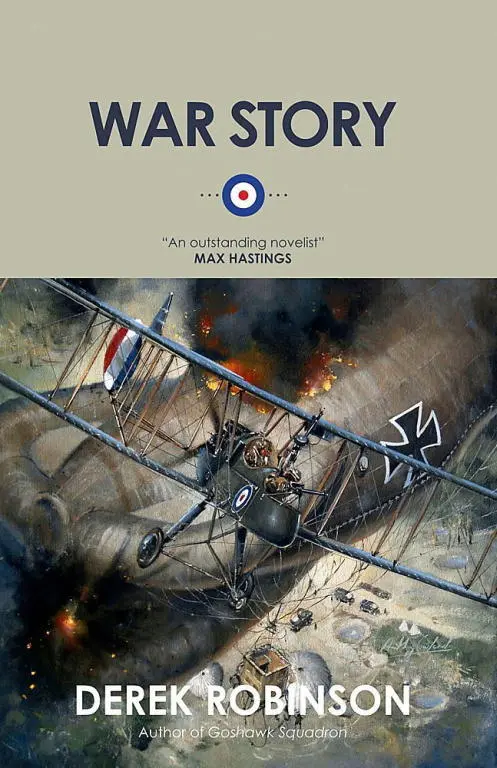
- Название:War Story
- Автор:
- Издательство:Quercus
- Жанр:
- Год:2011
- Город:London
- ISBN:978-0-857388-483-0
- Рейтинг книги:4 / 5. Голосов: 1
-
Избранное:Добавить в избранное
- Отзывы:
-
Ваша оценка:
War Story: краткое содержание, описание и аннотация
Предлагаем к чтению аннотацию, описание, краткое содержание или предисловие (зависит от того, что написал сам автор книги «War Story»). Если вы не нашли необходимую информацию о книге — напишите в комментариях, мы постараемся отыскать её.
Five days later, he crash-lands at his destination, having lost his map, his ballast and every single plane in his charge. To his C.O. he’s an idiot, to everyone else—especially the tormenting Australian who shares his billet—a pompous bastard.
This is 1916, the year of the Somme, giving Paxton precious little time to grow from innocent to veteran.
War Story — читать онлайн бесплатно полную книгу (весь текст) целиком
Ниже представлен текст книги, разбитый по страницам. Система сохранения места последней прочитанной страницы, позволяет с удобством читать онлайн бесплатно книгу «War Story», без необходимости каждый раз заново искать на чём Вы остановились. Поставьте закладку, и сможете в любой момент перейти на страницу, на которой закончили чтение.
Интервал:
Закладка:
“It’s happened before. I don’t think you ever get accustomed to it.”
Milne watched him for a long time. Dando rarely blinked. “The funny thing is,” Milne said,”I sometimes have a great desire to go and blow a general’s head off. One of ours, not theirs. Isn’t that strange?”
“Well,” Dando said thoughtfully,”it’s certainly a sign of life.” Milne laughed at that, and Dando joined in. Milne laughed until he exhausted himself. “Oh dear, oh dear,” he said. “Dear oh dear oh dear.”
“Sorry,” Dando murmured. “Not meant as a joke.”
“Write it down. Tell Bob Bliss. He thinks I’m a bad boy.”
“He’s going to have to know the truth soon.” Dando took a seat “I didn’t tell him anything yesterday, because our tests aren’t always completely accurate and anyway I wanted to see you before—”
“Very kind of you,” Milne said harshly. “Just spare me the medical niceties, they’re wasted… Oh, bugger,” he barked. “I’m starting to bloody well cry again.” He found a handkerchief and spread it over his eyes. “My manners are going to hell, aren’t they? I should be ashamed… There was nothing wrong with your tests, old chap. They hit the bullseye. I’ve known for a month it wasn’t dyspepsia. Such a rotten coward. Didn’t want to do anything.”
“There’s not a lot that can be done,” Dando said.
After a while Milne took the handkerchief away. “What a lovely evening.” He got off the bed and went to the window. “I don’t think I’ve ever seen such a marvellous evening. God must be getting good at it. Makes no sense, does it?”
“Nobody ever promised that anything would make sense,” Dando remarked gently.
Milne sat on the bed and blew his nose. “I shan’t lead the patrol this evening. Tim Piggott can do it. Would you tell him for me?” Dando nodded. He waited to see if Milne had anything more to say. Then he left.
‘A’ Flight took off about half an hour later. Milne, still sitting on the bed, heard the engines fade to nothing. He went out and found Alice. He rode the mule at a slow walk to the far end of the airfield. There was nothing to do there, so he did nothing.
The sky was slowly gathering its strength for another grand finale of a sunset. Milne had always seen the sky as his workshop: sometimes dirty and full of rubbish, sometimes clean and full of flying. The weather came from the west and the Huns from the east. Now, for the first time, he took delight in its colours and shapes: the clouds were dazzlingly white, the blue was inhumanly pure and deep. With a bit of imagination, the blue became ocean and the clouds were islands that drifted…
Alice looked around. The padre was bicycling towards them.
“I saw you out here all alone, old chap,” he said. “I wondered if you planned to come and have some dinner.”
Milne shook his head.
The padre dismounted. “You know me, Rufus,” he said. “A bad ball hit for six beats the best sermon ever preached.” He fed Alice a sugar lump. “Nonetheless, when a chap’s spirit is troubled… Well, there’s a trick I’ve learned that’s worth a try.” He handed Milne a Bible. “Open it anywhere you like and let your finger fall, and just see what verse you get.”
Milne did this. “Numbers, Chapter 21, verse 9,” he said.”‘And Moses made a serpent of brass, and put it upon a pole, and it came to pass, that if a serpent had bitten any man, when he beheld the serpent of brass, he lived’.” He returned the book, still open.
“Stuff and nonsense,” the padre said. “I don’t believe it for a moment. Do you?” He studied the page, and grunted. “According to verse 6 the real serpents wouldn’t even have been there if God hadn’t sent them to bite the people. I must confess that there are times when it strikes me that the Almighty throws his weight about a sight too freely.” He tore out the page and screwed it up.
“Bad luck,” Milne said.
“Worse things happen at sea. Anything I can do for you?”
Milne combed the mule’s mane with his fingers, teasing out the tangles and the burrs. He smoothed its ears until the animal had had enough and shook its head. The padre got onto his bicycle and waited. “There is one thing,” Milne said. “You could tell them to start up my machine. And tell them to put ballast in the front cockpit.”
“Ballast? Ballast.” The padre pedalled away. “Ballast, ballast, ballast,” he repeated, the words growing fainter each time.
Milne watched the sunset develop. The colours became absurdly rich, vast sweeps of lemon yellow and rose and buttermilk and brick red, as if a drunken genius had been turned loose. It deserved a symphony, Milne thought, but what it got was a lone piper leading a company of Scots infantry along the road that flanked the aerodrome. In the distance an engine coughed and died, coughed again and roared. He nudged the mule with his knees. After dinner the adjutant went to bed, hot with fever. “Waste of time, old boy,” he had said when Dando offered to examine him. “You don’t speak the lingo. This is an old Hindustani curse, this is.” The padre and Dando settled down to chess in the anteroom. After five minutes, Paxton came over and looked. “Who’s winning?” he asked. No answer. He went for a walk, and was watching some of the men playing football when Corporal Lacey approached. “You have been sent a box of cigars, sir,” he said.
“Yes? From my uncle, I expect.”
“And you may have noticed that we have no hot water.”
“Nothing to do with me. Go and tell the adjutant.”
“Mr. Appleyard generates his own heat. What’s more he rarely takes a bath. However, with your agreement and your cigars I can get hold of a lorryload of coal this evening, thus guaranteeing hot water for the rest of the month.”
Paxton stared. “Sounds very fishy to me. Why don’t you just—”
“Why don’t we just ask the Army for more coal? Because the squadron’s had its ration.” Lacey was calm, almost placid. “Why have we run out? Because the adjutant swapped a quarter of the coal ration for thirty cases of wine. Why was that a mistake? Because he forgot to give any wine to the officer commanding the fuel depot. Why should that matter? Because the officer hates his job, and if we tell him we’ve run out of coal he will enjoy greatly not giving us any more for as long as possible. How long is that? Until our next ration is due.”
They watched the football. Someone scored a goal, and performed a handstand to celebrate. “But perhaps you like cold water,” Lacey said.
“You want me to give my cigars to this wretched officer at the fuel depot,” Paxton said.
“No fear. The sentry at the back gate gets the cigars. He’s reliable. I wouldn’t trust the officer with a bar of chocolate, the man’s a scoundrel, an absolute rogue.”
Despite himself, Paxton laughed. “Your idea sounds fairly crooked to me.”
“In the Army,” Lacey said,”the shortest distance between two points is a crooked line.” At eight thousand feet it was still as bright as mid-afternoon. The flood of sunlight coming from behind him meant that Milne could see everything to the eastward with astonishing clarity. Only one thing annoyed him: he had forgotten his silk scarf, and now every time he turned his head to search the sky, cold air whipped around his neck. That meant stiffness and aches. It was such a stupid mistake. He knew exactly where he had left the scarf; he could see it now, hanging over the back of a cane chair. Idiot.
Eight thousand feet was as high as this FE2b would climb. If he eased the stick back he immediately sensed the plane flirting with a stall: the engine simply couldn’t shove the wings through the thin air fast enough. Even so, eight thousand didn’t guarantee safety; plenty of Huns got a lot higher than that. Far to the south a tiny trickle of black archie showed itself. Probably a French patrol going home. Elsewhere, the sky was empty. Millions of men down below, all cramped and crowded and crushed together. Nobody else up here. What a silly war.
Читать дальшеИнтервал:
Закладка:
Похожие книги на «War Story»
Представляем Вашему вниманию похожие книги на «War Story» списком для выбора. Мы отобрали схожую по названию и смыслу литературу в надежде предоставить читателям больше вариантов отыскать новые, интересные, ещё непрочитанные произведения.


Обсуждение, отзывы о книге «War Story» и просто собственные мнения читателей. Оставьте ваши комментарии, напишите, что Вы думаете о произведении, его смысле или главных героях. Укажите что конкретно понравилось, а что нет, и почему Вы так считаете.