Derek Robinson - War Story
Здесь есть возможность читать онлайн «Derek Robinson - War Story» весь текст электронной книги совершенно бесплатно (целиком полную версию без сокращений). В некоторых случаях можно слушать аудио, скачать через торрент в формате fb2 и присутствует краткое содержание. Город: London, Год выпуска: 2011, ISBN: 2011, Издательство: Quercus, Жанр: Историческая проза, prose_military, на английском языке. Описание произведения, (предисловие) а так же отзывы посетителей доступны на портале библиотеки ЛибКат.
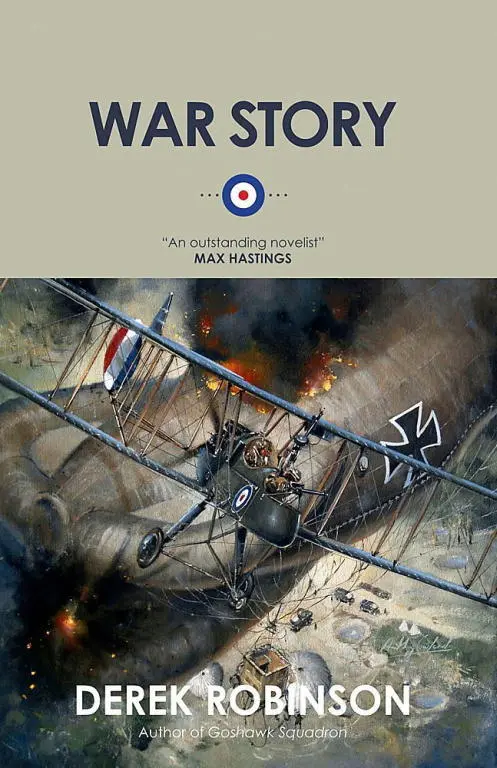
- Название:War Story
- Автор:
- Издательство:Quercus
- Жанр:
- Год:2011
- Город:London
- ISBN:978-0-857388-483-0
- Рейтинг книги:4 / 5. Голосов: 1
-
Избранное:Добавить в избранное
- Отзывы:
-
Ваша оценка:
War Story: краткое содержание, описание и аннотация
Предлагаем к чтению аннотацию, описание, краткое содержание или предисловие (зависит от того, что написал сам автор книги «War Story»). Если вы не нашли необходимую информацию о книге — напишите в комментариях, мы постараемся отыскать её.
Five days later, he crash-lands at his destination, having lost his map, his ballast and every single plane in his charge. To his C.O. he’s an idiot, to everyone else—especially the tormenting Australian who shares his billet—a pompous bastard.
This is 1916, the year of the Somme, giving Paxton precious little time to grow from innocent to veteran.
War Story — читать онлайн бесплатно полную книгу (весь текст) целиком
Ниже представлен текст книги, разбитый по страницам. Система сохранения места последней прочитанной страницы, позволяет с удобством читать онлайн бесплатно книгу «War Story», без необходимости каждый раз заново искать на чём Вы остановились. Поставьте закладку, и сможете в любой момент перейти на страницу, на которой закончили чтение.
Интервал:
Закладка:
Paxton heard them too: crackings and hangings. Holes appeared in the wings; then more holes, and flying splinters and strips of fabric. He stood up to get a better view, leaning into the rush of air, and from the corner of his eye saw a flicker of tiny flame and with it heard the whizz of bullets and sat down with a wallop that broke the seat. The Lewis gun, miraculously, was on the right mounting. The enemy machine was above and to the right of their tail, not much of a target, just a purple silhouette. Paxton cocked and fired. The gun made a wonderful high-speed battering sound so he kept on firing, hugging the Lewis so as to share its power. At last he paused, and looked for his victim. Not there. Nowhere. Yes: on the left now, and curling in for another attack. Paxton yanked the Lewis off its pin just as Kellaway came out of his state of shock and thrust the Quirk into as steep a dive as possible. Paxton stumbled. His finger was still on the trigger and he put a dozen rounds through the upper wing. Then he was on the floor, tangled in his straps, hearing the whipcrack of bullets all around. Then the cloud rushed up and saved them.
Kellaway loved this cloud. He wanted to live in it for the rest of his life, or at least for an hour. As the dank greyness raced past he knew that he would soon fall out of the bottom, so he hauled back on the stick. Too much. Now he was climbing. Or was he? It felt like climbing. It might still be diving. He couldn’t read the speed in this gloom. He might stall and spin. The engine sounded under strain. He might pop out of the top and get shot to blazes. Oh God , Kellaway prayed, Oh God, what should I do? No answer came. He did a little of everything: middled the stick, opened the throttle, worked the rudder pedals once each way for luck. It worked. Or maybe it made no difference, maybe he was doing the right thing in the first place; anyway the cloud was still doing its merciful job half a minute later. And when at last the BE2c slid out of the bottom, crabwise, right wing down, the Albatros was not behind it. The Albatros was half a mile in front and coming towards them, zigzagging through a field of white puffballs: British archie.
Kellaway saw none of this. He had his head down and he was trying to make sense of his restless compass. Paxton saw it, saw black Maltese crosses on the wings, guessed that the German was heading for home. He shouted: “There’s our Hun! There’s our blasted Hun!” The words were blown away and when Kellaway looked up, all he saw was delight on Paxton’s face, and his outflung arm. It must point towards home, to Pepriac. Now Kellaway knew he was going to live, and the day seemed golden. In fact as he turned onto Paxton’s course it was golden: sunlight had broken through the clouds! Kellaway felt saved. When Paxton pointed left, he steered left. Paxton waved downwards; he pushed the plane into a gentle dive. Paxton spiked the Lewis gun onto a forward mounting and changed the drum. Kellaway looked where the gun was pointing and shut his eyes.
The Albatros was apparently laying its own carpet of white archie, fresh puffballs always appearing ahead, old ones dying behind. Paxton, aiming out and down, fired a long burst as the paths of the two planes crossed until he lost it beneath the BE2c. By the time he had dismounted the Lewis and slung it across the cockpit the Albatros was on fire and nearly out of range. He blasted off more shots. Its tail broke off and blew away. Kellaway got a glimpse of the pilot, seemingly unhurt, throwing up his hands in rage or despair. The archie was everywhere, endlessly grunting. The Albatros fell, nose down, as if desperate to escape. A wing peeled back, clung to the side of the fuselage, snapped its roots, fluttered free. The guns stopped.
“I thought it was like driving a car,” said a captain in the Gordon Highlanders. “I thought you had a sort of a steeringwheel and when you wanted to go fast you put your foot down.”
“No, no,” Piggott said. “Completely different.”
Five officers of the Gordon Highlanders had been the first guests to arrive for Milne’s party; and as Milne himself hadn’t returned, Piggott was looking after them. They peered into the aeroplanes, touched them and sniffed them with a mixture of amazement and amusement. Piggott hid his feelings, but he was not amused. “You’ve seen an aeroplane before?” he said.
“Oh, to be sure. But not one like this.”
“Perhaps if you thought of it as a boat. There is the rudder, on the tail. Here is the propeller, which drives it forward. The propeller’s in the middle of the machine because that gives the observer a clear field of fire at the enemy in front.”
They walked to the front and looked at the nose. “What if a Jerry sneaks up behind you?” one of them asked.
“Then he’s a cad,” Piggott said,”and we never speak to him again.” While they were laughing he excused himself to go and welcome fresh arrivals. The Gordon Highlanders agreed that all RFC pilots were mad. “You’d need to be an imbecile to go up in that thing,” the captain said. “It hasn’t even got any brakes.”
Milne landed at last, carrying a side of smoked salmon he had bought from a lieutenant in the Border Regiment who had just been sent two and who wasn’t all that keen on salmon anyway. He gave it to the sergeant cook. “Thank you, sir,” he said. “I hope I done right. I sent off two drivers to get all the food and drink they could find. I couldn’t feed a hundred guests on what was in stores, sir.”
“Of course you couldn’t. Did they find anything?”
“Lots of stuff, sir. Cost a packet, too.”
“If we get through this day alive,” Milne said, tossing his hat in the air,”I’ll put you up for a medal.”
Somebody had strung up some bunting and the flags of the Allies. Every table and chair had been brought out. Two bars had been set up. Seventy guests had arrived and another staff car rolled in every five or ten minutes. Milne, strolling about and making small-talk, was impressed by his own achievement: all these regiments, all these different uniforms, all those cooks carving cold ham and tongue and roast chicken, and batmen opening bottles of wine – it was like a garden party. Even the sun had come out. Everyone smiled. He’d borrowed a ten-piece band from the 8th Devons (camped only a few miles away) and they were playing a selection of hits from the London shows, jolly tunes like When you wore a tulip and Alexander’s Ragtime Band. Just like a garden party. No girls, of course. Pity about that. He stopped at a group of the Green Howards who were laughing at something Douglas Goss had told them. He said: “Pity we haven’t got any girls. Sorry about that.”
They were slightly embarrassed, and said nothing. What was there to say? Some smiled politely, some shrugged, some drank.
“I’ve got a girl,” Goss said,”but she’s in Norfolk.”
“I can beat that,” said a Green Howards captain. “I’ve got a wife in Brighton.”
“You can see Brighton from here,” Milne said,”on a clear day.” They looked at him, doubtful, afraid of further embarrassment. “At eight or nine thousand feet, that is. And no cloud.”
“Of course,” said the captain. “No cloud.”
“Can I get you a drink, sir?” Goss asked.
“I suppose you miss each other rather a lot,” Milne said.
“Oh well. You know how it is. One gets plenty of letters, but—”
“I knew a very pretty girl once,” Milne said. “Not in Brighton, though.” To Goss’s horror, a tear was leaking from Milne’s right eye. Goss looked around for a drinks-waiter and saw the adjutant approaching instead. “This is our adj,” he said. “Anything goes wrong, it’s his fault, isn’t it, Uncle?”
“Could I have a word, sir?” Appleyard said.
Читать дальшеИнтервал:
Закладка:
Похожие книги на «War Story»
Представляем Вашему вниманию похожие книги на «War Story» списком для выбора. Мы отобрали схожую по названию и смыслу литературу в надежде предоставить читателям больше вариантов отыскать новые, интересные, ещё непрочитанные произведения.



Обсуждение, отзывы о книге «War Story» и просто собственные мнения читателей. Оставьте ваши комментарии, напишите, что Вы думаете о произведении, его смысле или главных героях. Укажите что конкретно понравилось, а что нет, и почему Вы так считаете.