Derek Robinson - War Story
Здесь есть возможность читать онлайн «Derek Robinson - War Story» весь текст электронной книги совершенно бесплатно (целиком полную версию без сокращений). В некоторых случаях можно слушать аудио, скачать через торрент в формате fb2 и присутствует краткое содержание. Город: London, Год выпуска: 2011, ISBN: 2011, Издательство: Quercus, Жанр: Историческая проза, prose_military, на английском языке. Описание произведения, (предисловие) а так же отзывы посетителей доступны на портале библиотеки ЛибКат.
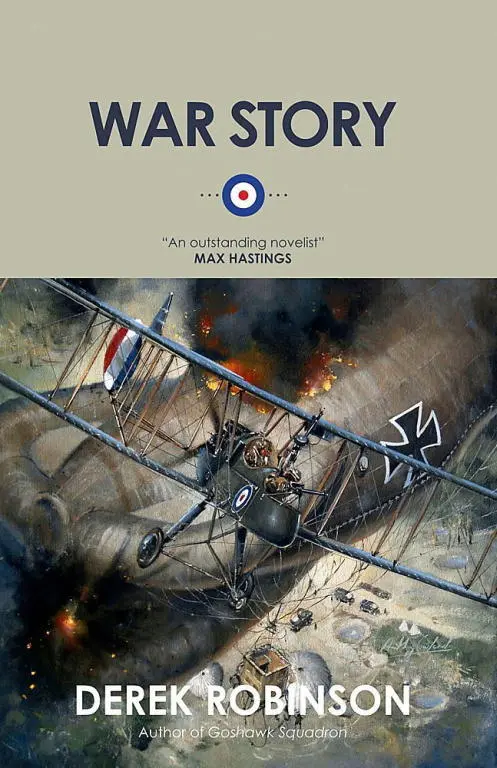
- Название:War Story
- Автор:
- Издательство:Quercus
- Жанр:
- Год:2011
- Город:London
- ISBN:978-0-857388-483-0
- Рейтинг книги:4 / 5. Голосов: 1
-
Избранное:Добавить в избранное
- Отзывы:
-
Ваша оценка:
War Story: краткое содержание, описание и аннотация
Предлагаем к чтению аннотацию, описание, краткое содержание или предисловие (зависит от того, что написал сам автор книги «War Story»). Если вы не нашли необходимую информацию о книге — напишите в комментариях, мы постараемся отыскать её.
Five days later, he crash-lands at his destination, having lost his map, his ballast and every single plane in his charge. To his C.O. he’s an idiot, to everyone else—especially the tormenting Australian who shares his billet—a pompous bastard.
This is 1916, the year of the Somme, giving Paxton precious little time to grow from innocent to veteran.
War Story — читать онлайн бесплатно полную книгу (весь текст) целиком
Ниже представлен текст книги, разбитый по страницам. Система сохранения места последней прочитанной страницы, позволяет с удобством читать онлайн бесплатно книгу «War Story», без необходимости каждый раз заново искать на чём Вы остановились. Поставьте закладку, и сможете в любой момент перейти на страницу, на которой закончили чтение.
Интервал:
Закладка:
“It’s the officers, shooting at empty bottles,” Lacey said. “If the Hun ever attacks with empty bottles, we shall be ready for him.”
About half an hour later, Cleve-Cutler telephoned the adjutant and asked him if he could spare a few minutes.
Appleyard splashed some eau-de-cologne on his cheeks and the back of his neck: it tightened up the skin and stopped him sweating for a while. He chewed a peppermint lozenge, sucked in his gut until he could tighten his belt, picked up his clipboard and set out. Tiny silver sparkles danced in front of his eyes, and his ears were singing. He thought of loosening his belt; instead, he went back and took a swig of medicine. He chewed another lozenge and set out again, eyesight and hearing clear. “Got a touch of the old Afghan Curse today,” he said. Corporal Lacey paused in his typing and smiled sympathetically.
Cleve-Cutler gave the adjutant what seemed like a welcoming smile. “I make it just over a thousand pounds,” he said. “On a captain’s pay it’ll take you about three years to repay that. But you won’t be a captain, will you? You’ll be a nothing, once you’ve been court-martialled. Isn’t that right?”
Appleyard turned away from that appallingly jaunty expression. He could feel his gut slipping until it was below his belt. He opened his mouth, and then closed it. The singing in his ears had started again.
“It’s too late to ask me what on earth I mean,” Cleve-Cutler said. “That’s a card you play immediately or not at all. Anyway, you’re sacked.”
“I can explain,” Appleyard said.
“Start by telling me where it’s all gone. Not even you could spend a thousand pounds on booze and still be standing.”
“It’s a damned lie.” The adjutant was on the edge of a stutter. “Who’s been feeding you these lies?”
“All this stuff came out of your office.”
“I see. I see. I see.” Appleyard took a quick trip up and down the room. “My office. My papers. This is what the British Army’s come to, is it? Well, I’ll fight it. I’ve fought for my country, I’ve fought the bloody Boers, the Afghans, the Zulus, black as your hat, bullets won’t stop ‘em—”
“No, I don’t think you will,” Cleve-Cutler said.
The adjutant shut his eyes and rubbed the lids with his fingertips, several times. When he looked again, the CO was still in the same place with the same expression. “All I can say is I’m glad you find it so bloody funny,” he said.
Cleve-Cutler glanced through the papers again. For a long minute there was no sound but the soft rustle as he turned a page. “Tell you what,” he said. “Let’s forget all that’s been said, and start afresh. You’ve stolen just over a thousand pounds from this squadron. Now where on earth did it go?”
“Horses,” Appleyard said. “It went on the horses. There’s still lots of racing in England. Chap in Amiens, used to be a bookie, now he’s a lieutenant in the Signals, he runs a book on the English races. I lost most of it through him.”
“And the rest?”
“Drank it.”
“Now we know.” Cleve-Cutler stood up.
“I don’t suppose…” Appleyard blew his nose. “I mean, you wouldn’t consider…”
“You’re sacked, Uncle. Message ends.” He held the door open for him.
Foster lay on the grass outside the mess, his head resting on a cushion, and studied the sky through binoculars. “Remarkable,” he said. “Amazing.”
Some of the officers were resting in deckchairs. Most were half-asleep. “There’s damn-all up there,” Ogilvy said drowsily. “You’ve got a pigeon-dropping on the lens, Frank.”
“No, no. I heard it, and now I can see it. Definitely a Hun.” That aroused them. Foster’s eyesight was phenomenal: on patrol he was invariably the first to see the speck that turned into an aeroplane. An anti-aircraft battery stationed at Pepriac crossroads opened up and rapidly battered the afternoon quiet to bits. “Told you so,” Foster said. “Daddy’s always right, children.” Two miles high the shells burst against the blue like little splatters of spilt milk.
“Any good?” Elliott asked.
“Well, they nearly hit a cloud. Not the cloud our Hun has gone behind, however.”
Charlie Essex settled back and closed his eyes again. “Bloody nerve,” he grumbled. “Probably a tradesman. Tell him to go around the back, Frank.”
Dando said: “Can’t you do anything? Go up and shoo him off?” Nobody bothered to answer. “I thought that’s what you were here for,” Dando said. “My mistake.” He picked up his book.
“Oh, he’s far too high for us,” Foster said, still using his binoculars. “If I told Spud and Gus to go and chase him, now, they’d take ten minutes to get dressed and thirty minutes to climb up there and frankly I don’t think he’s willing to wait that long.”
“So he’s just going to get away.”
“Don’t get shirty with us, old boy,” Mayo said. “It’s his fault for not making an appointment.”
“Hullo, he’s dropped something,” Foster said. “Parachute, I think.”
The parachute took fifteen minutes to fall. The pilot had judged well: it landed in the next field. Several of the squadron were there waiting for it.
“Message-bag,” said Ogilvy. “I bet it’s booby-trapped. Where’s the squadron booby?”
“Inspecting the latrines,” Jimmy Duncan said.
Foster turned it over with his foot. “No, the German air force woulda’t be so crude,” he said. “I know what’s in here.” He undid the drawstring. The bag held the scorched fragment of a British officer’s tunic, two fire-blackened medal ribbons, a broken cockpit watch, half a shoe, and the remains of a cheque book. “That’s that, then,” he said.
“There’s absolutely no doubt?” Dando asked.
“None. They knew where to drop it, you see. Their intelligence is pretty good.”
“In that case,” Dando said,”I’m free to tell you that he had cancer of the stomach. He probably suspected something for a month. It was pretty well confirmed a couple of days ago.”
Foster shoved the bits back into the bag. “I wish I’d seen his last fight,” he said. “You’d better tell the new CO about the cancer.”
“Don’t tell Dougie Goss,” said Essex. “He’ll think he’s got it too.” Nobody laughed. “Still, I suppose it’s not infectious or contagious or whatever,” he said. Dando didn’t answer. They began to walk back to camp.
Later that afternoon, some of ‘B’ Flight returned from leave. The flight commander, Captain Gerrish, was tall and bony, with big hands and feet and a broken nose above a sprawling black moustache that did something, but not enough, to hide the absence of two front teeth, which had gone at the same time that he broke his nose in a small crash during training. His eyelids were heavy. He had been nicknamed ‘Plug’, short for ‘Plug-ugly’. It was dangerous to call Gerrish ugly. He was usually amiable, but sometimes he grew silent and gloomy and then he was liable to hit people who made jokes about him.
He was cheerful enough when he came into the anteroom.
“Have a good leave, Plug?” Goss said. “Ah, new records!” He took them from him. “This is Dando, by the way,” he said while he glanced at the labels. “That’s his surname, he hasn’t got a Christian name, I think it got amputated by mistake… I say: ragtime!”
Gerrish shook hands with Dando, and called for tea. “Anything exciting happen while I was away?” he asked.
“No, it’s been very dull.” Goss was winding the gramophone. “Fritz is being feeble. No fun at all.”
Mayo put aside his newspaper. “Were you still here when Toby Chivers…”
“Yes. That was the day before I left.”
Читать дальшеИнтервал:
Закладка:
Похожие книги на «War Story»
Представляем Вашему вниманию похожие книги на «War Story» списком для выбора. Мы отобрали схожую по названию и смыслу литературу в надежде предоставить читателям больше вариантов отыскать новые, интересные, ещё непрочитанные произведения.

Обсуждение, отзывы о книге «War Story» и просто собственные мнения читателей. Оставьте ваши комментарии, напишите, что Вы думаете о произведении, его смысле или главных героях. Укажите что конкретно понравилось, а что нет, и почему Вы так считаете.