Derek Robinson - War Story
Здесь есть возможность читать онлайн «Derek Robinson - War Story» весь текст электронной книги совершенно бесплатно (целиком полную версию без сокращений). В некоторых случаях можно слушать аудио, скачать через торрент в формате fb2 и присутствует краткое содержание. Город: London, Год выпуска: 2011, ISBN: 2011, Издательство: Quercus, Жанр: Историческая проза, prose_military, на английском языке. Описание произведения, (предисловие) а так же отзывы посетителей доступны на портале библиотеки ЛибКат.
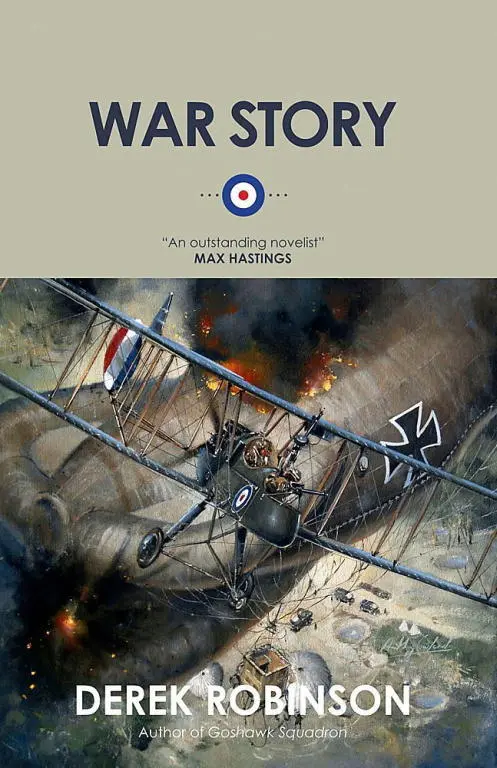
- Название:War Story
- Автор:
- Издательство:Quercus
- Жанр:
- Год:2011
- Город:London
- ISBN:978-0-857388-483-0
- Рейтинг книги:4 / 5. Голосов: 1
-
Избранное:Добавить в избранное
- Отзывы:
-
Ваша оценка:
War Story: краткое содержание, описание и аннотация
Предлагаем к чтению аннотацию, описание, краткое содержание или предисловие (зависит от того, что написал сам автор книги «War Story»). Если вы не нашли необходимую информацию о книге — напишите в комментариях, мы постараемся отыскать её.
Five days later, he crash-lands at his destination, having lost his map, his ballast and every single plane in his charge. To his C.O. he’s an idiot, to everyone else—especially the tormenting Australian who shares his billet—a pompous bastard.
This is 1916, the year of the Somme, giving Paxton precious little time to grow from innocent to veteran.
War Story — читать онлайн бесплатно полную книгу (весь текст) целиком
Ниже представлен текст книги, разбитый по страницам. Система сохранения места последней прочитанной страницы, позволяет с удобством читать онлайн бесплатно книгу «War Story», без необходимости каждый раз заново искать на чём Вы остановились. Поставьте закладку, и сможете в любой момент перейти на страницу, на которой закончили чтение.
Интервал:
Закладка:
It was still early morning, and O’Neill had been thinking of the second breakfast soon to be eaten – thinking of it for perhaps ten seconds, or forty, or ninety, he couldn’t be sure, time played terrible tricks after a couple of hours in the air – when he glanced left at his leader and saw empty sky. Nothing to the right either. He flew a slow figure-of-eight, using his bank to search high and low. Duncan looked at him and gestured failure. Well, it wouldn’t be the first time that a pair of aircraft had been cruising home when one blew its engine or bust a vital spar or snapped a control cable and went down so suddenly that its partner noticed nothing. O’Neill got back on course for Pepriac. He was beginning his final glide to the field when the sun was blotted out. It was Cleve-Cutler’s FE, half a length above and behind. The CO waved. His machine sank, and vanished again.
O’Neill worked it out as he made his landing. The FE had an enormous blind spot directly behind its tail. With a bulky engine roaring at his back the pilot could neither see nor hear anything that followed him closely. And Cleve-Cutler must have trailed him very closely indeed. He must have duplicated every move, quick as a shadow.
Quite a clever bit of flying. Filthy with risk, of course. Cleve-Cutler’s observer said afterwards that there were times when he could have reached out and grabbed O’Neill’s rudder, but nobody believed that. Nevertheless, his face and goggles were black with exhaust smuts from O’Neill’s engine. Cleve-Cutler said nothing about it.
He rarely talked shop. A couple of minutes’ comments after the next day’s Flying Orders had been read out, perhaps: an exchange of views on the probable weather, especially wind and cloud, or a change in the system of signals between aircraft, or reports of a new German machine. Then he would conspicuously change the subject, as if to say: Enough is enough, I leave the rest to you, let’s not allow the war to spoil the entire day. He was very good at conversation, or rather at getting others to talk while he listened. He seemed to find everyone entertaining; even Jimmy Duncan made him grin. (But then so did the squadron dog, a mongrel that had turned up in the ration wagon one day.) After a week, almost everyone in Hornet Squadron began to believe that the old man – the new old man – was his especial friend. The exception was Paxton.
Paxton had decided to lie low for a while. There seemed to be some sort of conspiracy to blame him for everything and thank him for nothing. Nobody had thanked him for getting that load of coal, for instance. And of course he got no credit for shooting down the Hun; on the contrary he’d been blamed for it, as if it was his fault that the Hun had attacked them. He wrote a letter to his parents: It is just my foul luck to have been sent to a squadron with so many wasters and drunks in it. On my first flight over the Lines we met a Hun and after a bit of a scrap I managed to shoot him down in flames. Just writing those words excited Paxton. He had to pause and do some deep breathing. But my flight commander, who is an absolute pig, refuses to approve my claim! What’s more he is very ill-mannered and beastly about it. It is all so unfair that I sometimes wonder who is the real enemy out here. The last line sounded a bit whining so he crossed it out. Next day he re-read the whole letter and tore it up. Everything he’d written was still true but he was eighteen; it was up to him to fight his own battles now.
He hadn’t mentioned O’Neill because he couldn’t put his hatred of the man into words.
The day after Cleve-Cutler and Brazier arrived, Paxton inspected the latrines (for the second time) and went back to his billet. He was braced for another fight with O’Neill. He had decided that the only way to cope with the Australian was to ignore him completely. Even so, his heart was kicking his ribs and his fingertips were prickling when he opened the door. The room was empty.
Ever since the business of the stolen book he had kept all his belongings padlocked in his trunk. He found the key but even as be began to insert it the padlock swung open. He stopped breathing; the sound of his own pulse was as loud in his ears as the pounding of surf. When his lungs complained, he sucked in a huge breath and looked around the room as if his enemy might be lurking somewhere.
O’Neill had picked the lock. Paxton clearly remembered testing it, after he had turned the key. “Swine,” he breathed. “Stinking, sneaking swine.” He didn’t really want to look inside the chest. His fingers were trembling when he opened the hasp and lifted the lid: God alone knew what that Australian pig might have done to his things. Lying on top was his book, The Riddle of the Sands , held together by a rubber band.
Paxton had given it up for lost since his first fight with O’Neill. Maybe there was a shred of decency in the fellow, after all. He took off the rubber band and thumbed the pages, but nothing gave way to his thumb. The book refused to open. All the pages were stuck together. It was as solid as a block of wood.
That chest had been Paxton’s last hope. It was the keep of the castle into which he had retreated. Let O’Neill do his worst outside, Paxton had thought; as long as I have that one place which is safe and private and secure, then I don’t care. Now he felt as if he had been raped. “Raped,” he whispered, and played angrily with the padlock, making the shackle go in and out as fast as he could, just to prove its filthy treachery.
“Having trouble with your equipment, sir?” Private Fidler asked. He was standing in the doorway, holding a broom,”I find a touch of Vaseline sometimes helps.”
“Oh, mind your own damn business.” Paxton tossed the lock onto his bed. “If you want something to do, you can clean my boots again, they’re filthy.” He kicked the lid of the chest shut.
“Bust, is it, sir?” Fidler picked up the lock. “Oh dear. Look at this. My old grannie could open this with one wave of her feather duster.”
“Thank you, I’m sure she could. I’m extremely grateful for your advice, Fidler. Most helpful. Perhaps I’ll go round to Harrods and get something better.”
“Well, I suppose you could do that, sir.” Fidler swept a patch of floor, carefully redistributing the dust, fairly and evenly. “But if it was me I’d go and see Corporal Lacey.”
Lacey had no padlocks but he knew where the best were stored and how to get one. “Good cigars are the most useful currency in the Corps,” he said,”and as it happens another box of cigars arrived for you today.”
“Good heavens,” Paxton said.
“Yes. When the first box proved so valuable I took the liberty of sending a telegram to your uncle, nominally from you, asking for more.”
“You did what? You’ve got a damn nerve, Lacey.”
“But you do want the cigars? Five will get you the strongest padlock in France.”
“Who from?”
“It’s best that you don’t know. Now if you’ll excuse me, I must get back to my desk. Captain Brazier frets if I’m not at his beck and call.”
Later that day, Lacey delivered the padlock. It was the size of a small pineapple and two keys were needed to operate it. “Specially made to protect gold bullion deliveries up the Khyber Pass,” Lacey said. “Don’t lose the keys or you’ll have to dynamite your way in.”
Paxton dropped the hasp over the staple and fitted the shackle through the slot. The two keys turned slickly, moving heavy and complex mechanisms. “That’s one problem solved,” he said.
Cleve-Cutler kept his squadron busy. Whenever the weather allowed, Brigade HQ ordered them up for escort duties or reconnaissance patrols. Each of the three flights was in the air at some time of the day, and Cleve-Cutler encouraged the pilots to practise low-level flying in their spare time. He also liked the observers to practise gunnery in the butts. What he didn’t like was to see people standing around.
Читать дальшеИнтервал:
Закладка:
Похожие книги на «War Story»
Представляем Вашему вниманию похожие книги на «War Story» списком для выбора. Мы отобрали схожую по названию и смыслу литературу в надежде предоставить читателям больше вариантов отыскать новые, интересные, ещё непрочитанные произведения.


Обсуждение, отзывы о книге «War Story» и просто собственные мнения читателей. Оставьте ваши комментарии, напишите, что Вы думаете о произведении, его смысле или главных героях. Укажите что конкретно понравилось, а что нет, и почему Вы так считаете.