Derek Robinson - War Story
Здесь есть возможность читать онлайн «Derek Robinson - War Story» весь текст электронной книги совершенно бесплатно (целиком полную версию без сокращений). В некоторых случаях можно слушать аудио, скачать через торрент в формате fb2 и присутствует краткое содержание. Город: London, Год выпуска: 2011, ISBN: 2011, Издательство: Quercus, Жанр: Историческая проза, prose_military, на английском языке. Описание произведения, (предисловие) а так же отзывы посетителей доступны на портале библиотеки ЛибКат.
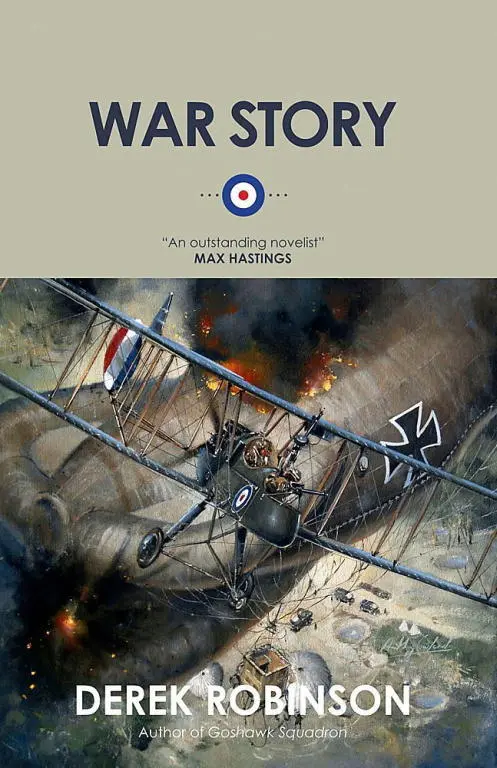
- Название:War Story
- Автор:
- Издательство:Quercus
- Жанр:
- Год:2011
- Город:London
- ISBN:978-0-857388-483-0
- Рейтинг книги:4 / 5. Голосов: 1
-
Избранное:Добавить в избранное
- Отзывы:
-
Ваша оценка:
War Story: краткое содержание, описание и аннотация
Предлагаем к чтению аннотацию, описание, краткое содержание или предисловие (зависит от того, что написал сам автор книги «War Story»). Если вы не нашли необходимую информацию о книге — напишите в комментариях, мы постараемся отыскать её.
Five days later, he crash-lands at his destination, having lost his map, his ballast and every single plane in his charge. To his C.O. he’s an idiot, to everyone else—especially the tormenting Australian who shares his billet—a pompous bastard.
This is 1916, the year of the Somme, giving Paxton precious little time to grow from innocent to veteran.
War Story — читать онлайн бесплатно полную книгу (весь текст) целиком
Ниже представлен текст книги, разбитый по страницам. Система сохранения места последней прочитанной страницы, позволяет с удобством читать онлайн бесплатно книгу «War Story», без необходимости каждый раз заново искать на чём Вы остановились. Поставьте закладку, и сможете в любой момент перейти на страницу, на которой закончили чтение.
Интервал:
Закладка:
On his second day in command, ‘B’ Flight had been sent up to do the usual variety of jobs. Plug Gerrish, the flight commander, rendezvoused with a BE2c to give it protection while it directed an artillery shoot. Unusually, the plane quit and went home after half an hour, but by then Gerrish and his observer, a red-haired, sharp-faced, Scottish lieutenant called Ross, had seen and warned off a Fokker monoplane. It climbed and loitered. It seemed interested rather than aggressive.
Gerrish waited until the BE2c was safely out of sight before i.e went up and tried to catch the Fokker. No hope. It climbed as he climbed. At about eight thousand feet it levelled off. For some minutes they flew parallel, near enough to be able to see details: oil stains, patched canvas, the other man’s goggles, machine guns.
Ross took out his binoculars and had a good long look. Either this was a new type or the Fokker was even smaller than he remembered. Really, it looked old-fashioned: just a plain cross, with square wings stuck on a square fuselage, not much better than the thing Blériot flew across the Channel. Strange to think that Fokkers had frightened the life out of everyone only six months ago. This one had twin Spandau machine guns on top of the engine, very wicked-looking, perforated like cheese graters, but obviously the pilot wasn’t looking for a fight with anyone. Feeble, feeble. Gerrish banged his fist on the nacelle and Ross stuffed the binoculars away. Time to go.
Gerrish was bored. He put the tail up and the nose down and enjoyed plunging into nothingness. This was what he liked about flying: if you got tired of one place you could be somewhere else in no time at all. From the corner of his eye he saw the Fokker diving too. That was no good; he was fed up with this Hun. He steepened the dive, determined to out-race him; then changed his mind, opened the throttle until the vibrations made the instruments blur, and hauled the FE into a loop. The Fokker followed him. Gerrish looked out and saw the monoplane hanging upside-down just as he was hanging upside-down. They came out of the loop like brothers. It was a game now. Gerrish side-slipped left, then right, then developed a corkscrewing dive that widened into a lazy spiral. The German pilot copied everything, perfectly, instantly, levelled out as Gerrish levelled out, and waited to see what was next. Gerrish waggled his wings. He didn’t look for the reply; he knew it was there. He flew home, feeling amused but also annoyed. Fun and games were all very well, but when were they going to start killing each other again?
Foster and Yeo landed together. It had been another dud patrol. Their observers trudged away to get out of their flying kit but Yeo had things to discuss with his fitter and rigger. Foster leaned on the wing of his plane and watched. It was hot and he began to feel sleepy.
Yeo’s discussion ended. Foster heaved himself upright. They walked slowly and silently to the pilots’ hut, scuffing their boots, sweating.
Yeo peeled off his sheepskin coat and let it fall. He slumped into a chair and got rid of his scarf. He tried to prise off one boot with the toe of the other but it refused to loosen.
“Hang on,” Foster said. He took hold of the boot and dragged it off.
“Thanks awfully,” Yeo said. Apart from formalities, those were the first words they had exchanged since the business with Binns.
Foster pulled off the other boot. “Are we friends?” he asked.
“We always were,” Yeo said. “Sometimes good, sometimes bad. But always friends.”
Next morning was wet but not windy. A soft, fine rain drifted across the aerodrome like smoke. Condensation dribbled down the inside of windows and when Tim Piggott got dressed his clothes felt clammy. ‘A’ Flight was due to be on patrol at 9 a.m. and he was not looking forward to it. Flying an FE2b through rain was like sitting on the sharp end of a schooner in a gale. The cockpit was open, with only half a thumbnail of a windscreen, and when rain arrived at seventy or eighty miles an hour it stung.
Talk at breakfast was subdued.
“They ought to call the war off on days like this,” Charlie Essex said.
“You mean like Wimbledon?” O’Neill said.
“Exactly. The grass gets dreadfully cut-up if you fight when it’s wet.”
Goss got up and took his coffee to a window. At the far end of the field, the windsock almost came to life-and then lost interest again. The adjutant walked past, under a large and brightly striped golf umbrella. It made him look ten feet tall. “I don’t see how anyone at the Front can see anything through all this muck,” Goss said.
The adjutant came in and gave the umbrella to Collins. “Porridge with plenty of salt,” he said. The chair creaked as he sat down. “Reminds me of the day we counter-attacked at Mons,” he said. “Same sort of rain. Perfect cover. Master Fritz never saw us coming. Scarcely a shot fired. All bayonet work. I encouraged thrift, you see.”
“Nice to know we won something at Mons,” Piggott said.
“No, we lost. The Hun brought up his guns and blew us all to blazes.” His porridge arrived. “This is what the ground looked like after the barrage.” He stirred it with his spoon. “Exactly like this.”
“No good for mixed doubles, then,” Essex said. Brazier raised an eyebrow. “Sorry,” Essex said. “Family joke.”
“Come on, let’s go and do this bloody silly patrol,” Piggott growled. Men stood, chairs grated, boots scuffed.
“Don’t be late back,” Brazier said. “There’s to be a court of inquiry starting at eleven o’clock into the circumstances leading up to the death of a sergeant muleteer while driving a squadron tender when unauthorised so to do. You may be wanted to attend.”
“What good’s an inquiry?” Goss said. “He’s dead. They’re both dead.”
“But not authorised so to be.” Brazier looked for Collins. “More salt,” he said.
The first three FEs took off one after the other, their propellers blasting the drenched grass and leaving a wake of spray that ceased as each machine came unstuck and began to climb. Douglas Goss was in the fourth plane, with an observer called Henley. Towards the end of his take-off run, with the aeroplane feeling ready and willing to stop jolting and start flying, the engine quit. In the sudden silence, the wings lost their lift and the weight of the aeroplane – nearly a ton, fully loaded – settled on the tricycle undercarriage. The FE took a hundred yards to run to a halt, squeaking and groaning all the way.
“What’s wrong?” Henley asked.
“I think the wheels need oiling. Or maybe you weren’t praying hard enough.”
“I’m agnostic, you know that.”
“Well, so’s the engine. It certainly doesn’t want to go to heaven.”
“Suits me. We can play ping-pong instead.”
A lorryload of ground crew came out and pushed the FE back to its hangar. “Sorry about that, sir,” said Goss’s fitter. Within two minutes he had found the fault. “Magneto’s gone dud, sir,” he said. “Can’t understand it, I tested it three times yesterday and—”
“Never mind.” Goss took the magneto and kicked it away, and hurt his foot. “Put another one in, and this time make sure it’s brand new.”
“The other one was brand new, sir.”
“Charming. Just what I wanted to hear.” Goss supported himself on Henley’s shoulders and limped off. “I’ve broken several toes,” he said.
“Frankly, Dougie, I think this war is going to be the death of you.”
It took twenty minutes to fit and test the new magneto. Cleve-Cutler came out to see what the trouble was. “We’ve missed the rendezvous by now, sir,” Goss said. “Anyway, I expect they cancelled the shoot and forgot to tell us.”
Читать дальшеИнтервал:
Закладка:
Похожие книги на «War Story»
Представляем Вашему вниманию похожие книги на «War Story» списком для выбора. Мы отобрали схожую по названию и смыслу литературу в надежде предоставить читателям больше вариантов отыскать новые, интересные, ещё непрочитанные произведения.




Обсуждение, отзывы о книге «War Story» и просто собственные мнения читателей. Оставьте ваши комментарии, напишите, что Вы думаете о произведении, его смысле или главных героях. Укажите что конкретно понравилось, а что нет, и почему Вы так считаете.