Derek Robinson - War Story
Здесь есть возможность читать онлайн «Derek Robinson - War Story» весь текст электронной книги совершенно бесплатно (целиком полную версию без сокращений). В некоторых случаях можно слушать аудио, скачать через торрент в формате fb2 и присутствует краткое содержание. Город: London, Год выпуска: 2011, ISBN: 2011, Издательство: Quercus, Жанр: Историческая проза, prose_military, на английском языке. Описание произведения, (предисловие) а так же отзывы посетителей доступны на портале библиотеки ЛибКат.
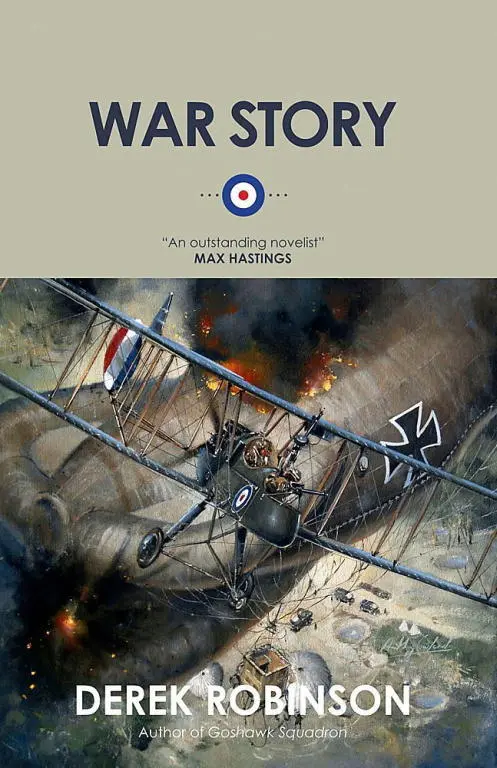
- Название:War Story
- Автор:
- Издательство:Quercus
- Жанр:
- Год:2011
- Город:London
- ISBN:978-0-857388-483-0
- Рейтинг книги:4 / 5. Голосов: 1
-
Избранное:Добавить в избранное
- Отзывы:
-
Ваша оценка:
War Story: краткое содержание, описание и аннотация
Предлагаем к чтению аннотацию, описание, краткое содержание или предисловие (зависит от того, что написал сам автор книги «War Story»). Если вы не нашли необходимую информацию о книге — напишите в комментариях, мы постараемся отыскать её.
Five days later, he crash-lands at his destination, having lost his map, his ballast and every single plane in his charge. To his C.O. he’s an idiot, to everyone else—especially the tormenting Australian who shares his billet—a pompous bastard.
This is 1916, the year of the Somme, giving Paxton precious little time to grow from innocent to veteran.
War Story — читать онлайн бесплатно полную книгу (весь текст) целиком
Ниже представлен текст книги, разбитый по страницам. Система сохранения места последней прочитанной страницы, позволяет с удобством читать онлайн бесплатно книгу «War Story», без необходимости каждый раз заново искать на чём Вы остановились. Поставьте закладку, и сможете в любой момент перейти на страницу, на которой закончили чтение.
Интервал:
Закладка:
“I don’t think he likes you,” Kellaway said.
“I loathe and detest him. He’s foul and disgusting and he steals everything he can lay his hands on. He stole my pyjamas. Wait a minute…” Paxton thought hard. When had he last seen those pyjamas?
“What was all that gibberish about your trunk?” Kellaway said.
Paxton, frowning furiously, was searching for his keys. “I had to buy this special padlock just to keep the thieving beggar out,” he said. Kellaway came over to see. The keys turned sweetly. The shackle slid out of the staple. Paxton grunted with relief. “I’ve beaten the blighter,” he said. He raised the lid and it fell to the floor with a crash that made him jump.
“Hullo!” Kellaway said. “What’s happened now?”
Paxton picked up the lid and examined it. “Someone’s knocked the pins out of the hinges,” he said. “There’s nothing holding the hinges together.” He put the lid back in place and sat on it. “It shouldn’t be possible, not when it’s shut and locked, but…”
Kellaway delicately fingered the ends of the stitches on his chin. The cut itched, which was supposed to be a sign that it was healing. “Why don’t you get your own back?” he asked. “Hit him, or something.”
“I don’t intend to sink to his level. The man’s a cad, I shall treat him as a cad. Sooner or later the message will sink in.”
“Well,” Kellaway said. “You know best.”
Next day the weather was lovely and the squadron’s Flying Orders were cancelled. Everyone must be available for the Court of Inquiry.
This was unpopular, not just because it meant hanging around all day in one’s best uniform but because it made people feel as if they were being treated like schoolboys. “What’s all the fuss?” asked the Canadian, Stubbs. “The guy crashed a tender. Happens all the time.”
“You don’t understand how generals think,” Foster said. “Planned destruction is one thing. You can have all the massacre and mayhem you like, at the Front. What they won’t tolerate is accidental death behind the Lines. That upsets them. It’s wasteful. Untidy.”
“One of us should own up,” Essex said. “Not me, I’ve got an alibi, I was smashing up a hotel in Amiens at the time.”
After breakfast, Corporal Lacey sought out Paxton and handed him a diary. “I came across this when I was parcelling up Mr. Henley’s belongings,” he said. “I think somebody ought to read it.”
The diary was the size of a pocketbook, with a scuffed green leather cover. “You think it might have something in it that would embarrass his family?” Paxton asked. He tried to remember what Henley had looked like. Something like a potato. Bland and harmless. “Not much chance of that, is there?”
“Somebody ought to read it, all the same.”
“D’you mean you’ve noticed something?”
“Certainly not. Far be it from me to read the private and confidential papers of a commissioned officer. It’s simply that with the Court of Inquiry in session, nothing should be overlooked, no matter how trivial.” Lacey raised a finger. “Apparently trivial.”
“I don’t see what the devil the Court of Inquiry has to do with it.” But Paxton opened the diary.
“June the fourth,” Lacey said.
Paxton found the page, and read, and grunted, and read on. “Good God,” he said, still reading, while his hand took a tighter grip of the pages. “What a pair of gibbering idiots.”
“The adjutant is in his office,” Lacey said.
Paxton showed the diary to the adjutant, who showed it to the CO, who showed it to Colonel Bliss when he arrived to reopen the inquiry.
Bliss read the entry three times.
“So,” he said. “This fathead Henley got tight, pinched the keys of the tender from the CO when he wasn’t looking, realised he couldn’t drive, persuaded the other fathead Kellaway to drive, they got into an argument about its horsepower and decided to settle it by seeing how many horses they could swap it for, but what they thought were horses turned out to be mules.”
“It was dark,” Cleve-Cutler said.
“Of course it was. I expect Sergeant Harris thought he was getting a Rolls-Bentley. If it hadn’t been so damn dark none of this would have happened. I blame everything on the blackout. In fact, considering this joker was writing his diary in the pitch black and falling-down drunk too, it’s amazing he could put two words together. I’d like to congratulate him. Wheel him on.”
“Can’t,” Cleve-Cutler said. “He copped it, yesterday.”
“What bad luck. Never mind, wheel on the other idiot.” Bliss checked the page. “Kellaway.”
“No good either. He banged his head, lost his memory.”
“Really? All of it? What a dangerous place this is. First you lose your CO, then your adjutant, then Henley, and now Kellaway can’t find his memory. Honestly, it’s getting so a chap daren’t put anything down for a minute. What’s behind it, d’you think? Magpies? Squirrels? Cat-burglars?”
“You don’t believe this stuff in Henley’s diary.”
“Do you?”
“If it’ll get us out of a hole, yes.”
Colonel Bliss went off to telephone his boss, the general. When he came back he said: “The old buffer is satisfied. He knew Milne couldn’t possibly have done anything so bloody silly, and now events have proved him right.”
“So can we fly again?”
“Yes. In fact he’s so pleased that he’s put Hornet Squadron on double patrols for a week.” Bliss returned the diary. “I liked the bit about the argument over horse-power,” he said. “Somebody used his imagination there.”
Kellaway and Paxton were among the pallbearers at Henley’s funeral. There was no coffin; the body was in a neat canvas bag resting on a board. It lay on the floor of the tender that carried the funeral party to the graveyard at Pepriac church. Paxton was shocked by the absence of a coffin but he quickly forgot about it as he watched the body get jolted inside its bag by the bumpy ride. What fascinated him was the utter helplessness of this corpse, the way you could actually see the wobble of its feet or its head. All through the burial ceremony he kept thinking how easy it was to kill a man. You aim, you squeeze, and before he hears the bang of your gun he’s dead. But even that wasn’t the most exciting part. The real thrill was turning an aeroplane into a flaming wreck. That Albatros had looked so beautiful. And he had knocked it out of the sky. He, Oliver Paxton, not yet nineteen, never very brilliant at Sherborne although he’d got his rugger colours, couldn’t master trigonometry to save his life but he could blast a Hun before lunch. He could count up to one! The padre finished speaking. Paxton hadn’t heard a word. He glanced across the open grave at Kellaway. He’s smiling , Kellaway thought. What on earth is there to smile about? An NCO shouted orders. Rifle fire crashed and echoed. Paxton smelled fumes, and tasted the scent of intoxication.
Paxton had no difficulty getting permission to leave Pepriac. Lacey fixed it with the adjutant. Now that Paxton had got his uncle to send a box of the best Havana-Havanas every other day it seemed that Lacey could fix anything.
At first he explored the land to the south, as far as the river Somme, the limits of the British Army. It was easy walking: gentle slopes, vast fields, well drained by the chalk that gleamed wherever a trench had been dug. Ten or twelve miles was nothing. And everywhere he went he met soldiers in camp, soldiers out training, soldiers on the march. The countryside was studded with regiments, and more kept arriving: not from the Trenches but from base camps, sometimes from England.
This military richness amazed and impressed him. Buglecalls delighted him. Sometimes, when the air was still, three or four buglers in different camps would overlap and he stopped to admire the sheer cleverness of the organisation. He liked watching men on parade. He liked watching the wagontrains, sometimes six horses to a wagon, rumbling by knee-deep in white dust. But most of all he liked watching troops on the march behind a band of fifes and drums. The crunch of boots, the shrill of fifes, the thump and thunder of drumskins: all combined to make his chest swell and his legs twitch with suppressed energy. As the column marched away he felt a huge, patriotic pride mixed with a regret that he could do nothing to demonstrate that pride. He was an Englishman. That was Saint George’s music. He wanted to slay a dragon or two.
Читать дальшеИнтервал:
Закладка:
Похожие книги на «War Story»
Представляем Вашему вниманию похожие книги на «War Story» списком для выбора. Мы отобрали схожую по названию и смыслу литературу в надежде предоставить читателям больше вариантов отыскать новые, интересные, ещё непрочитанные произведения.

Обсуждение, отзывы о книге «War Story» и просто собственные мнения читателей. Оставьте ваши комментарии, напишите, что Вы думаете о произведении, его смысле или главных героях. Укажите что конкретно понравилось, а что нет, и почему Вы так считаете.