Derek Robinson - War Story
Здесь есть возможность читать онлайн «Derek Robinson - War Story» весь текст электронной книги совершенно бесплатно (целиком полную версию без сокращений). В некоторых случаях можно слушать аудио, скачать через торрент в формате fb2 и присутствует краткое содержание. Город: London, Год выпуска: 2011, ISBN: 2011, Издательство: Quercus, Жанр: Историческая проза, prose_military, на английском языке. Описание произведения, (предисловие) а так же отзывы посетителей доступны на портале библиотеки ЛибКат.
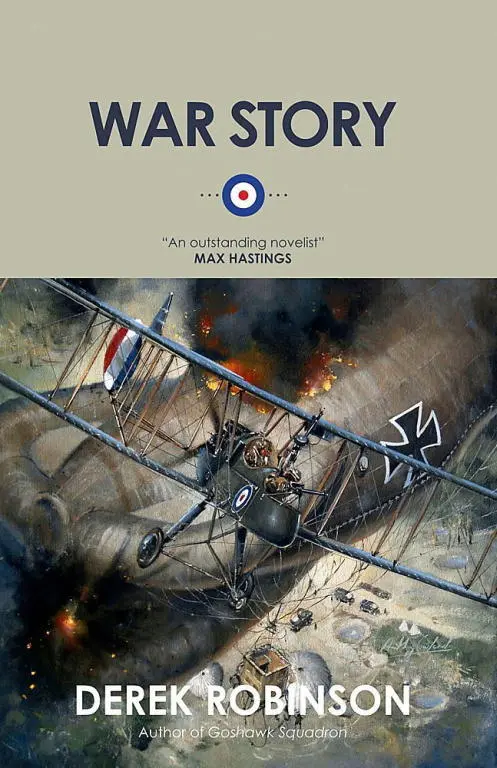
- Название:War Story
- Автор:
- Издательство:Quercus
- Жанр:
- Год:2011
- Город:London
- ISBN:978-0-857388-483-0
- Рейтинг книги:4 / 5. Голосов: 1
-
Избранное:Добавить в избранное
- Отзывы:
-
Ваша оценка:
War Story: краткое содержание, описание и аннотация
Предлагаем к чтению аннотацию, описание, краткое содержание или предисловие (зависит от того, что написал сам автор книги «War Story»). Если вы не нашли необходимую информацию о книге — напишите в комментариях, мы постараемся отыскать её.
Five days later, he crash-lands at his destination, having lost his map, his ballast and every single plane in his charge. To his C.O. he’s an idiot, to everyone else—especially the tormenting Australian who shares his billet—a pompous bastard.
This is 1916, the year of the Somme, giving Paxton precious little time to grow from innocent to veteran.
War Story — читать онлайн бесплатно полную книгу (весь текст) целиком
Ниже представлен текст книги, разбитый по страницам. Система сохранения места последней прочитанной страницы, позволяет с удобством читать онлайн бесплатно книгу «War Story», без необходимости каждый раз заново искать на чём Вы остановились. Поставьте закладку, и сможете в любой момент перейти на страницу, на которой закончили чтение.
Интервал:
Закладка:
One day he took the squadron dog, now named Brutus, with him for company. This worked so well that next day he asked Kellaway to come.
Dando had grounded Kellaway until he was sure he had recovered from his concussion. Kellaway was not keen on walking. “That’s why I left the Somerset Light Infantry and joined the Corps,” he said. “All that marching. You walk everywhere in the infantry. Awfully tiring. I’ve got small feet, too.”
“Just a short stroll,” Paxton said.
“Nice lunch somewhere?”
“Yes.”
“I’m not absolutely sure it was the Somerset Light Infantry. Sometimes I think it was, sometimes I wonder. D’you ever get that feeling?”
“No. Come on, get your boots on.”
It was another fine day. The fields were awash with poppies, and there was always a skylark high above, singing as if God were holding auditions. Paxton and Kellaway walked north. They visited battalions of the Royal Inniskilling Fusiliers, the Highland Light Infantry, the King’s Own Yorkshire Light Infantry, the Scottish Rifles. They were offered lunch in the mess by some Northumberland Fusiliers, newly arrived. Only eggs and potatoes, for which the Fusiliers apologised, but lots of wine and cheese. Kellaway quickly drank two glasses of wine and became very jaunty.
“Your face seems to have acquired a few battle honours lately,” one of the hosts said to him.
“Ah, yes.” He felt his bruises. “But you ought to see the other chap.”
“No, no.” Paxton made a little melodrama out of it. “Not a good idea. Might put them off their food.”
They asked him what had happened, as he knew they would. This was his party-piece. He was good at this. “Routine patrol,” he said. “Four or five thousand feet. Above the clouds, anyway. You wouldn’t have seen a thing from down here.” That always impressed people. “Along came this Hun, two-seater, Fokker, nasty piece of work. Machine-guns fore and aft. One of their latest grids. Bigger than us, and faster. He knew it, too. You could tell from the way he charged at us. I reckon he must have been doing a hundred miles an hour.” There was utter silence now. He took a sip of wine.
“Then we had a scrap and I shot him down,” Kellaway said. “Pass the potatoes, old bean.”
Paxton tried to grin and be a part of the laughter, but he felt sick with rage and hatred. Kellaway had not only pinched his story, he had pinched his Hun! And he was still chattering away. Paxton gave up. He chewed the tasteless food in order to make his face do something that hid his expression.
Kellaway was saying: “… but that one doesn’t count because he ran away home, and it was downhill all the way so he went very fast. Anyhow, we made up for it next day. We caught a whale. Huge German aeroplane. When we searched the wreckage we found a billiard table and a genuine lavatory with a chain you could pull. I put three drums of ammunition through the Lewis before that Hun went down. The barrel was so hot it glowed red like a poker.”
“So how many Huns have you shot down, in all?”
“Seven. Eight, if you count double for the whale.”
Paxton made an effort to be cheerful but he felt both angry and ashamed. They left as soon as he could contrive it, which was not until Kellaway had drunk a lot of brandy. Neither of them spoke until they were out of sight of the camp. “I must say that was the most disgusting performance I have ever witnessed,” Paxton said; but he was talking to himself: Kellaway had turned aside and was pissing on an old tree stump. Paxton walked slowly on, his face twisted in distaste, waiting for Kellaway to catch up and be condemned in style. But Kellaway didn’t catch up. Paxton went back and found him asleep with his hat over his eyes. “Sod you, then,” he said, and felt soiled by his own words. He walked away and spat to cleanse his mouth.
For half an hour he wandered about, watching troops erect tents. Then he decided to go home. Kellaway was where he had left him, still asleep. By now Paxton was too weary to be angry. “Come on,” he said.
Kellaway awoke like a child, smiling, yawning and stretching. “Goodness, I’m thirsty,” he said. “D’you know, I just had the most extraordinary dream. I dreamt I was back at school, and it was last summer, because I was captain of tennis which I was, you see – only I was in uniform, and…”
Paxton let him ramble on as they walked back, until he lost patience and interrupted. “Why did you tell all those frightful lies?”
“Steady on. It’s only a dream.”
“I’m not talking about your dopey dream. I mean all the lies you told the Northumberland Fusiliers at lunch.”
“Lunch?” Kellaway kicked at a dandelion. “Did we have lunch?”
“You told them you’d shot down seven or eight Huns.”
“No! Really? What a spoof!” Kellaway was delighted.
“There is such a thing as honour, you know,” Paxton said.
“Did they believe me?”
“Yes, of course.”
“I don’t see how anybody’s honour has suffered, then. Do you?”
Paxton felt trapped. “It’s just not good enough,” he said.
Chapter 11
Flying two patrols a day was not unusual in 1916. Plenty of Quirks went up twice a day, coming home for lunch as if they were keeping office hours. But at least the crews of Quirks had specific jobs to do, and once they had done them they could quit, put the nose down and buzz off. FE2bs led a different life.
They were built to fight. The initial stood for ‘Farman Experimental’ but a lot of people assumed they meant ‘Fighting Experimental’, and some of the more gung-ho pilots actually called their machines ‘fighters’ instead of ‘scouts’. Cleve-Cutler was one of these. When his flight commanders complained that they hardly ever saw enemy planes, and so two patrols a day were twice as pointless as one, he said: “Not at all. Now we own the sky. If Jerry wants it back he’ll have to come up and fight us for it.”
“I think Jerry’s trying to bore us to death,” Gerrish said.
“Then stir him up. You’re supposed to be flying offensive patrols, so be more offensive. Be downright bloody disgusting.”
“I couldn’t do that,” Foster said. “Nanny made me promise. However,” he added as he saw Cleve-Cutler’s expression, “I suppose I could always shoot Nanny first.”
“And don’t be so damned cocky,” Cleve-Cutler said. “Remember what happened to that chap Dobson or Hobson or whatever his name was, at Lagnicourt last month.” The meeting broke up in silence. Hobson had crashed in flames, caught by a low-flying enemy machine which shot him down when he was only fifty feet off the ground, thinking his patrol was over, probably thinking the other plane (if he saw it) must be British. Nobody knew what Hobson had thought. Nobody caught the other plane, either.
Flying offensive patrols was a wearying grind. There were the physical demands of going from ground level to the same height as the top of a small Alp and sitting there for an hour or more in a Force 10 gale. Do it twice a day for a week and your body starts to complain: the head throbs, or the sinuses burn, or the ears develop a persistent buzz. But that was trivial. The great strain was the search, and it grew worse when there was nothing to find. The sky became achingly empty. Impossibly empty. Some pilots and observers lost faith in their own eyes. The less they found the more they worried. After all, they were up there to kill someone. Where was the bastard? Stealing into their blind spot? About to kill with the shot the victim never hears? So they searched, and worried. A man would have to be crazy not to worry. On the other hand, worry was exhausting. Worry too much and you might end up too tired to search. It was something to worry about, was worry.
Читать дальшеИнтервал:
Закладка:
Похожие книги на «War Story»
Представляем Вашему вниманию похожие книги на «War Story» списком для выбора. Мы отобрали схожую по названию и смыслу литературу в надежде предоставить читателям больше вариантов отыскать новые, интересные, ещё непрочитанные произведения.



Обсуждение, отзывы о книге «War Story» и просто собственные мнения читателей. Оставьте ваши комментарии, напишите, что Вы думаете о произведении, его смысле или главных героях. Укажите что конкретно понравилось, а что нет, и почему Вы так считаете.