Derek Robinson - War Story
Здесь есть возможность читать онлайн «Derek Robinson - War Story» весь текст электронной книги совершенно бесплатно (целиком полную версию без сокращений). В некоторых случаях можно слушать аудио, скачать через торрент в формате fb2 и присутствует краткое содержание. Город: London, Год выпуска: 2011, ISBN: 2011, Издательство: Quercus, Жанр: Историческая проза, prose_military, на английском языке. Описание произведения, (предисловие) а так же отзывы посетителей доступны на портале библиотеки ЛибКат.
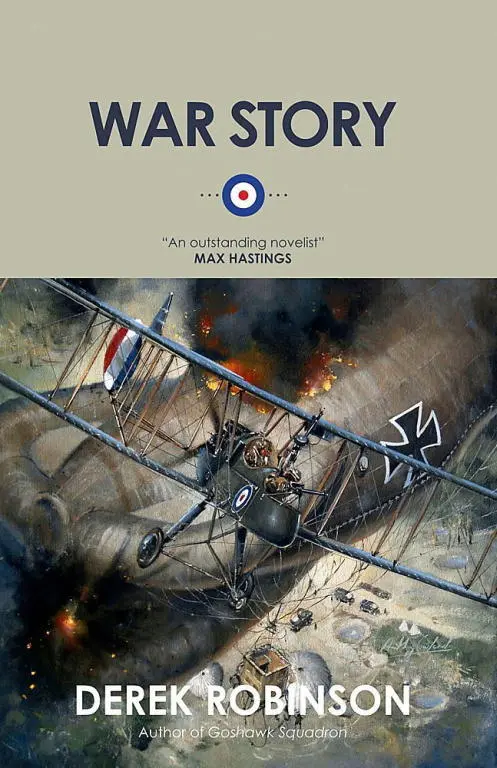
- Название:War Story
- Автор:
- Издательство:Quercus
- Жанр:
- Год:2011
- Город:London
- ISBN:978-0-857388-483-0
- Рейтинг книги:4 / 5. Голосов: 1
-
Избранное:Добавить в избранное
- Отзывы:
-
Ваша оценка:
War Story: краткое содержание, описание и аннотация
Предлагаем к чтению аннотацию, описание, краткое содержание или предисловие (зависит от того, что написал сам автор книги «War Story»). Если вы не нашли необходимую информацию о книге — напишите в комментариях, мы постараемся отыскать её.
Five days later, he crash-lands at his destination, having lost his map, his ballast and every single plane in his charge. To his C.O. he’s an idiot, to everyone else—especially the tormenting Australian who shares his billet—a pompous bastard.
This is 1916, the year of the Somme, giving Paxton precious little time to grow from innocent to veteran.
War Story — читать онлайн бесплатно полную книгу (весь текст) целиком
Ниже представлен текст книги, разбитый по страницам. Система сохранения места последней прочитанной страницы, позволяет с удобством читать онлайн бесплатно книгу «War Story», без необходимости каждый раз заново искать на чём Вы остановились. Поставьте закладку, и сможете в любой момент перейти на страницу, на которой закончили чтение.
Интервал:
Закладка:
“Bloody archie,” Essex muttered. “I really hate the stinking stuff. It doesn’t fight fair.”
“Nobody’s invented the perfect weapon yet,” Foster said, chewing a thumbnail. Yeo sighed, and Foster sat on his hand again.
“We’re not going to find the answer here,” Ogilvy said. “Maybe if we go up and look…”
Nobody had a better suggestion. “All right,” Foster said. “Next time the weather’s right, James and I will study the problem from several angles.”
“Keep your heads down,” Essex said. “They can’t see you if you can’t see them. That’s a scientific fact.”
Pepriac was rarely silent. Engines were constantly being tested, and aircraft took off and landed all day. No matter how often he saw it, the act of take-off – the bellowing, bouncing charge across the grass, the instant of lift, the easy climb – never lost its magic for Paxton. He felt the cramp of envy, and a craving that no amount of tramping across the land of the Somme could diminish. He went to see Tim Piggott and asked to be allowed to fly again.
“It’s not my decision. I didn’t ground you.” Piggott’s rigger had extracted a ragged lump of shrapnel from his FE’s undercarriage and it lay on his desk. He poked at it with a pencil. “Besides, there’s no room for you. All the FEs are fully crewed.”
“There’s the Quirk.”
“If it was up to me you could take it and good riddance to you both.” Piggott frowned, hard. His left eyelid had started flickering again. He put a finger on it to make it stop. “The Hun loves chumps like you. Very sentimental, the Hun, very fond of children, he enjoys putting large lumps of red-hot metal through their stupid little heads.” The point of the pencil snapped against the piece of shrapnel. Piggott looked at it bleakly. “Buzz off,” he said.
Paxton told Kellaway about this exchange. “If you ask me,” he said,”it’s a clear case of professional jealousy. We knocked down a Hun and Piggott got hit by shrapnel.”
“Sorry to hear that,” Kellaway said. “Where was he hit?”
“Oh… I don’t know. At the Front somewhere.”
“A chest wound?”
“No, no, no. Piggott wasn’t touched. For God’s sake pay attention.”
“I’m getting one of my headaches,” Kellaway said. “I’d better go and lie down.”
Paxton was not discouraged by Piggott’s words. Sooner or later, he knew, the squadron would need a pilot. Every day there were forced landings because of engine failures – a cracked fuel line, a clogged-up carburettor, a broken electrical lead. The crew of a machine in ‘C’ Flight were lucky to survive when their propeller shattered and the fragments hacked through the control cables leading to the tail. The plane obligingly crashed into a small lake, the only stretch of water for miles around, and they waded ashore. Once, as an FE circled the aerodrome, smoke suddenly boiled out of the engine and Paxton thought his day had come; but this pilot deftly blew out the fire with a series of plunging sideslips, and he landed grinning. Another time, Paxton saw an officer fall out of a tree, and he sent a passing mechanic to get the ambulance. The officer turned out to be Douglas Goss (he had been looking for a lost cricket ball). He was a catalogue of pain and injury, but it was a walking catalogue, and he dismissed the ambulance and limped back to the mess. “Bloody branch broke,” he told Dando. “Typical shoddy frog tree.” Frank Foster picked a twig out of Goss’s hair, and said: “Anyone who goes up in one of those things must be mad, that’s my opinion.” Next day Goss was flying as usual.
Paxton borrowed a motorcycle and explored the more northerly parts of the Somme. He found a fresh kaleidoscope of regiments, with more units arriving daily. It excited him to know he was part of the most brilliant battle-force the world had ever seen, he was in the prime of his life, and he was about to demonstrate his dash and prove his courage in the mightiest clash of arms ever known. And – most splendid part of all – Britain was going to win! Patriotism glowed in him like plum brandy.
The roads were dense with military traffic, endless supply columns feeding the infantry its meat and drink, its bullets and bags of mail and boots, and so Paxton often rode his motorcycle across country. It was a sign of the changing times that he was stopped by a military policeman at the entrance to a field, and made to prove his identity.
“If you wouldn’t mind keeping to the side of the field, sir,” the man said. “There’s manoeuvres going on in the middle.”
Paxton-chugged around the edge and saw nothing going on in the middle. He was stopped by another MP, and then by a third, who was reluctant to let him continue. “You ought to have been given a special pass, sir,” he said.
“Well, I’m certainly not going back to get one,” Paxton said crisply. The man consulted his clipboard. Paxton looked too. “There it is, for heaven’s sake,” he said. “Air Liaison. Two from the end. Satisfied?” He rode off before there could be any argument
A couple of hundred yards ahead stood a reviewing stand built of scaffolding poles and planks. Cars were parked nearby, and a crowd of officers lounged about. It was an odd scene: like the finish of a fashionable point-to-point, but without the horses.
He avoided the crowd and left his bike near the cars. This wasn’t his sort of show; those were staff officers, colonels and brigadiers and generals; he shouldn’t be here; he could get into very hot water. That’s what made it irresistible. But did he have the nerve to walk over to those officers and join in their conversation? No. No, he knew he wasn’t brave enough for that. Instead he walked over to a driver who was sitting on a running-board. The man came to attention. “Stand at ease,” Paxton said. “Look here, I can’t afford to stay long, I’ve got to get back to my squadron.” He glanced wisely at the sky. “Routine patrol, but it’s got to be done.” How sweetly the lies flowed!”So when is this show going to start, d’you reckon?”
“Well, it’s late now, sir. In fact—” An orange flare burst high in the air, half a mile away. The crowd began moving towards the stand. “Good man,” Paxton said. (Always praise the servants, his father had taught, even when they haven’t done anything; it costs nothing and they feel they have to work harder to deserve it.) He hurried to join the crowd.
Nobody looked twice at him. He found a space to stand at the top, in a corner, behind some Guards subalterns. Their gloss made him feel dingy.
A major appeared below, and announced through a megaphone: “One minute to zero hour.” Paxton began to notice things. Two hundred yards to the right a long trench had been dug, in the correct military zigzag pattern; communication trenches led to it. Two hundred yards to the left, white tapes had been laid in a long line, parallel to the trench. A second set of tapes could be seen a hundred yards behind the first. Between the trenches and the tapes the ground was smooth and green. There was no breeze. Sounds carried perfectly: a few crows complaining as usual, a horse neighing somewhere out of sight. It was all very peaceful. “Zero hour in five seconds,” the major said. Conversation ceased.
Whistles blew, dozens of whistles, and men popped up from the trench as if on springs. “The first wave will advance in extended line at walking pace,” the megaphone informed. “They will cross No-Man’s-Land in eight minutes and thirty seconds.” Indeed the wave had set off and NCOs could be heard shouting, straightening the line. Very soon it was impressively correct. A lieutenant walked in front of each platoon, holding a revolver or a walking stick. “The men are spaced five yards apart,” the megaphone declared. “Company HQ, comprised of company commander and six men, can be seen following.” Whistles shrilled again, and the trench ejected another force. “The first wave having completed one hundred yards, the second wave commences the advance,” explained the megaphone.
Читать дальшеИнтервал:
Закладка:
Похожие книги на «War Story»
Представляем Вашему вниманию похожие книги на «War Story» списком для выбора. Мы отобрали схожую по названию и смыслу литературу в надежде предоставить читателям больше вариантов отыскать новые, интересные, ещё непрочитанные произведения.

Обсуждение, отзывы о книге «War Story» и просто собственные мнения читателей. Оставьте ваши комментарии, напишите, что Вы думаете о произведении, его смысле или главных героях. Укажите что конкретно понравилось, а что нет, и почему Вы так считаете.