Derek Robinson - War Story
Здесь есть возможность читать онлайн «Derek Robinson - War Story» весь текст электронной книги совершенно бесплатно (целиком полную версию без сокращений). В некоторых случаях можно слушать аудио, скачать через торрент в формате fb2 и присутствует краткое содержание. Город: London, Год выпуска: 2011, ISBN: 2011, Издательство: Quercus, Жанр: Историческая проза, prose_military, на английском языке. Описание произведения, (предисловие) а так же отзывы посетителей доступны на портале библиотеки ЛибКат.
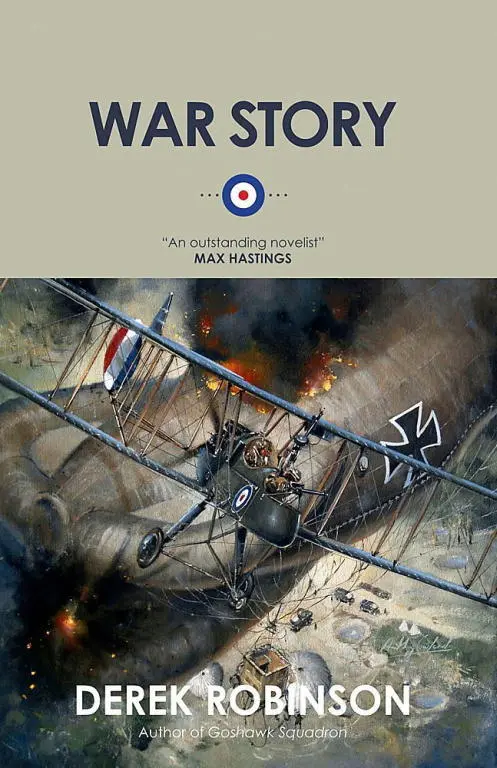
- Название:War Story
- Автор:
- Издательство:Quercus
- Жанр:
- Год:2011
- Город:London
- ISBN:978-0-857388-483-0
- Рейтинг книги:4 / 5. Голосов: 1
-
Избранное:Добавить в избранное
- Отзывы:
-
Ваша оценка:
War Story: краткое содержание, описание и аннотация
Предлагаем к чтению аннотацию, описание, краткое содержание или предисловие (зависит от того, что написал сам автор книги «War Story»). Если вы не нашли необходимую информацию о книге — напишите в комментариях, мы постараемся отыскать её.
Five days later, he crash-lands at his destination, having lost his map, his ballast and every single plane in his charge. To his C.O. he’s an idiot, to everyone else—especially the tormenting Australian who shares his billet—a pompous bastard.
This is 1916, the year of the Somme, giving Paxton precious little time to grow from innocent to veteran.
War Story — читать онлайн бесплатно полную книгу (весь текст) целиком
Ниже представлен текст книги, разбитый по страницам. Система сохранения места последней прочитанной страницы, позволяет с удобством читать онлайн бесплатно книгу «War Story», без необходимости каждый раз заново искать на чём Вы остановились. Поставьте закладку, и сможете в любой момент перейти на страницу, на которой закончили чтение.
Интервал:
Закладка:
Paxton was puzzled. This was all rather slow. He expected troops to charge when they advanced, shouting hoarse defiance, terrifying the enemy into surrender or retreat. These chaps were just plodding. Then the first wave got close enough for him to see how heavily loaded they were. Equipment was strung all over them. Faces shone with sweat. “Full packs are worn,” the megaphone announced obligingly. “Two days’ rations and water bottles are carried. Each man has his rifle with bayonet, two gas respirators, full ammunition pouches, two grenades, one spade, one pair of wirecutters and other minor kit. Thus he can be sure of being ready to cope with any eventuality.”
The first wave plodded past the reviewing stand. Whistles shrilled and the third wave appeared from the trench.
“At zero hour,” said the megaphone,”our barrage lifted from the enemy Front Line, represented here by white tape, and moved to the enemy Second and Third Lines. No resistance is anticipated. However, for training purposes, some opposition has been allowed to exist.” Sure enough, half a dozen isolated figures sat up behind the white tape and began firing blanks. The first wave kept walking. Eventually the megaphone admitted: “Minor casualties may be suffered.” Here and there a man gratefully sank to his knees and lay down. A bugle sounded. Stretcher-bearers climbed out of the trench and trotted forward.
“You will notice,” the megaphone said,”that some men carry poles with flags. These will be raised in due course to act as markers for our guns. Others carry wiring stakes. They will use these to fortify captured positions. Rockets and carrier pigeons are carried for purposes of communication. Machine-gun units are present.”
By now a fourth wave of troops had come out of the trench. The first three waves were walking steadily across No-Man’sLand, five yards between men, a hundred yards between waves, the NCOs nagging at them to straighten their lines. Paxton was enormously impressed. There was something so calm yet so implacable about this attack. Unstoppable: that was the word. They looked as if they could walk all day, wading rivers, climbing hills, trampling the enemy beneath their steady tread, never tiring. He chuckled. “They really need a band,” he murmured,”playing ‘Land of Hope and Glory’.” The Guards subalterns looked at him, looked at each other, looked away. Go to hell , Paxton thought cheerfully. How many Huns have you shot down? Well, then.
A green rocket went up. “The first wave has now reached and captured the enemy Front Line,” the megaphone reported. “It arrived fifteen seconds late. Our apologies.” The reviewing stand was mildly amused. “The fifth wave has now left our trenches.” My God! Paxton thought. Is there no end to them? ”This fifth wave will carry out mopping-up operations, if necessary. The sixth wave will act as reinforcements, preparatory to the seventh wave, which will consist of Battalion HQ including Signals.”
There was a pause while the second wave trudged to the white tape and lay down. The third wave followed but crossed the tape and kept going. So did the fourth. A minute later a red rocket went up. “The enemy Second and Third Lines have now been captured,” said the megaphone. “Our barrage had already lifted from them, of course.” There was a flicker of ironic applause. “The opportunity for breakthrough has therefore been created,” said the megaphone defiantly.
Everyone looked to the right. This was the climax, the clincher, the cream on the cake. Sure enough, a trumpet call brought a squadron of cavalry surging into view, and behind it a second and a third, all boiling up to a full-blooded gallop. The horses went streaming over the trench. Paxton stopped breathing. Bright pennants raced from the ends of lances, swords made streaks of light. It was a race between the squadrons. The infantry had scattered to leave a wide gap. As the cavalry hammered past them they cheered, a throaty, disciplined roar that made Paxton grin with delight. He breathed again, deeply and triumphantly. The cavalry raced out of sight. “The breakthrough has been achieved,” said the megaphone. “Tea will now be served.”
The reviewing stand slowly emptied. Everyone drifted, in a haze of talk, to a group of trestle tables. Paxton took half a cucumber sandwich, a slice of cake and a cup of tea. He found himself standing next to a middle-aged major who blinked a lot. “What did you think of it, sir?” he asked.
The major sipped his tea and stopped blinking. He said: “I think perhaps someone has over-egged the pudding.”
“I meant the exercise, sir.”
“So did I, old chap. So did I.”
Potty , Paxton thought. “Excuse me, sir,” he said, and sidled away.
Bunches of troops were walking back to where they had come from. He rode his motorcycle across the field, twisting and turning to dodge them, and going slightly too fast because he enjoyed it and because he envied the way the cavalry had been free to race like the devil. Some soldiers stopped and cheered him. That made him feel good. He celebrated with a bit more speed. The rear wheel skidded out of a turn, nothing dangerous, just enough to earn another cheer, so he purposely skidded out of the next turn, straightened up and charged into a little hollow so fast that he came out of it flying, three feet of air beneath his wheels. He landed almost perfectly; but almost wasn’t good enough at that speed. The bike wobbled more and more as if it were shaking its head harder and harder until finally it fell over and flung him aside.
The nearest group of men waited and watched. When they saw him stand up, they walked on.
His lungs didn’t want to work. That was the worst thing. No matter how hard he sucked, his lungs refused to fill. All the breath had been knocked out of them and now they seemed numb or dead or something. Not dead: struggling. Failing. Useless. He thought: This must be what drowning is like , and immediately thought, What an odd thing to think , and then miraculously squeezed a cupful of air into each lung.
After two minutes he had so much breath he could afford to laugh.
The handlebar was a bit skewed but the wheels went round and the brakes worked. Trouble was, the engine wouldn’t start. No matter how hard he stamped on the starter, the engine wouldn’t even cough. He laboured at it until his leg was weary and his face was sticky with sweat.
It was a long way to Pepriac.
He propped the wretched machine on its stand, and sat down to rest. “D’you know what you are?” he said to it. “You’re a mechanical turd.” A soldier was watching.
He was short, and made to look shorter by the packs and webbing and equipment hung about him. “Hullo,” Paxton said. “I don’t suppose you can make this damn thing go, can you?”
The soldier came over and stooped to look at it. His hands and wrists, grasping his rifle, were small. The cords at the back of his neck were not yet powerful enough to be those of a man. “I could try, sir,” he said.
“Please do.”
The soldier laid down his rifle and took off his steel helmet. He had a small face with neat and tidy features, like a boy’s, and serious eyes. His black hair had been closely clipped. He sat on his heels to examine the machine; and Paxton, with a great rush of memory, saw who it was he looked like. The gardener’s boy. Dick. The best friend he’d never had.
No, that wasn’t strictly true. For a couple of weeks, in the summer holidays when they were both fifteen, he and Dick had been wonderful friends, closer than he had known it was possible to be, each totally trusting the other and each able to make the other laugh just by looking into his eyes. Dick was only the gardener’s boy but he had something special, not just good looks, although Paxton envied his smooth skin and freckles (he used to count them) but a kind of charm that Paxton had never met before. For that couple of weeks he felt he wasn’t fully alive unless he was with Dick. His parents noticed. They disapproved. Dick was barely literate and have you seen his fingernails? Paxton got packed off to stay with a seaside aunt until next term began. After that, it wasn’t the same.
Читать дальшеИнтервал:
Закладка:
Похожие книги на «War Story»
Представляем Вашему вниманию похожие книги на «War Story» списком для выбора. Мы отобрали схожую по названию и смыслу литературу в надежде предоставить читателям больше вариантов отыскать новые, интересные, ещё непрочитанные произведения.

Обсуждение, отзывы о книге «War Story» и просто собственные мнения читателей. Оставьте ваши комментарии, напишите, что Вы думаете о произведении, его смысле или главных героях. Укажите что конкретно понравилось, а что нет, и почему Вы так считаете.