Derek Robinson - War Story
Здесь есть возможность читать онлайн «Derek Robinson - War Story» весь текст электронной книги совершенно бесплатно (целиком полную версию без сокращений). В некоторых случаях можно слушать аудио, скачать через торрент в формате fb2 и присутствует краткое содержание. Город: London, Год выпуска: 2011, ISBN: 2011, Издательство: Quercus, Жанр: Историческая проза, prose_military, на английском языке. Описание произведения, (предисловие) а так же отзывы посетителей доступны на портале библиотеки ЛибКат.
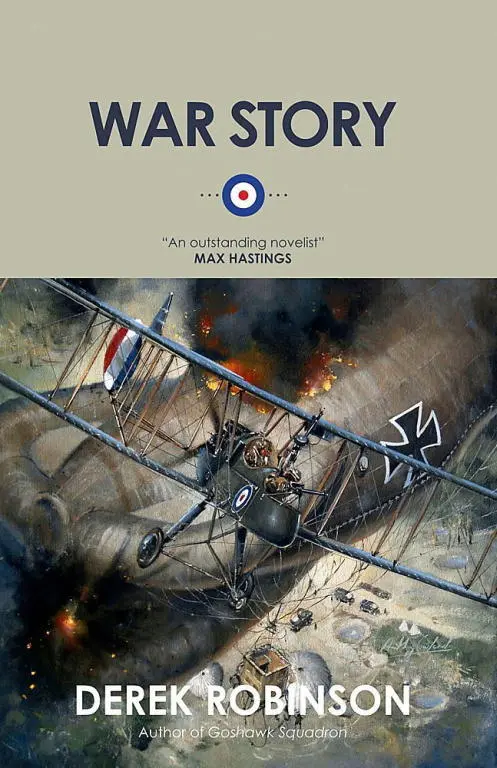
- Название:War Story
- Автор:
- Издательство:Quercus
- Жанр:
- Год:2011
- Город:London
- ISBN:978-0-857388-483-0
- Рейтинг книги:4 / 5. Голосов: 1
-
Избранное:Добавить в избранное
- Отзывы:
-
Ваша оценка:
War Story: краткое содержание, описание и аннотация
Предлагаем к чтению аннотацию, описание, краткое содержание или предисловие (зависит от того, что написал сам автор книги «War Story»). Если вы не нашли необходимую информацию о книге — напишите в комментариях, мы постараемся отыскать её.
Five days later, he crash-lands at his destination, having lost his map, his ballast and every single plane in his charge. To his C.O. he’s an idiot, to everyone else—especially the tormenting Australian who shares his billet—a pompous bastard.
This is 1916, the year of the Somme, giving Paxton precious little time to grow from innocent to veteran.
War Story — читать онлайн бесплатно полную книгу (весь текст) целиком
Ниже представлен текст книги, разбитый по страницам. Система сохранения места последней прочитанной страницы, позволяет с удобством читать онлайн бесплатно книгу «War Story», без необходимости каждый раз заново искать на чём Вы остановились. Поставьте закладку, и сможете в любой момент перейти на страницу, на которой закончили чтение.
Интервал:
Закладка:
That was when the French began firing off rockets, to warn the pilot. Foster’s observer killed him before he could look around to see what they meant. Foster’s observer shot him dead, in the back, as Yeo had been shot. The Nieuport tumbled as if it had tripped over its own feet. Foster climbed away and watched it crash and burn.
He flew home, and remembered nothing about the journey. If the French tried to chase him they took too long getting off the ground because they never caught him. He landed and gave the machine to his groundcrew.
Cleve-Cutler was waiting. “Well, that squares the account,” Foster said. “Now maybe we can get on with the war.” In the distance the racket from the mess rose and fell.
“I’ve kept it warm for you,” Cleve-Cutler said.
The noise of snoring woke Paxton, and hatred flared like a fire in sudden wind. It was a primitive, grunting snoring, typical of O’Neill. Paxton snarled. The snoring stopped. Too late, of course: sleep was impossible now. He sat up. The billet was empty.
Kellaway came in, swinging his sponge-bag. “I can’t tell you how unspeakably filthy you look this morning,” he said.
Paxton tried to speak but his mouth seemed to be stuck together. He was wearing his uniform, including shoes. He must have slept in his clothes. He got his lips apart and cleared his throat. The effect was nothing to be proud of. “Unspeakably filthy,” Kellaway said.
Paxton got to his feet and walked to the foot of the bed. His knees wobbled as if taken by surprise and he had to clutch at a chair. For a few seconds the floor receded enormously until he felt as if he were looking down from a mountaintop. His ears made a note higher than any violin could reach.
O’Neill kicked the door open and came in whistling. Paxton had to sit down.
This whistling was slow torture. It was never loud and it never stopped; it just warbled on and on, endlessly, like the whistle of a kettle always coming to the boil but never making it. Half the time O’Neill was flat. If he had been flat all the time Paxton could have accepted it but instead O’Neill’s whistling slipped off-key and then, after a bar or two, found it again, for a short while. He often skipped a beat; sometimes he skipped whole bars and picked up the tune at odd and disturbing places. His whistling never paused but it was always sluggish. It dragged. It was slipshod. It drove Paxton mad. He hunched his shoulders and clenched his teeth.
“Hard cheese on Jimmy Yeo, wasn’t it?” Kellaway said.
O’Neill stopped whistling. Paxton slowly relaxed. “Oh well,” O’Neill said. “There are worse ways to go. Bloke I knew caught the Queensland potato blight. His name was Lewis. He looked so bloody awful he had to go round with his head in a sack. Five years he lingered. They called him Lingering Lew.”
“You do talk a lot of balls,” Kellaway said.
“Mind you,” O’Neill said,”he never looked as bad as that.”
They gazed at Paxton. “A cold bath would do you a world of good,” Kellaway said. “The CO wants to see us all in half an hour.” Paxton tried to stand, but one leg was much shorter than the other. Either that, or the floor was cockeyed.
Cleve-Cutler assembled his officers in the debris of the mess and held up a canvas message-bag with a German eagle stamped on it. “The enemy dropped this behind our Lines at dawn,” he said. “It’s addressed to me, here. Full marks to German Intelligence. It contains some personal items found in the wreck of Yeo’s FE, and there’s a note saying both men will get a military funeral. I’m glad about that. The padre’s going to say a few words.”
There was some shuffling of feet. Broken glass tinkled.
“The squadron has lost two good friends,” the padre said. “Two thoroughly decent sportsmen. I know you will agree when I say they each played a straight bat, often on a bumpy wicket, and indeed they had assembled a very creditable score when, out of the blue, the Great Umpire in the Sky decided that both their innings were closed, as one day He will for each and all of us.
“If his decisions sometimes seem hard to understand we always have the Bible to turn to for help. It has never failed me, and it did not fail me now. Last night, I admit, I was sorely puzzled by the actions of our French allies. I prayed for guidance, and when I awoke this morning the answer came to me immediately: Exodus eight.” He opened his Bible. “Verse 8. Pharaoh says to Moses: ‘Entreat the Lord, that he may take away the frogs from me, and from my people’. And verse 13: ‘And the Lord did according to the word of Moses; and the frogs died out of the houses, out of the villages, and out of the fields.’” He closed his Bible. “They had a plague of frogs, you see. Well, in a sense, can we not say that we too, yesterday, suffered from a plague of frogs? And that our remedy was very similar? The Lord smote the frogs of Egypt, and we smote the frogs of France. In both cases, the godly people were not plagued by frogs any more. The message of God’s holy word,” he said, waving it above his head,”is here for all to see, if only we look hard enough. In the name of the Father, and of the Son, and of the Holy Ghost. Amen.”
They mumbled their amens.
“Thank you, padre,” Cleve-Cutler said. His fixed half-grin glittered with an amusement that perhaps he really felt. “As far as I’m concerned a plague of frogs consists of one, and in future if one frog pilot so much as looks at you sideways, blow his head off. Okay, that’s all.”
As they dispersed, Goss said to the padre: “I never knew all that stuff about frogs. How on earth did they get into the houses?”
“It’s rather a complicated story, Douglas. You see, God wanted Pharaoh to let the Israelites go out of Egypt, and when he refused, God sent this plague of frogs to show Pharaoh that he meant business.”
“And did it work?”
“Well, no, it didn’t, so God sent a plague of lice to Egypt, and when that didn’t work He sent swarms of flies, but Pharaoh still refused to let them go.”
“What a bally nerve.”
“Yes. So God sent a murrain upon all the beasts of Egypt. That’s a disease like boils, very unpleasant. Then he sent plagues of hail and locusts, and a plague of darkness.”
“My stars. Not very nice for Pharaoh’s mob.”
“No.”
“And I expect God got His way in the end.”
“Yes.”
“He usually does, doesn’t He?”
“I suppose so.”
“In fact Pharaoh was a bit of a chump to think he could win.”
“A bit of a chump. Yes.”
Cleve-Cutler was sitting on his bed, reading a letter from a friend in his old squadron and grinning because it was a very funny letter, when Foster knocked on the door.
“Want a whisky?” Cleve-Cutler said. “You look absolutely frozen.” It was not a cold day.
“No thanks.” Foster sat in a chair, didn’t like it, got up and sat on the floor in a corner of the room. “The other day you offered me a job in another outfit. Acting CO.”
“It’s gone.” Cleve-Cutler found a couple of glasses and wiped them with a towel. “D’you want to move, Frank?”
“Yes. Now.”
“Can’t be done, old boy. I need you here.”
“Oh well.” Foster found a long, thin splinter of wood in the wall of the hut and began pulling it free. “Doesn’t matter. I don’t deserve to be given a squadron, I’m too stupid. I’ve been incredibly stupid.”
Cleve-Cutler poured whisky and gave him a glass. “Yes?” he said.
“I can’t believe how dense I’ve been. I really, honestly did think it would all be over soon. Then we’d all go home and…” He stirred his whisky with the splinter. “It’s going to go on for ever, isn’t it?”
Читать дальшеИнтервал:
Закладка:
Похожие книги на «War Story»
Представляем Вашему вниманию похожие книги на «War Story» списком для выбора. Мы отобрали схожую по названию и смыслу литературу в надежде предоставить читателям больше вариантов отыскать новые, интересные, ещё непрочитанные произведения.




Обсуждение, отзывы о книге «War Story» и просто собственные мнения читателей. Оставьте ваши комментарии, напишите, что Вы думаете о произведении, его смысле или главных героях. Укажите что конкретно понравилось, а что нет, и почему Вы так считаете.