Derek Robinson - War Story
Здесь есть возможность читать онлайн «Derek Robinson - War Story» весь текст электронной книги совершенно бесплатно (целиком полную версию без сокращений). В некоторых случаях можно слушать аудио, скачать через торрент в формате fb2 и присутствует краткое содержание. Город: London, Год выпуска: 2011, ISBN: 2011, Издательство: Quercus, Жанр: Историческая проза, prose_military, на английском языке. Описание произведения, (предисловие) а так же отзывы посетителей доступны на портале библиотеки ЛибКат.
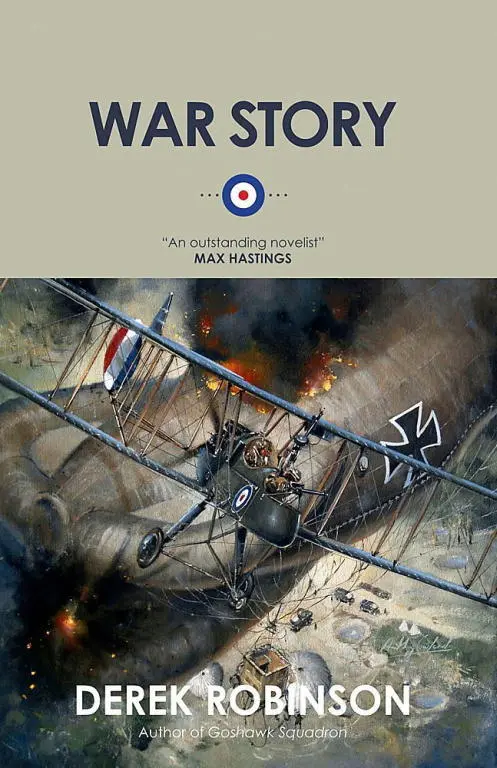
- Название:War Story
- Автор:
- Издательство:Quercus
- Жанр:
- Год:2011
- Город:London
- ISBN:978-0-857388-483-0
- Рейтинг книги:4 / 5. Голосов: 1
-
Избранное:Добавить в избранное
- Отзывы:
-
Ваша оценка:
War Story: краткое содержание, описание и аннотация
Предлагаем к чтению аннотацию, описание, краткое содержание или предисловие (зависит от того, что написал сам автор книги «War Story»). Если вы не нашли необходимую информацию о книге — напишите в комментариях, мы постараемся отыскать её.
Five days later, he crash-lands at his destination, having lost his map, his ballast and every single plane in his charge. To his C.O. he’s an idiot, to everyone else—especially the tormenting Australian who shares his billet—a pompous bastard.
This is 1916, the year of the Somme, giving Paxton precious little time to grow from innocent to veteran.
War Story — читать онлайн бесплатно полную книгу (весь текст) целиком
Ниже представлен текст книги, разбитый по страницам. Система сохранения места последней прочитанной страницы, позволяет с удобством читать онлайн бесплатно книгу «War Story», без необходимости каждый раз заново искать на чём Вы остановились. Поставьте закладку, и сможете в любой момент перейти на страницу, на которой закончили чтение.
Интервал:
Закладка:
“Look on the bright side, Frank. Lots of lovely promotion waiting for chaps like you.”
Foster aimed the splinter like a dart and tossed it across the room. “Stupid and blind,” he said. “I thought I’d never cop it. Other people go west. Not me. Now I know better. Or worse.”
“Oh, tosh!” Cleve-Cutler said. “Your chances improve with experience, everyone knows—”
“Flamer,” Foster said. “I’ll be a flamer. Quite soon.”
“Bet you won’t. Week’s pay. How’s that, Frank?”
“It’s bound to happen.” Foster made a sour face. “Doesn’t matter.”
“It matters to me. I need you.”
Foster stood up and drank the whisky. “Incredibly stupid,” he said, and went out.
Nothing was heard from the French about Foster’s revenge. It was assumed that the incident was closed. Brazier told Cleve-Cutler of an occasion late in 1914 when English artillery had accidentally dropped a few shells on a French position. Before the French protest could be translated the same number of French shells had fallen among English troops. “Nothing left to be said, after that,” Brazier remarked. “Or written. I gave our gunners a damn good rollicking but you won’t find a whisper of it in the regimental history. Now then: what d’you want me to enter in the squadron diary regarding the loss of Yeo and his observer?”
“Killed while attacking an enemy balloon,” Cleve-Cutler said. “You might chuck in a ‘gallantly’. That never did any harm.”
“And Foster’s business?”
“Exactly. It’s Foster’s business. Nothing to do with us.”
Nevertheless, Cleve-Cutler knew that Foster’s state of mind was something he could not ignore. The man still did his job well but off-duty he could be touchy and unpredictable. Sometimes he was as debonair as ever; at other times he laughed when there was no joke to laugh at; and once or twice he withdrew into a kind of frozen silence while conversation went on around him.
“You know him better than I do,” Cleve-Cutler said to Piggott. “Have a quiet word with him.”
Piggott had a chance for a quiet word when he found Foster sitting alone at the end of the bar, holding a fly-swat. He seemed to be in a cheerful mood. “See that fly, Tim?” he said. At least a dozen flies were circling nearby. “That one on the left… No, it’s in the middle now… There he goes… I’m going to kill that fly, Tim. Sooner or later he’ll wander over here and then…” Foster demonstrated a brisk swat, and smiled. “One dead fly.”
“I see.” Piggott got himself a bar stool. “Does it have to be that particular fly?”
He had asked the wrong question. All Foster’s cheerfulness faded away. He looked saddened and weary. “Probably not,” he said. “I suppose one dead fly is worth just as much as another. What’s the price of a dead fly nowadays? About a thousand pounds, isn’t it?”
Piggott was baffled, but he decided to go along with what might turn out to be an elaborate joke. “It depends who’s buying,” he said.
Foster got off his stool, thrashed about with the swat, and drove all the flies away. “They’ll be back in two minutes,” he said,”so I don’t see the point of it all. Do you?”
“Maybe there isn’t a point.” Piggott’s threshold of tolerance for foolishness was low and he had almost reached it. “Listen, Frank,” he said, “we’re all as cheesed-off as you are about what that murdering frog did.”
Foster frowned hard. “I don’t follow you, Tim.”
“That awful business with Yeo.”
“Oh, that.” Foster tossed his fly-swat in the air and deftly caught it. “Doesn’t matter.”
Cleve-Cutler listened to Tim’s report. “Oh well,” he said,”he’ll get over it, I expect. Whatever it is.”
Chapter 13
All the FEs were up on patrol. Kellaway had gone to hospital to have his head examined. The aerodrome was dull. For ten minutes Paxton threw an old tennis ball for Brutus to chase. Then he went to the adjutant and asked permission to go to Amiens for a haircut. “Get me some decent ink while you’re there,” Brazier said. “This Army stuff’s like gnat’s piss.”
A wagon was leaving the transport section. Paxton waved it down. Corporal Lacey was driving. “I have a few calls to make en route,” Lacey said as Paxton got in. The cab was stacked with boxes of Havana-Havanas. “I want to collect some new old furniture to replace the old old furniture in your mess, for instance.”
“Sorry about that. Childish way to behave. Mindless destruction.”
“Do you think so? I’m surprised. The apparent vandalism of squadron parties and mess nights is squarely in the Western tradition of emotional relief through the exercise of seemingly primitive orgies of self-indulgence which are actually very tightly contained.”
“Tightly contained?” Paxton scoffed. “Don’t talk rot. We smashed everything in sight.”
“Exactly. Everything in sight in the mess. It was like Carnival, or Mardi Gras, or New Year’s Eve in Glasgow. A beano as an essential corrective to the restraints and restrictions of the rest of the year. With all due respect to the Duke of Wellington, the battle of Waterloo was not won on the playing-fields of Eton. It was won in the shambles and wreckage of the Fourth of June celebrations, when the Old Etonians proved they were as happily violent as any, and far more so than most.”
“Tosh,” Paxton said. It wasn’t an adequate answer, but Lacey engaged the clutch and revved the engine and after that it was too noisy to talk.
They drove over washboard pavé and rutted side roads and potholed farm tracks, calling on depots where stores were heaped in small pyramids of boxes that could be seen a mile away. Sometimes Lacey stopped at the main entrance; more often he went to the back and talked to a shirt-sleeved NCO who lived in a small guard hut with a large guard dog. Cigars changed hands; goods were loaded into the wagon: timber, carpet, drums of olive oil, bits of plumbing, rolls of canvas, a cinema projector, much furniture, a piano, a hip-bath, and more that was hidden inside wooden crates. He also collected items at military storehouses in requisitioned barns and farms. There were so many stops that Paxton lost interest until he saw Lacey and a sergeant discussing a cow. Lacey didn’t take the cow but he did come away with a box of live hens. “What’s wrong with the cow?” Paxton asked, sarcastically. “Too heavy?” “Too pregnant,” Lacey said.
At last they drove into Amiens. Occasional gaps in the streets showed where bombs, or perhaps long-range shells, had fallen, but the town was full of life, most of it in khaki and all of it with francs to spend. Lacey trundled through the centre, pointing out the good places and the bad. “That’s the only shop to go to for handkerchiefs… This little restaurant on the corner is very sound on fish… I can’t recommend that café unless you’re desperate for company… Stay away from them , they’re so overpriced it’s quite criminal… Excellent pâté here…” Eventually he ran out of shops and increased speed.
“Where are you going?” Paxton complained. “I came here to get a haircut, you fool.”
Lacey stopped the wagon. “Surely you don’t want to have your hair cut back there , do you?” he asked. “They’re all barbarians. I wouldn’t let them cut the grass. I assumed you would want to go to the place that I go to.” For a moment they stared at each other. “It’s tucked away behind l’église St.-Jacques,” he said. “It’s called Leroux Frères.”
“You’re M.N.T. Lacey,” Paxton said in a voice that was not much more than a whisper. “You played Hamlet in the school play.”
Читать дальшеИнтервал:
Закладка:
Похожие книги на «War Story»
Представляем Вашему вниманию похожие книги на «War Story» списком для выбора. Мы отобрали схожую по названию и смыслу литературу в надежде предоставить читателям больше вариантов отыскать новые, интересные, ещё непрочитанные произведения.


Обсуждение, отзывы о книге «War Story» и просто собственные мнения читателей. Оставьте ваши комментарии, напишите, что Вы думаете о произведении, его смысле или главных героях. Укажите что конкретно понравилось, а что нет, и почему Вы так считаете.