Derek Robinson - War Story
Здесь есть возможность читать онлайн «Derek Robinson - War Story» весь текст электронной книги совершенно бесплатно (целиком полную версию без сокращений). В некоторых случаях можно слушать аудио, скачать через торрент в формате fb2 и присутствует краткое содержание. Город: London, Год выпуска: 2011, ISBN: 2011, Издательство: Quercus, Жанр: Историческая проза, prose_military, на английском языке. Описание произведения, (предисловие) а так же отзывы посетителей доступны на портале библиотеки ЛибКат.
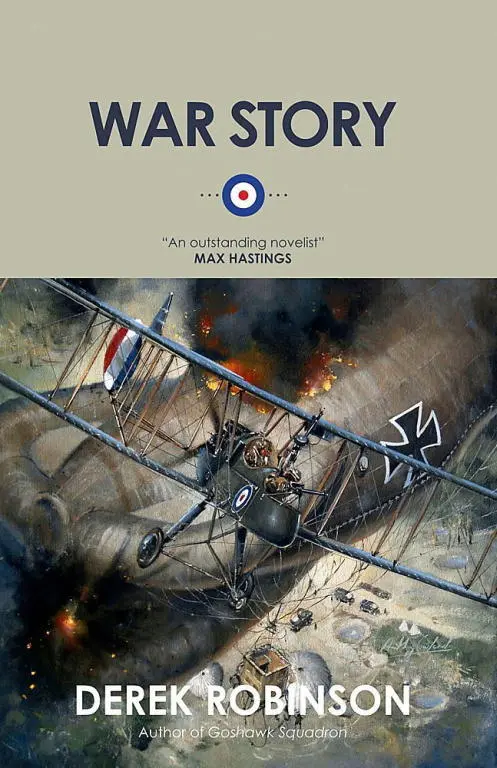
- Название:War Story
- Автор:
- Издательство:Quercus
- Жанр:
- Год:2011
- Город:London
- ISBN:978-0-857388-483-0
- Рейтинг книги:4 / 5. Голосов: 1
-
Избранное:Добавить в избранное
- Отзывы:
-
Ваша оценка:
War Story: краткое содержание, описание и аннотация
Предлагаем к чтению аннотацию, описание, краткое содержание или предисловие (зависит от того, что написал сам автор книги «War Story»). Если вы не нашли необходимую информацию о книге — напишите в комментариях, мы постараемся отыскать её.
Five days later, he crash-lands at his destination, having lost his map, his ballast and every single plane in his charge. To his C.O. he’s an idiot, to everyone else—especially the tormenting Australian who shares his billet—a pompous bastard.
This is 1916, the year of the Somme, giving Paxton precious little time to grow from innocent to veteran.
War Story — читать онлайн бесплатно полную книгу (весь текст) целиком
Ниже представлен текст книги, разбитый по страницам. Система сохранения места последней прочитанной страницы, позволяет с удобством читать онлайн бесплатно книгу «War Story», без необходимости каждый раз заново искать на чём Вы остановились. Поставьте закладку, и сможете в любой момент перейти на страницу, на которой закончили чтение.
Интервал:
Закладка:
Everyone chatted to him; he chatted to everyone. Judy ordered apple pie for him, and it was a revelation: sweet and tangy, crisp and flaky. Apple pie at Sherborne had been stodge in stodge. How right he had been to leave school! He could easily eat another piece of apple pie but he wasn’t sure if that was the done thing. In any case she took his hand, and squeezed it, and said, “Now you’re going to protect me against all these hulking great thugs, aren’t you, David?”
“But of course.” He felt like St. George with a freshly ground and sharpened sword.
She took his arm as they all trooped out. He realised that nobody had paid. Money didn’t seem to matter to these people; this was a refreshing, exhilarating experience; an introduction to a higher level of living. He cocked an eyebrow at the smiling head waiter as they went by. The man saw it, and cocked an eyebrow in return.
Two chauffeur-driven Buick limousines were waiting. They drove out of Amiens to the west, quite fast. “This must seem awfully slow to you,” she said. She had an appealing way of drawling one word in a sentence; apart from that her voice was light and only faintly tinged with Irish. At first, when he saw that elfin face, he had assumed she was delicately built, even fragile, but now he saw that she was slim unfashionably slender, in fact – but very well put together. Jolly nice legs, and a jolly good chest, or whatever it was that girls called it. “I’m just glad to be alive,” he said. She opened her eyes wide. “Death by starvation,” he said. “Deadly dreary.” She laughed, and imitated his clipped style: “Deadly dreary,” and laughed again, all of which made him feel good. “Want to play a little tennis?” she said.
They were passing some grass courts. Beyond them a lake glittered in the sunshine, with a wooded hill overlooking it and part of a big, honey-coloured house visible through the trees. “Don’t you lose a lot of tennis balls in the lake?” he asked.
“Hundreds!” she said with a childlike gusto. “Thousands!”
Jimmy Duncan knew he’d already killed the gunner of the Aviatik when he saw a red streak shimmering along its side. That was during the third attack, when he fired two short bursts but the German pilot jinked so hard that Duncan missed with both; however, there was no return fire and he saw the long streak behind the rear cockpit. It stood out against the Aviatik’s camouflage, a pattern of green and yellow cubes, like expensive gift-wrapping. Maybe a bullet had nicked an artery. If the gunner wasn’t dead he was dying fast: Jimmy Duncan knew that for sure. Now was the time to get in really close and blow the Aviatik to bits. Now. Fast.
Frank O’Neill wasn’t so sure. He hadn’t noticed the blood and he thought maybe the gunner was reloading, or clearing a stoppage. Rush in now and he might pop up and make holes in them both. Besides, there might be another machine lurking high above, in the sun. It was a dazzling afternoon and he couldn’t search that part of the sky but something in his gut said somebody was up there. They were three miles on the wrong side of the Lines and they’d been bloody lucky to catch the Aviatik, so lucky that he wondered whether it was a decoy and he was about to be jumped from a great height. It was late in their second patrol of the day and O’Neill was tired.
On the other hand the Aviatik was slow and probably damaged. It couldn’t get away. It should be an easy kill.
He flew the FE parallel to the Aviatik, just outside the range of its gun, and tried to squint up into the semi-glare around the blinding disc of the sun. Splinters of light danced in his eyes until they were lost in the wash of tears.
“I got the gunner,” Duncan bawled. He was kneeling on his seat and facing O’Neill. “Gunner’s dead.”
“Says you,” O’Neill shouted.
“Let’s go, let’s get the bugger.” Duncan tried to reach into O’Neill’s cockpit and grab the joystick. “He’s mine, I want him.”
O’Neill batted his hand away. “Okay!” he shouted. “Sit down, for Christ’s sake!” If Duncan had knocked the joystick he might have been thrown out. It was a measure of Duncan’s hunger for a kill after dozens of barren patrols.
Duncan sat. O’Neill nudged the throttle forward and eased the joystick across. The horizon swung like a seesaw. A touch of rudder brought the nose around until the Aviatik was dead ahead, chugging along, pouring smoke from its upright exhaust, its pilot praying for rescue, or a cloud, or a miracle. When it was obvious that none of those was going to appear he despaired and stuck his nose down.
To dive was the only thing left to do and also the worst thing to do. The FE could outdive an Aviatik, which meant that O’Neill would catch him, and when he did the German pilot would no longer be so free to jink and dodge and swerve. On the other hand it could be dangerous down there. German ground fire was notoriously lethal. All these thoughts chased each other through O’Neill’s mind when it was already too late. The FE was howling and vibrating as its dive steepened.
He caught the Aviatik after they had fallen about a thousand feet, and the strain on the German plane’s wings was such that O’Neill could see them fluttering and distorting. If his FE was doing the same he didn’t want to know, so he didn’t look behind him. He manoeuvred so as to give Duncan a slightly upward shot. When the Aviatik exploded or fell to pieces he wanted to be out of the way. They were four lengths apart. France lay in front like a map. Duncan fired. Every third shot was a tracer. His bullets went skimming over the Aviatik’s top wing. He adjusted his aim and fired again. The Lewis gun jammed.
Duncan had never before cleared a jam when he was hanging in a dive with a hurricane battering at his arms. The Lewis often jammed; he knew just what to do; but it demanded strength and skill to force the gun to reject the faulty round wedged in its breech, and then to accept a fresh round, properly cocked, while the FE rocked and shuddered. This jam was a bad one. Duncan heaved and thumped until in the end he had to fumble under his seat for the leather mallet and give the gun an almighty wallop, and then another. The third bash did the trick. He gasped for breath and relaxed. The FE lurched, and the mallet swung and knocked the ammunition drum off the top of the gun. He grabbed and missed. The drum bounced off his chest and vanished. Fear made him shout: that drum could have smashed their propeller! Maybe it sailed wide. Maybe it went clean through the disc. What difference? By the time he had unclipped a spare drum and banged it into place the dive was over. Duncan looked up and saw trees higher than his head. O’Neill was chasing the Aviatik up a valley.
The German was dipping and rising, working hard at making himself a poor target, but the valley was narrowing and O’Neill was steadily gaining. Duncan fired a couple of short bursts. The Aviatik seemed to stagger. It dropped until its wheels were parting the tall grass. O’Neill held the FE steady to give Duncan a good, final, downward shot. Both men were looking at the Aviatik. Neither of them saw the telegraph wire strung across the valley. It took Duncan’s head off as cleanly as a grocer cutting cheese and then it snapped. O’Neill felt the FE shudder. At first he thought a cylinder had blown, but the engine note sounded true. Duncan wasn’t firing. Why the hell wasn’t Duncan firing? Another jam? O’Neill half stood and looked down into the front cockpit. Duncan’s body was flopping about and blood was jetting out. The body flopped again and O’Neill got a hot squirt in the face. He sat down and hauled the joystick into his stomach and spat. As the FE climbed away, below it and behind, the Aviatik came to rest with its tail in the air.
Читать дальшеИнтервал:
Закладка:
Похожие книги на «War Story»
Представляем Вашему вниманию похожие книги на «War Story» списком для выбора. Мы отобрали схожую по названию и смыслу литературу в надежде предоставить читателям больше вариантов отыскать новые, интересные, ещё непрочитанные произведения.




Обсуждение, отзывы о книге «War Story» и просто собственные мнения читателей. Оставьте ваши комментарии, напишите, что Вы думаете о произведении, его смысле или главных героях. Укажите что конкретно понравилось, а что нет, и почему Вы так считаете.