Derek Robinson - War Story
Здесь есть возможность читать онлайн «Derek Robinson - War Story» весь текст электронной книги совершенно бесплатно (целиком полную версию без сокращений). В некоторых случаях можно слушать аудио, скачать через торрент в формате fb2 и присутствует краткое содержание. Город: London, Год выпуска: 2011, ISBN: 2011, Издательство: Quercus, Жанр: Историческая проза, prose_military, на английском языке. Описание произведения, (предисловие) а так же отзывы посетителей доступны на портале библиотеки ЛибКат.
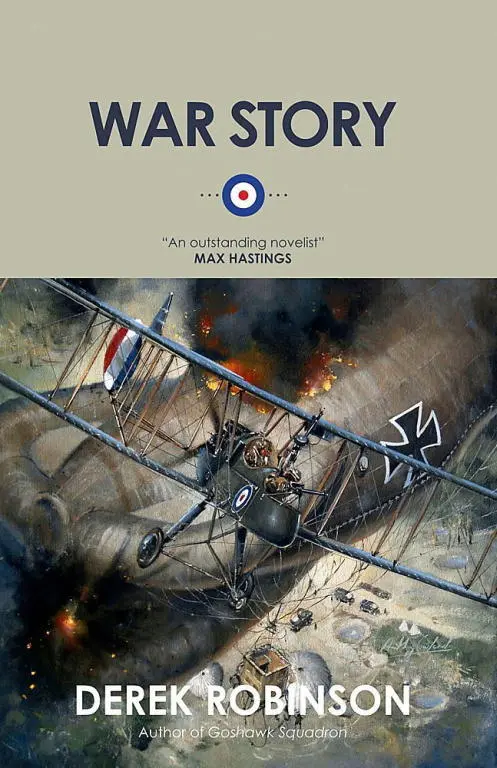
- Название:War Story
- Автор:
- Издательство:Quercus
- Жанр:
- Год:2011
- Город:London
- ISBN:978-0-857388-483-0
- Рейтинг книги:4 / 5. Голосов: 1
-
Избранное:Добавить в избранное
- Отзывы:
-
Ваша оценка:
War Story: краткое содержание, описание и аннотация
Предлагаем к чтению аннотацию, описание, краткое содержание или предисловие (зависит от того, что написал сам автор книги «War Story»). Если вы не нашли необходимую информацию о книге — напишите в комментариях, мы постараемся отыскать её.
Five days later, he crash-lands at his destination, having lost his map, his ballast and every single plane in his charge. To his C.O. he’s an idiot, to everyone else—especially the tormenting Australian who shares his billet—a pompous bastard.
This is 1916, the year of the Somme, giving Paxton precious little time to grow from innocent to veteran.
War Story — читать онлайн бесплатно полную книгу (весь текст) целиком
Ниже представлен текст книги, разбитый по страницам. Система сохранения места последней прочитанной страницы, позволяет с удобством читать онлайн бесплатно книгу «War Story», без необходимости каждый раз заново искать на чём Вы остановились. Поставьте закладку, и сможете в любой момент перейти на страницу, на которой закончили чтение.
Интервал:
Закладка:
“No.”
“How to lose ten ugly pounds at a stroke: volunteer to be O’Neill’s observer.” Kellaway giggled. “Get it?”
Paxton turned and went out. He took his binoculars from O’Neill’s bedside and walked to the far end of the aerodrome where there was an oak tree he could climb. It was dusk, and he watched the starshells and flares and coloured rockets to the east. Sometimes, when he was lucky, he saw the actual flash of guns. It was magical and beautiful, thrilling and manly. It made him feel cleaner and stronger.
Chapter 14
Breakfast before a dawn patrol was always hard-boiled eggs and tea. Nobody liked the eggs but they were better than nothing. After an hour of O’Neill’s aerobatics Paxton’s stomach held nothing and his mind was full of murder.
Tim Piggott’s briefing had needed very few words; it was obvious to Paxton that everyone knew the drill. Dawn patrols were freelance affairs: the British artillery was still in bed, so there were no shoots to cover, and the light wasn’t good enough for photo-reconnaissance. Hornet squadron was going over to show the flag, to remind fritz how inferior he was. O’Neill’s words to Paxton were even briefer. “Puke on your boots,” he said,”not on me.”
They were a mile up and two miles over when he began throwing the FE about. At first he swung in and out of a series of tight bends as if swerving past obstacles, wings tipped almost to the vertical. Paxton quite enjoyed that. O’Neill levelled out. Paxton turned to look at him and as he did, O’Neill stuffed the nose down hard and Paxton whacked his face against the back of the cockpit. He was still struggling to get back in his seat when the dive abruptly bottomed out and became a climb. His breakfast began to come loose. O’Neill stalled at the top and Paxton braced himself as the FE toppled sideways and threatened to fall on its back. A frighteningly long sideslip grew into another dive. The rush of air tore at Paxton’s bloody face. His goggles had been knocked upwards and the gale made him weep. He never saw how the dive ended; all he saw was a small cloud dead ahead that was rotating rapidly, clockwise. Then the machine smashed into the cloud and bounced like a rubber ball and came out into sunshine with the Earth hanging sideways from the sky and Paxton hanging desperately in his straps while boiled eggs and tea fought to get out of his mouth. After that O’Neill began attempting some quite ambitious stunts.
The adjutant doubled as intelligence officer. When they landed he took their report. “Nothing much,” O’Neill said. “One stroppy little Fokker tried to jump us. He wasn’t very good. Soon got fed up.”
Brazier looked at Paxton. “Did you damage him?”
“No.” He peeled a bit of dried vomit off his chin. “No, he was always behind us, wasn’t he?”
“Not always.”
“And it wasn’t a Fokker, it was an Albatros. Two Albatroses.”
Brazier crossed out what he’d written.
“Fokker,” O’Neill said. “One Fokker.”
“Make up your ruddy minds.”
“I observed two Albatroses,” Paxton said,”and I should know because I’m the observer.”
Brazier grunted, and wrote some more. “Where’s that black ink you said you were going to get me?”
Paxton had completely forgotten about it. “They were sold out,” he said. The adjutant sniffed disbelief. “Everyone’s been buying it,” Paxton said. “The stuff the Army issues is like gnat’s piss.”
The afternoon patrol was similar but worse. Paxton lost his lunch, bruised his elbows and knees and bloodied his nose. O’Neill told Brazier the German archie had been bad, so he’d dodged about a bit. “Anything to add?” Brazier asked. Paxton shook his head. The archie had been quite light but he hadn’t the strength to get into an argument. Instead he stared at the thick growth of hair sprouting from the adjutant’s nostrils. How ugly. How insanitary.
O’Neill whistled his aimless, dreary whistle as they walked to their billet. Eventually Paxton recognised the tune through the wreckage: it was Jesu Joy of Man’s Desiring. Once, Paxton had told Kellaway that it was his favourite piece of music. That was why O’Neill was murdering it, of course.
“I say, you do look grim,” Kellaway remarked. “Pale, too.”
“I offered to lend him my rouge,” O’Neill said, flat as mud,“but he’s very fussy about these things.”
Paxton had a bath and slept for an hour. When he awoke the others had gone. He went outside. The air smelt marvellously fresh, as if he had convalesced for a week. What he wanted above all was tea, hot sweet tea. The mess would have people in it. He went instead to the Orderly Room. Corporal Lacey had a Mozart piano concerto on the gramophone. He reached to turn it off but Paxton shook his head and sat down. Lacey got on with his work. Mozart got on with his genius. The piano duelled brilliantly and courteously with the orchestra and won a fair fight. Silence. Paxton sighed and pointed to the kettle. Lacey made tea. Next door the clerk-typists began pecking.
“I hear you met Mrs. Kent Haffner,” Lacey said. “A very spirited young lady.”
“That seems like a month ago.” Paxton warmed his hands on the half-pint mug. He could feel the tea reviving him. “How do you know her?”
Lacey smiled. “Just chance. I understand you have another uncle who owns a company that makes gramophone records. Why don’t you write to him? Jazz, ragtime, songs from the London shows.”
“Cigars aren’t good enough?”
“Not always. With a supply of records I could get two cows and fifty hens. Fresh milk and eggs for the mess.”
Paxton looked at him. Lacey’s feet were on his desk and his hands were linked behind his head. “I can’t help thinking you should be an officer,” Paxton said.
“I probably should. I don’t want to be an officer. I’ve never wanted to be an officer. War seems to me to be a very silly affair. I can’t see the glory in killing people, still less in being killed.”
“But you joined the Army.”
“Well, I decided I’d better do what I wanted to do before somebody else ordered me to do what I disliked intensely. You see, I never believed that this would be a short war. It was obvious when war broke out that everyone wanted it and was thoroughly pleased with it. They weren’t going to let go of it in a hurry. On the other hand, if it did last a long time, I might get conscripted and sent to stick bayonets in Germans, or, even worse, made to lead other men with bayonets. So I took a course in shorthand and typing. Then I joined up. A man who can type fast and accurately and do shorthand is like gold in the Army. Ask the adjutant. Such a man is never going to be put in the trenches. Nor is he ever going to be pushed into a commission. So here I am, utterly indispensable. What more can a man do for his country?”
Paxton got up and went to the door. He threw the dregs of his tea onto the grass. “He can die,” he said.
“Oh, anyone can die. It takes no great skill to die. No skill at all, in fact. Thoroughly unqualified people do it all the time. Personally, I reckon that dying has been highly overrated. I blame the newspapers.”
Paxton returned his mug. “Thanks for the tea,” he said. “No thanks for the philosophy.”
Hornet Squadron was pleased with itself that night. During the afternoon, Plug Gerrish had found a Halberstadt twoseater and stalked it for twenty minutes until he crept under its tail and Ross, his observer, killed the pilot with a burst of only seven bullets. This was the squadron’s first confirmed kill since Milne’s ramming (which didn’t really count) and it was regarded as a change of luck. Then Goss and Stubbs had come across a German balloon stuck high in the sky. It must have had trouble down below, a jammed winch or something, because they were able to fly right up to it. At first the archie was furious but when the two German observers took to their parachutes the risk of harming their own men silenced the guns long enough to let Stubbs pump tracer and incendiary into the big bag, which burned like a beacon. So it was a happy day. Dinner in the mess was loud with triumph. The air criss-crossed with flying bread.
Читать дальшеИнтервал:
Закладка:
Похожие книги на «War Story»
Представляем Вашему вниманию похожие книги на «War Story» списком для выбора. Мы отобрали схожую по названию и смыслу литературу в надежде предоставить читателям больше вариантов отыскать новые, интересные, ещё непрочитанные произведения.


Обсуждение, отзывы о книге «War Story» и просто собственные мнения читателей. Оставьте ваши комментарии, напишите, что Вы думаете о произведении, его смысле или главных героях. Укажите что конкретно понравилось, а что нет, и почему Вы так считаете.