Derek Robinson - War Story
Здесь есть возможность читать онлайн «Derek Robinson - War Story» весь текст электронной книги совершенно бесплатно (целиком полную версию без сокращений). В некоторых случаях можно слушать аудио, скачать через торрент в формате fb2 и присутствует краткое содержание. Город: London, Год выпуска: 2011, ISBN: 2011, Издательство: Quercus, Жанр: Историческая проза, prose_military, на английском языке. Описание произведения, (предисловие) а так же отзывы посетителей доступны на портале библиотеки ЛибКат.
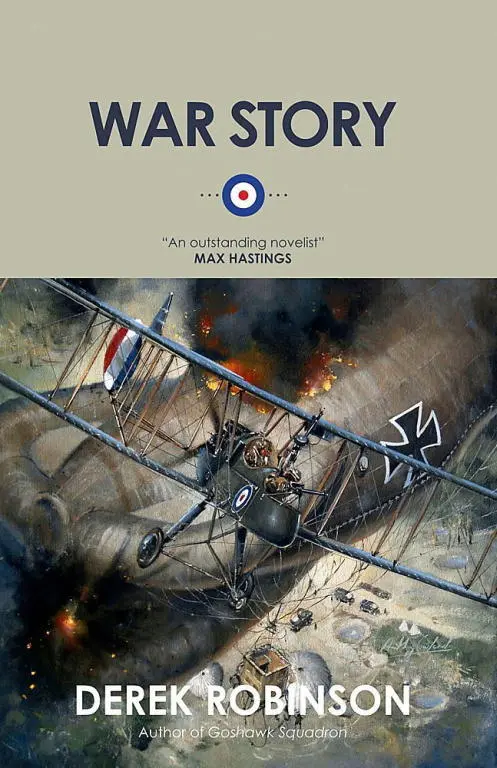
- Название:War Story
- Автор:
- Издательство:Quercus
- Жанр:
- Год:2011
- Город:London
- ISBN:978-0-857388-483-0
- Рейтинг книги:4 / 5. Голосов: 1
-
Избранное:Добавить в избранное
- Отзывы:
-
Ваша оценка:
War Story: краткое содержание, описание и аннотация
Предлагаем к чтению аннотацию, описание, краткое содержание или предисловие (зависит от того, что написал сам автор книги «War Story»). Если вы не нашли необходимую информацию о книге — напишите в комментариях, мы постараемся отыскать её.
Five days later, he crash-lands at his destination, having lost his map, his ballast and every single plane in his charge. To his C.O. he’s an idiot, to everyone else—especially the tormenting Australian who shares his billet—a pompous bastard.
This is 1916, the year of the Somme, giving Paxton precious little time to grow from innocent to veteran.
War Story — читать онлайн бесплатно полную книгу (весь текст) целиком
Ниже представлен текст книги, разбитый по страницам. Система сохранения места последней прочитанной страницы, позволяет с удобством читать онлайн бесплатно книгу «War Story», без необходимости каждый раз заново искать на чём Вы остановились. Поставьте закладку, и сможете в любой момент перейти на страницу, на которой закончили чтение.
Интервал:
Закладка:
“Yes. I thought you knew.”
“You were years and years ahead of me. I was just a kid. In fact you must have been in your last year when I was in my first.”
“Probably.”
“And the moustache… It completely changes your face.”
“I recognised you immediately. But then, yours is a much smaller moustache.”
Paxton looked away. “You were a prefect,” he said. “You beat me, once.”
“Did I? Why?”
“For fighting.”
“Ah. And did the beating hurt?”
“Not much.”
“No. My heart wasn’t in it, even in those days.”
They drove to Leroux Frères. From the outside it could have been mistaken for a town house. A very old man opened the door and silently took their hats and Paxton’s cane. The place smelled faintly of sandalwood soap. He led them to a room that was all marble and mahogany except for a pair of barber’s chairs placed back to back. Two men, black-suited, grey-haired and silent, helped them out of their tunics and into the chairs. These, Paxton thought, must be the famous frères. His mind was still fluttering around the discovery that Lacey was an old boy of Sherborne. “Um…” he said. “Je voudrais que vous … um…”
“Don’t bother,” said Lacey from the other chair. “They know what’s best for you.”
Paxton gave up. It was all too much. A hot towel was wrapped around his face below the eyes and the chair smoothly reclined. He found himself looking at the ceiling. It was covered in frescoes, skilfully drawn and delicately coloured and so erotic that his stomach muscles jumped like hot chestnuts. A small gathering of men and women, none with clothes on and all splendidly athletic, were doing amazing things to one another as if it were all great fun. There seemed to be some kind of sequence to the pictures. One led to another. Heavens above! Paxton’s eyeballs rolled around in their sockets while the scissors snipped.
When he was back on his feet and in his tunic, nicely brushed down and buttoned up, he suddenly remembered the need to pay. “Don’t bother,” Lacey said before Paxton could reach his francs. “I have an arrangement.” Lacey shook hands with the man who had cut his hair. Paxton did likewise. The very old man showed them out. Fancy shaking hands with your barber , Paxton thought. No wonder the frogs are in such a pickle.
“Quite a decent haircut,” he said.
“Thank you.”
Paxton jutted his chin. He felt in danger of being patronised. “Mind you, I’m not sure I believed it all,” he said.
Lacey looked amused. “These things can always be tested. It’s early in the day, but there are a couple of places you might like to try. For instance…”
“No.” Paxton felt his face going red. “No thanks. Lunch is what I need.”
Lacey drove him to a serious-looking hotel called Voyageurs. “Their terrine de canard is not to be despised,” he said.
“Aren’t you coming in?”
“It’s officers only. I wear mufti when I come here. Feel free to mention my name. I shall go off to a rude, crude cave and eat half as well as you for a tenth of the price.”
Paxton climbed down and watched the wagon clatter away. He felt suddenly quite lost without Lacey. But that was absurd. Lacey was one of the Other Ranks, while he was Our Trusty and well beloved Oliver Arthur David Paxton, in whom King George reposed especial Trust and Confidence… He looked at Voyageurs , and it seemed even more serious and costly and overwhelming. He breathed deeply and ran up the steps as if he owned the place. When in doubt, get on or get out.
The restaurant took up almost the whole of the ground floor. It was busy; very busy. The head waiter was fussing with a party of staff officers who had just arrived, and when at last he came hurrying over to Paxton his flurry of apologies and welcomes went straight past him to yet another highranking group, all spurs and red tabs, who got steered to an empty table. Paxton felt exposed and ignored. The head waiter eventually found time for him, took the news that he was alone with tightened lips, and did a lot of muttering and standing on tiptoe before he found him a small table in a dim corner and disappeared.
The menu was as long as a short story, and Paxton understood about six words of it. He couldn’t see terrine de canard anywhere. He began to loathe Lacey.
Waiters hurried by, blinkered in their devotion to duty to others, until he lost patience and tried to stop one. Total failure. The man shrugged, said something in the usual gabbling gibberish and laughed, actually laughed as he went away. Paxton sat and steamed. He was helpless. He hated being helpless. He hated these arrogant frog waiters and these fat and greedy colonels and brigadiers. He was hungry. Ravenous. And still nobody came.
When he had lost all hope, and given up, a waiter did actually arrive. He placed a tulip-shaped glass of champagne in front of Paxton. Beside the glass he placed a card. Then he stood back and waited.
Paxton tasted the champagne and drank the lot in one go. The card was embossed in gold with the name Judith Kent Haffner. Extraordinary. He looked at the waiter, who shrugged, but then what else could you expect? He turned the card over. Join me before you starve to death. Green ink. Firm, confident handwriting.
There were eight or nine young officers seated at her table in the middle of the room. The oldest was a major in the Royal Sussex with a badly scarred face; he looked about 25. The rest were captains and lieutenants of Paxton’s age or a year or two older. Most wore medal ribbons. It was a noisy, jolly party; everyone was talking and pointing and telling the others to shut up and listen, and failing, and laughing. Judith Kent Haffner was listening and talking and joining in the jokes too, but mainly what she was doing was smiling at Paxton as he followed the waiter. And Paxton, who was not much good at smiling and who fundamentally disapproved of strange women sending him drinks, found himself smiling back. She was not the matron he had expected. She was young and she was startlingly pretty in a way that reminded him of the pictures of girl elves in the fairy stories read to him by his nanny: big eyes, big mouth, shiny black hair cut short and swept forward in twin curls that touched her cheekbones. She reached out a long, slender and almost naked arm and took Paxton’s hand. Her fingers were firm. “Buzz off, Henry,” she said. The cavalry lieutenant sitting at her left immediately got up and cheerfully moved away. A waiter scooped up Henry’s plate and held the chair for Paxton to sit. “You’re one of those golden eagles, aren’t you?” she said. “I can tell from your wings.”
“I potter about the sky occasionally.”
She found that very funny, and he felt flattered. “What’s your name?” she asked.
“Paxton. Oliver Paxton. And you must be Mrs. Haffner.”
“No, no. Everyone calls me Judy. I don’t like Oliver. Haven’t you got another name?”
Paxton didn’t like Arthur. “There’s David.”
“Bring my friend David a lovely steak,” she told a waiter.
His glass was filled with wine. The cavalryman, Henry, had been found a place elsewhere at the table. A steady shuttle of waiters came and went. The only person not eating was Judy. She seemed able to follow half a dozen conversations at once. Occasionally she stroked Paxton’s hand, even tucking her little finger inside his, and when his steak came she watched him eat and she shared in his enjoyment; he looked at her and she made a happy pout, so he sliced the most tender piece of the steak and carefully put it between her lips. She shut her eyes as she ate. For no reason at all he felt a little weak, and drank some more claret.
Читать дальшеИнтервал:
Закладка:
Похожие книги на «War Story»
Представляем Вашему вниманию похожие книги на «War Story» списком для выбора. Мы отобрали схожую по названию и смыслу литературу в надежде предоставить читателям больше вариантов отыскать новые, интересные, ещё непрочитанные произведения.




Обсуждение, отзывы о книге «War Story» и просто собственные мнения читателей. Оставьте ваши комментарии, напишите, что Вы думаете о произведении, его смысле или главных героях. Укажите что конкретно понравилось, а что нет, и почему Вы так считаете.