Ken Follett - World Without End
Здесь есть возможность читать онлайн «Ken Follett - World Without End» весь текст электронной книги совершенно бесплатно (целиком полную версию без сокращений). В некоторых случаях можно слушать аудио, скачать через торрент в формате fb2 и присутствует краткое содержание. Жанр: Историческая проза, на английском языке. Описание произведения, (предисловие) а так же отзывы посетителей доступны на портале библиотеки ЛибКат.
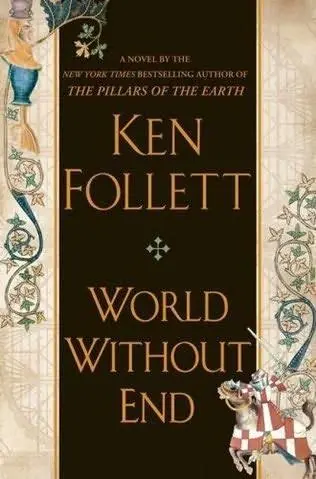
- Название:World Without End
- Автор:
- Жанр:
- Год:неизвестен
- ISBN:нет данных
- Рейтинг книги:5 / 5. Голосов: 1
-
Избранное:Добавить в избранное
- Отзывы:
-
Ваша оценка:
World Without End: краткое содержание, описание и аннотация
Предлагаем к чтению аннотацию, описание, краткое содержание или предисловие (зависит от того, что написал сам автор книги «World Without End»). Если вы не нашли необходимую информацию о книге — напишите в комментариях, мы постараемся отыскать её.
Ken Follett has 90 million readers worldwide. The Pillars of the Earth is his bestselling book of all time. Now, eighteen years after the publication of The Pillars of the Earth, Ken Follett has written the most-anticipated sequel of the year, World Without End.
In 1989 Ken Follett astonished the literary world with The Pillars of the Earth, a sweeping epic novel set in twelfth-century England centered on the building of a cathedral and many of the hundreds of lives it affected. Critics were overwhelmed-"it will hold you, fascinate you, surround you" (Chicago Tribune)-and readers everywhere hoped for a sequel.
World Without End takes place in the same town of Kingsbridge, two centuries after the townspeople finished building the exquisite Gothic cathedral that was at the heart of The Pillars of the Earth. The cathedral and the priory are again at the center of a web of love and hate, greed and pride, ambition and revenge, but this sequel stands on its own. This time the men and women of an extraordinary cast of characters find themselves at a crossroad of new ideas-about medicine, commerce, architecture, and justice. In a world where proponents of the old ways fiercely battle those with progressive minds, the intrigue and tension quickly reach a boiling point against the devastating backdrop of the greatest natural disaster ever to strike the human race-the Black Death.
Three years in the writing, and nearly eighteen years since its predecessor, World Without End breathes new life into the epic historical novel and once again shows that Ken Follett is a masterful author writing at the top of his craft.
World Without End — читать онлайн бесплатно полную книгу (весь текст) целиком
Ниже представлен текст книги, разбитый по страницам. Система сохранения места последней прочитанной страницы, позволяет с удобством читать онлайн бесплатно книгу «World Without End», без необходимости каждый раз заново искать на чём Вы остановились. Поставьте закладку, и сможете в любой момент перейти на страницу, на которой закончили чтение.
Интервал:
Закладка:
She gave Peter the formula and, under her close supervision, he used all her remaining alum to dye twelve yards of best-quality wool cloth in one of his giant vats. When it had been fulled, Caris paid a finisher to draw off the loose threads with a teasel, the prickly head of a wild flower, and to repair small blemishes.
She went to St Giles’s Fair with a bale of perfect bright red cloth.
As she was unrolling it, she was addressed by a man with a London accent. “How much is that?” he said.
She looked at him. His clothes were expensive without being ostentatious, and she guessed he was wealthy but not noble. Trying to mask the trembling in her voice, she said: “Seven shillings a yard. It’s the best-”
“No, I meant how much for the whole cloth.”
“It’s twelve yards, so that would be eighty-four shillings.”
He rubbed the cloth between finger and thumb. “It’s not as close-woven as Italian cloth, but it’s not bad. I’ll give you twenty-seven gold florins.”
The gold coin of Florence was in common use, because England had no gold currency of its own. It was worth about three shillings, thirty-six English silver pennies. The Londoner was offering to buy her entire cloth for only three shillings less than she would get selling it yard by yard. But she sensed that he was not very serious about haggling – otherwise he would have started lower. “No,” she said, marvelling at her own temerity. “I want the full price.”
“All right,” he said immediately, confirming her instinct. She watched, thrilled, as he took out his purse. A moment later she held in her hand twenty-eight gold florins.
She examined one carefully. It was a bit larger than a silver penny. On one side was St John the Baptist, the patron saint of Florence, and on the other the flower of Florence. She placed it on a balance to compare its weight with that of a new-minted florin her father kept for the purpose. The coin was good.
“Thank you,” she said, hardly believing her success.
“I’m Harry Mercer of Cheapside, London,” he said. “My father is the largest cloth merchant in England. When you’ve got more of this scarlet, come to London. We’ll buy as much as you can bring us.”
“Let’s weave it all!” she said to her father when she returned home. “You’ve got forty sacks of wool left. We’ll turn it all into red cloth.”
“It’s a big enterprise,” he said thoughtfully.
Caris was sure her scheme would work. “There are plenty of weavers, and they’re all poor. Peter isn’t the only dyer in Kingsbridge, we can teach the others to use the alum.”
“Others will copy you, once the secret gets out.”
She knew he was right to think of snags, but all the same she felt impatient. “Let them copy,” she said. “They can make money too.”
He was not going to be pushed into anything. “The price will come down if there’s a lot of cloth for sale.”
“It will have to fall a long way before the business becomes unprofitable.”
He nodded. “That’s true. But can you sell that much in Kingsbridge and Shiring? There aren’t that many rich people.”
“Then I’ll take it to London.”
“All right.” He smiled. “You’re so determined. It’s a good plan – but even if it were a bad one, you’d probably make it work.”
She went immediately to Mark Webber’s house and arranged for him to begin work on another sack of wool. She also arranged for Madge to take one of Edmund’s ox-carts and four sacks of wool, and go around neighbouring villages looking for weavers.
But the rest of Caris’s family were not happy. Next day, Alice came to dinner. As they sat down, Petranilla said to Edmund: “Alice and I think you should reconsider your cloth-making project.”
Caris wanted him to tell her that the decision was made and it was too late to go back. But instead he said mildly: “Really? Tell me why.”
“You’ll be risking just about every penny you’ve got, that’s why!”
“Most of it’s at risk now,” he said. “I’ve got a warehouse full of wool that I can’t sell.”
“But you could make a bad situation worse.”
“I’ve decided to take that chance.”
Alice broke in: “It’s not fair on me!”
“Why not?”
“Caris is spending my inheritance!”
His face darkened. “I’m not dead yet,” he said.
Petranilla clamped her mouth shut, recognizing the undertone in his low voice; but Alice did not notice how angry he was, and ploughed on. “We have to think about the future,” she said. “Why should Caris be allowed to spend my birthright?”
“Because it’s not yours yet, and perhaps it never will be.”
“You can’t just throw away money that should come to me.”
“I won’t be told what to do with my money – especially by my children,” he said, and his voice was so taut with anger that even Alice noticed.
More quietly, she said: “I didn’t intend to annoy you.”
He grunted. It was not much of an apology, but he could never remain grumpy for long. “Let’s have dinner and say no more about it,” he said; and Caris knew that her project had survived another day.
After dinner she went to see Peter Dyer, to warn him of the large quantity of work coming his way. “It can’t be done,” he said.
That took her by surprise. He always looked gloomy, but he normally did what she wanted. “Don’t worry, you won’t have to dye it all,” she said. “I’ll give some of the work to others.”
“It’s not the dyeing,” he said. “It’s the fulling.”
“Why?”
“We’re not allowed to full the cloth ourselves. Prior Godwyn has issued a new edict. We have to use the priory’s fulling mill.”
“Well, then, we’ll use it.”
“It’s too slow. The machinery is old, and keeps breaking down. It’s been repaired again and again, so the wood is a mixture of new and old, which never sorts well. It’s no faster than a man treading in a bath of water. But there’s only one mill. It will barely cope with the normal work of Kingsbridge weavers and dyers.”
This was maddening. Surely her whole scheme could not fail because of a stupid ruling by her cousin Godwyn? She said indignantly: “But if the mill can’t do the work, the prior must permit us to tread the cloth by foot!”
Peter shrugged. “Tell him that.”
“I will!”
She marched off towards the priory but, before she got there, she thought again. The hall of the prior’s house was used for his meetings with townspeople, but all the same it would be unusual for a woman to go in alone without an appointment, and Godwyn was increasingly touchy about such things. Moreover, a straight confrontation might not be the best way to change his mind. She realized she would do better to think this through. She returned to her house and sat down with her father in the parlour.
“Young Godwyn is on weak ground here,” Edmund said immediately. “There never was a charge for using the fulling mill. According to legend, it was built by a townsman, Jack Builder, for the great Prior Philip; and, when Jack died, Philip gave the town the right to use the mill in perpetuity.”
“Why did people stop using it?”
“It fell into disrepair, and I think there was an argument about who should pay for its upkeep. The argument was never resolved, and people went back to treading cloth themselves.”
“Why, then, he has no right to charge a fee, nor to force people to use it!”
“No, indeed.”
Edmund sent a message to the priory asking when it might be convenient for Godwyn to see him, and the reply came back saying he was free right away, so Edmund and Caris crossed the street and went to the prior’s house.
Читать дальшеИнтервал:
Закладка:
Похожие книги на «World Without End»
Представляем Вашему вниманию похожие книги на «World Without End» списком для выбора. Мы отобрали схожую по названию и смыслу литературу в надежде предоставить читателям больше вариантов отыскать новые, интересные, ещё непрочитанные произведения.

Обсуждение, отзывы о книге «World Without End» и просто собственные мнения читателей. Оставьте ваши комментарии, напишите, что Вы думаете о произведении, его смысле или главных героях. Укажите что конкретно понравилось, а что нет, и почему Вы так считаете.