Ken Follett - World Without End
Здесь есть возможность читать онлайн «Ken Follett - World Without End» весь текст электронной книги совершенно бесплатно (целиком полную версию без сокращений). В некоторых случаях можно слушать аудио, скачать через торрент в формате fb2 и присутствует краткое содержание. Жанр: Историческая проза, на английском языке. Описание произведения, (предисловие) а так же отзывы посетителей доступны на портале библиотеки ЛибКат.
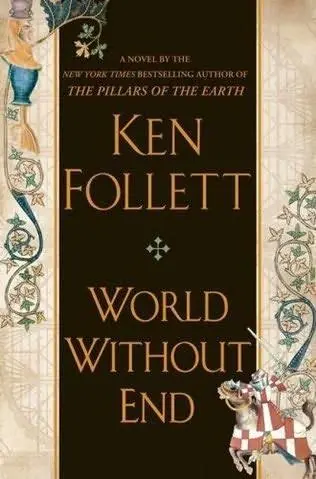
- Название:World Without End
- Автор:
- Жанр:
- Год:неизвестен
- ISBN:нет данных
- Рейтинг книги:5 / 5. Голосов: 1
-
Избранное:Добавить в избранное
- Отзывы:
-
Ваша оценка:
World Without End: краткое содержание, описание и аннотация
Предлагаем к чтению аннотацию, описание, краткое содержание или предисловие (зависит от того, что написал сам автор книги «World Without End»). Если вы не нашли необходимую информацию о книге — напишите в комментариях, мы постараемся отыскать её.
Ken Follett has 90 million readers worldwide. The Pillars of the Earth is his bestselling book of all time. Now, eighteen years after the publication of The Pillars of the Earth, Ken Follett has written the most-anticipated sequel of the year, World Without End.
In 1989 Ken Follett astonished the literary world with The Pillars of the Earth, a sweeping epic novel set in twelfth-century England centered on the building of a cathedral and many of the hundreds of lives it affected. Critics were overwhelmed-"it will hold you, fascinate you, surround you" (Chicago Tribune)-and readers everywhere hoped for a sequel.
World Without End takes place in the same town of Kingsbridge, two centuries after the townspeople finished building the exquisite Gothic cathedral that was at the heart of The Pillars of the Earth. The cathedral and the priory are again at the center of a web of love and hate, greed and pride, ambition and revenge, but this sequel stands on its own. This time the men and women of an extraordinary cast of characters find themselves at a crossroad of new ideas-about medicine, commerce, architecture, and justice. In a world where proponents of the old ways fiercely battle those with progressive minds, the intrigue and tension quickly reach a boiling point against the devastating backdrop of the greatest natural disaster ever to strike the human race-the Black Death.
Three years in the writing, and nearly eighteen years since its predecessor, World Without End breathes new life into the epic historical novel and once again shows that Ken Follett is a masterful author writing at the top of his craft.
World Without End — читать онлайн бесплатно полную книгу (весь текст) целиком
Ниже представлен текст книги, разбитый по страницам. Система сохранения места последней прочитанной страницы, позволяет с удобством читать онлайн бесплатно книгу «World Without End», без необходимости каждый раз заново искать на чём Вы остановились. Поставьте закладку, и сможете в любой момент перейти на страницу, на которой закончили чтение.
Интервал:
Закладка:
“Don’t you understand that the needs of the priory are sacred?” Petranilla said angrily. “The monks serve God! By comparison with that, the lives of the townspeople are insignificant.”
“Is that what your son Godwyn believes?”
“Of course.”
“I was afraid of that.”
“Don’t you believe the prior’s work is sacred?”
Caris had no answer to that, so she just shrugged, and Petranilla looked triumphant.
The dinner was good, but Caris was too tense to eat much. As soon as the others had finished, she said: “I have to go and see Peter Dyer.”
Petranilla protested: “Are you going to spend more? You’ve already given Mark Webber four shillings of your father’s money.”
“Yes – and the cloth is worth twelve shillings more than the wool was, so I’ve made eight shillings.”
“No, you haven’t,” Petranilla said. “You haven’t sold the cloth yet.”
Petranilla was expressing doubts that Caris shared, in her more pessimistic moments, but she was stung into denial. “I will sell it, though – especially if it’s dyed red.”
“And what will Peter charge for dyeing and fulling four narrow dozens?”
“Twenty shillings – but the red cloth will be worth double the brown burel, so we’ll make another twenty-eight shillings.”
“If you sell it. And if you don’t?”
“I’ll sell it.”
Her father intervened. “Let her be,” he said to Petranilla. “I’ve told her she can give this a try.”
Shiring Castle stood on top of a hill. It was the home of the county sheriff. At the foot of the hill stood the gallows. Whenever there was a hanging, the prisoner was brought down from the castle on a cart, to be hanged in front of the church.
The square in which the gallows stood was also the market place. The Shiring Fair was held here, between the guild hall and a large timber building that was the wool exchange. The bishop’s palace and numerous taverns also stood around the square.
This year, because of the troubles at Kingsbridge, there were more stalls than ever, and the fair spilled into the streets off the market place. Edmund had brought forty sacks of wool on ten carts, and could get more brought from Kingsbridge before the end of the week, if necessary.
To Caris’s dismay, it was not necessary. He sold ten sacks on the first day, then nothing until the end of the fair, when he sold another ten by reducing the price below what he had paid. She could not remember seeing him so down.
She put her four lengths of dull brownish-red cloth on his stall and, over the week, yard by yard, she sold three of the four. “Look at it this way,” she said to her father on the last day of the fair. “Before, you had a sack of unsaleable wool and four shillings. Now, you’ve got thirty-six shillings and a length of cloth.”
But her cheerfulness was only for his benefit. She was deeply depressed. She had boasted bravely that she could sell cloth. The result was not a complete failure, but it was no triumph. If she could not sell the cloth for more than it cost, then she did not have the solution to the problem. What was she going to do? She left the stall and went to survey other cloth sellers.
The best cloth came from Italy, as always. Caris stopped at the stall of Loro Fiorentino. Cloth merchants such as Loro were not wool buyers, though they often worked closely with buyers. Caris knew that Loro gave his English takings to Buonaventura, who used it to pay English merchants for their raw wool. Then, when the wool reached Florence, Buonaventura’s family would sell it, and with the proceeds pay back Loro’s family. That way, they all avoided the hazards of transporting barrels of gold and silver coins across Europe.
Loro had on his stall only two rolls of cloth, but the colours were much brighter than anything the local people could produce. “Is this all you brought?” Caris asked him.
“Of course not. I’ve sold the rest.”
She was surprised. “Everyone else is having a bad fair.”
He shrugged. “The finest cloth always sells.”
An idea was taking shape in Caris’s head. “How much is the scarlet?”
“Only seven shillings per yard, mistress.”
That was seven times the price of burel. “But who can afford it?”
“The bishop took a lot of my red, Lady Philippa some blue and green, a few daughters of the brewers and bakers in town, some lords and ladies from the villages round about… Even when times are hard, someone is prospering. This vermilion will be so beautiful on you.” With a swift motion, he unrolled the bale and draped a length over Caris’s shoulder. “Marvellous. See how everyone is looking at you already.”
She smiled. “I can see why you sell so much.” She handled the cloth. It was closely woven. She already had a cloak of Italian scarlet, the one that she had inherited from her mother. It was her favourite garment. “What dye do they use to get this red?”
“Madder, the same as everyone.”
“But how do they make it so bright?”
“It’s no secret. They use alum. It brightens the colour and also fixes it, so it won’t fade. A cloak in this colour, for you, would be wonderful, a joy for ever.”
“Alum,” she repeated. “Why don’t English dyers use it?”
“It’s very expensive. It comes from Turkey. Such luxury is only for special women.”
“And the blue?”
“Like your eyes.”
Her eyes were green, but she did not correct him. “It’s such a deep colour.”
“English dyers use woad, but we get indigo from Bengal. Moorish traders bring it from India to Egypt, and then our Italian merchants buy it in Alexandria.” He smiled. “Think how far it has travelled – to complement your outstanding beauty.”
“Yes,” said Caris. “Just think of that.”
The riverside workshop of Peter Dyer was a house as big as Edmund’s, but built of stone, and with no interior walls or floors – just a shell. Two iron cauldrons stood over great fires. Beside each was a hoist, like the ones Merthin made for building work. These were used to lift huge sacks of wool or cloth and lower them into the vats. The floors were permanently wet and the air was thick with steam. The apprentices worked barefoot, in their underdrawers because of the heat, their faces running with sweat, their hair gleaming with damp. There was an acrid smell that bit at the back of Caris’s throat.
She showed Peter her unsold length of cloth. “I want the bright scarlet that the Italian cloths have,” she said. “That’s what sells best.”
Peter was a lugubrious man who always looked injured, no matter what you said to him. Now he nodded glumly, as if acknowledging a justified criticism. “We’ll dye it again with madder.”
“And with alum, to fix the colour and make it brighter.”
“We don’t use alum. Never have. I don’t know anyone who does.”
Caris cursed inwardly. She had not thought to check this. She had assumed a dyer would know everything about dyes. “Can’t you try it?”
“I haven’t got any.”
Caris sighed. Peter seemed to be one of those craftsmen for whom everything is impossible unless they have done it before. “Suppose I could get you some?”
“Where from?”
“Winchester, I suppose, or London. Or perhaps from Melcombe.” That was the nearest big port. Ships came from all over Europe to Melcombe.
“If I had some, I wouldn’t know how to use it.”
“Can’t you find out?”
“Who from?”
“I’ll try to find out, then.”
He shook his head pessimistically. “I don’t know…”
She did not want to quarrel with him: he was the only large-scale dyer in town. “We’ll cross that bridge when we come to it,” she said in a conciliatory tone. “I won’t take up any more of your time discussing it now. First I’ll see if I can get some alum.”
Читать дальшеИнтервал:
Закладка:
Похожие книги на «World Without End»
Представляем Вашему вниманию похожие книги на «World Without End» списком для выбора. Мы отобрали схожую по названию и смыслу литературу в надежде предоставить читателям больше вариантов отыскать новые, интересные, ещё непрочитанные произведения.

Обсуждение, отзывы о книге «World Without End» и просто собственные мнения читателей. Оставьте ваши комментарии, напишите, что Вы думаете о произведении, его смысле или главных героях. Укажите что конкретно понравилось, а что нет, и почему Вы так считаете.