Ken Follett - World Without End
Здесь есть возможность читать онлайн «Ken Follett - World Without End» весь текст электронной книги совершенно бесплатно (целиком полную версию без сокращений). В некоторых случаях можно слушать аудио, скачать через торрент в формате fb2 и присутствует краткое содержание. Жанр: Историческая проза, на английском языке. Описание произведения, (предисловие) а так же отзывы посетителей доступны на портале библиотеки ЛибКат.
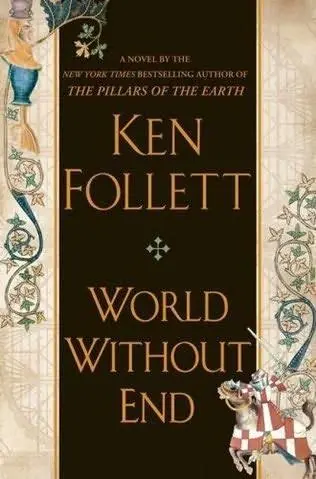
- Название:World Without End
- Автор:
- Жанр:
- Год:неизвестен
- ISBN:нет данных
- Рейтинг книги:5 / 5. Голосов: 1
-
Избранное:Добавить в избранное
- Отзывы:
-
Ваша оценка:
World Without End: краткое содержание, описание и аннотация
Предлагаем к чтению аннотацию, описание, краткое содержание или предисловие (зависит от того, что написал сам автор книги «World Without End»). Если вы не нашли необходимую информацию о книге — напишите в комментариях, мы постараемся отыскать её.
Ken Follett has 90 million readers worldwide. The Pillars of the Earth is his bestselling book of all time. Now, eighteen years after the publication of The Pillars of the Earth, Ken Follett has written the most-anticipated sequel of the year, World Without End.
In 1989 Ken Follett astonished the literary world with The Pillars of the Earth, a sweeping epic novel set in twelfth-century England centered on the building of a cathedral and many of the hundreds of lives it affected. Critics were overwhelmed-"it will hold you, fascinate you, surround you" (Chicago Tribune)-and readers everywhere hoped for a sequel.
World Without End takes place in the same town of Kingsbridge, two centuries after the townspeople finished building the exquisite Gothic cathedral that was at the heart of The Pillars of the Earth. The cathedral and the priory are again at the center of a web of love and hate, greed and pride, ambition and revenge, but this sequel stands on its own. This time the men and women of an extraordinary cast of characters find themselves at a crossroad of new ideas-about medicine, commerce, architecture, and justice. In a world where proponents of the old ways fiercely battle those with progressive minds, the intrigue and tension quickly reach a boiling point against the devastating backdrop of the greatest natural disaster ever to strike the human race-the Black Death.
Three years in the writing, and nearly eighteen years since its predecessor, World Without End breathes new life into the epic historical novel and once again shows that Ken Follett is a masterful author writing at the top of his craft.
World Without End — читать онлайн бесплатно полную книгу (весь текст) целиком
Ниже представлен текст книги, разбитый по страницам. Система сохранения места последней прочитанной страницы, позволяет с удобством читать онлайн бесплатно книгу «World Without End», без необходимости каждый раз заново искать на чём Вы остановились. Поставьте закладку, и сможете в любой момент перейти на страницу, на которой закончили чтение.
Интервал:
Закладка:
Godwyn had changed a lot in a year, Caris thought. There was no boyish eagerness left. He seemed wary, as if he expected them to be aggressive. She was beginning to wonder whether he had the strength of character to be prior.
Philemon was with him, pathetically eager as ever to fetch chairs and pour drinks, but with a new touch of assurance in his manner, the look of someone who knew he belonged here.
“So, Philemon, you’re an uncle now,” Caris said. “What do you think of your new nephew, Sam?”
“I’m a novice monk,” he said prissily. “We give up all worldly relations.”
Caris shrugged. She knew he was fond of his sister Gwenda but, if he wanted to pretend otherwise, she was not going to argue.
Edmund laid out the problem starkly for Godwyn. “Work on the bridge will have to stop if the wool merchants of Kingsbridge can’t improve their fortunes. Happily, we have come up with a new source of income. Caris has discovered how to produce high-quality scarlet cloth. Only one thing stands in the way of the success of this new enterprise: the fulling mill.”
“Why?” said Godwyn. “The scarlet cloth can be fulled at the mill.”
“Apparently not. It’s old and inefficient. It can barely handle the existing production of cloth. It has no capacity for extra. Either you build a new fulling mill-”
“Out of the question,” Godwyn interrupted. “I have no spare cash for that sort of thing.”
“Very well, then,” said Edmund. “You’ll have to permit people to full cloth in the old way, by putting it in a bath of water and stamping on it with their bare feet.”
The look that came over Godwyn’s face was familiar to Caris. It was compounded of resentment, injured pride and mulish obstinacy. In childhood he had looked like that whenever he was opposed. It meant he would try to bully the other children into submission or, failing that, stamp his foot and go home. Wanting his own way was only part of it. He seemed, Caris thought, to feel humiliated by disagreement, as if the idea that someone might think him wrong was too wounding to be borne. Whatever the explanation, she knew as soon as she saw the look that he was not going to be reasonable.
“I knew you would oppose me,” he said petulantly to Edmund. “You seem to think the priory exists for the benefit of Kingsbridge. You’ll just have to realize that it’s the other way around.”
Edmund rapidly became exasperated. “Don’t you see that we depend on one another? We thought you understood that interrelationship – that’s why we helped you get elected.”
“I was elected by the monks, not the merchants. The town may depend on the priory, but there was a priory here before there was a town, and we can exist without you.”
“You can exist, perhaps, but as an isolated outpost, rather than as the throbbing heart of a bustling city.”
Caris put in: “You must want Kingsbridge to prosper, Godwyn – why else would you have gone to London to oppose Earl Roland?”
“I went to the royal court to defend the ancient rights of the priory – as I am trying to do here and now.”
Edmund said indignantly: “This is treachery! We supported you as prior because you led us to believe you would build a bridge!”
“I owe you nothing,” Godwyn replied. “My mother sold her house to send me to the university – where was my rich uncle then?”
Caris was amazed that Godwyn was still resentful over what had happened ten years ago.
Edmund’s expression became coldly hostile. “I don’t think you have the right to force people to use the fulling mill,” he said.
A glance passed between Godwyn and Philemon, and Caris realized they knew this. Godwyn said: “There may have been times when the prior generously allowed the townspeople to use the mill without charge.”
“It was the gift of Prior Philip to the town.”
“I know nothing of that.”
“There must be a document in your records.”
Godwyn became angry. “The townspeople have allowed the mill to fall into disrepair, so that the priory has to pay to put it right. That is enough to annul any gift.”
Edmund was right, Caris realized: Godwyn was on weak ground. He knew about Prior Philip’s gift, but he intended to ignore it.
Edmund tried again. “Surely we can settle this between us?”
“I will not back down from my edict,” Godwyn said. “It would make me appear weak.”
That was what really bothered him, Caris realized. He was frightened that the townspeople would disrespect him if he changed his mind. His obstinacy came, paradoxically, from a kind of timidity.
Edmund said: “Neither of us wants the trouble and expense of another visit to the royal court.”
Godwyn bristled. “Are you threatening me with the royal court?”
“I’m trying to avoid it. But…”
Caris closed her eyes, praying that the two men would not push their argument to the brink. Her prayer was not answered.
“But what?” said Godwyn challengingly.
Edmund sighed. “But yes, if you force the townspeople to use the fulling mill, and prohibit home fulling, I will appeal to the king.”
“So be it,” said Godwyn.
34
The deer was a young female, a year or two old, sleek across the haunches, well muscled under a soft leather skin. She was on the far side of a clearing, pushing her long neck through the branches of a bush to reach a patch of scrubby grass. Ralph Fitzgerald and Alan Fernhill were on horseback, the hooves of their mounts muffled by the carpet of wet autumn leaves, and their dogs were trained to silence. Because of this, and perhaps because she was concentrating on straining to reach her fodder, the deer did not hear their approach until it was too late.
Ralph saw her first, and pointed across the clearing. Alan was carrying his longbow, grasping it and the reins in his left hand. With the speed of long practice, he fitted an arrow to the string in a heartbeat, and shot.
The dogs were slower. Only when they heard the thrum of the bowstring, and the whistle of the arrow as it flew through the air, did they react. Barley, the bitch, froze in place, head up, ears erect; and Blade, her puppy, now grown larger than his mother, uttered a low, startled woof.
The arrow was a yard long, flighted with swan feathers. Its tip was two inches of solid iron with a socket into which the shaft fitted tightly, it was a hunting arrow, with a sharp point: a battle arrow would have had a square head, so that it would punch through armour without being deflected.
Alan’s shot was good, but not perfect. It struck the deer low in the neck. She jumped with all four feet – shocked, presumably, by the sudden, agonizing stab. Her head came up out of the bush. For an instant, Ralph thought she was going to fall down dead, but a moment later she bounded away. The arrow was still buried in her neck, but the blood was oozing rather than spurting from the wound, so it must have lodged in her muscles, missing the major blood vessels.
The dogs leaped forward as if they, too, had been shot from bows; and the two horses followed without urging. Ralph was on Griff, his favourite hunter. He felt the rush of excitement that was what he mainly lived for. It was a tingling in the nerves, a constriction in the neck, an irresistible impulse to yell at the top of his voice; a thrill so like sexual excitement that he could hardly have said what the difference was.
Men such as Ralph existed to fight. The king and his barons made them lords and knights, and gave them villages and lands to rule over, for a reason: so that they would be able to provide themselves with horses, squires, weapons and armour whenever the king needed an army. But there was not a war every year. Sometimes two or three years would go by without so much as a minor police action on the borders of rebellious Wales or barbarian Scotland. Knights needed something to do in the interim. They had to keep fit and maintain their horsemanship and – perhaps most important of all – their blood lust. Soldiers had to kill, and they did it better when they longed for it.
Читать дальшеИнтервал:
Закладка:
Похожие книги на «World Without End»
Представляем Вашему вниманию похожие книги на «World Without End» списком для выбора. Мы отобрали схожую по названию и смыслу литературу в надежде предоставить читателям больше вариантов отыскать новые, интересные, ещё непрочитанные произведения.

Обсуждение, отзывы о книге «World Without End» и просто собственные мнения читателей. Оставьте ваши комментарии, напишите, что Вы думаете о произведении, его смысле или главных героях. Укажите что конкретно понравилось, а что нет, и почему Вы так считаете.