Ken Follett - World Without End
Здесь есть возможность читать онлайн «Ken Follett - World Without End» весь текст электронной книги совершенно бесплатно (целиком полную версию без сокращений). В некоторых случаях можно слушать аудио, скачать через торрент в формате fb2 и присутствует краткое содержание. Жанр: Историческая проза, на английском языке. Описание произведения, (предисловие) а так же отзывы посетителей доступны на портале библиотеки ЛибКат.
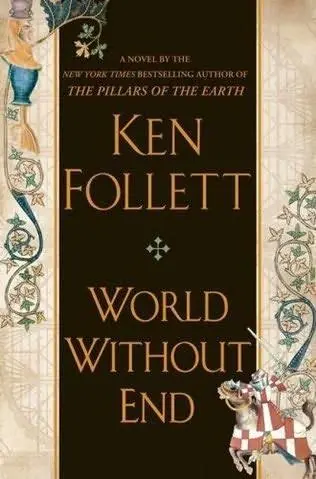
- Название:World Without End
- Автор:
- Жанр:
- Год:неизвестен
- ISBN:нет данных
- Рейтинг книги:5 / 5. Голосов: 1
-
Избранное:Добавить в избранное
- Отзывы:
-
Ваша оценка:
World Without End: краткое содержание, описание и аннотация
Предлагаем к чтению аннотацию, описание, краткое содержание или предисловие (зависит от того, что написал сам автор книги «World Without End»). Если вы не нашли необходимую информацию о книге — напишите в комментариях, мы постараемся отыскать её.
Ken Follett has 90 million readers worldwide. The Pillars of the Earth is his bestselling book of all time. Now, eighteen years after the publication of The Pillars of the Earth, Ken Follett has written the most-anticipated sequel of the year, World Without End.
In 1989 Ken Follett astonished the literary world with The Pillars of the Earth, a sweeping epic novel set in twelfth-century England centered on the building of a cathedral and many of the hundreds of lives it affected. Critics were overwhelmed-"it will hold you, fascinate you, surround you" (Chicago Tribune)-and readers everywhere hoped for a sequel.
World Without End takes place in the same town of Kingsbridge, two centuries after the townspeople finished building the exquisite Gothic cathedral that was at the heart of The Pillars of the Earth. The cathedral and the priory are again at the center of a web of love and hate, greed and pride, ambition and revenge, but this sequel stands on its own. This time the men and women of an extraordinary cast of characters find themselves at a crossroad of new ideas-about medicine, commerce, architecture, and justice. In a world where proponents of the old ways fiercely battle those with progressive minds, the intrigue and tension quickly reach a boiling point against the devastating backdrop of the greatest natural disaster ever to strike the human race-the Black Death.
Three years in the writing, and nearly eighteen years since its predecessor, World Without End breathes new life into the epic historical novel and once again shows that Ken Follett is a masterful author writing at the top of his craft.
World Without End — читать онлайн бесплатно полную книгу (весь текст) целиком
Ниже представлен текст книги, разбитый по страницам. Система сохранения места последней прочитанной страницы, позволяет с удобством читать онлайн бесплатно книгу «World Without End», без необходимости каждый раз заново искать на чём Вы остановились. Поставьте закладку, и сможете в любой момент перейти на страницу, на которой закончили чтение.
Интервал:
Закладка:
She left him. Who in town might know about alum? She wished now that she had asked Loro Fiorentino more questions. The monks ought to know about things like this, but they were no longer allowed to talk to women. She decided to see Mattie Wise. Mattie was forever mixing strange ingredients – maybe alum was one of them. More importantly, if she did not know she would admit her ignorance, unlike a monk or an apothecary who might make something up for fear of being thought foolish.
Mattie’s first words were: “How is your father?”
“He seems a bit shaken by the failure of the Fleece Fair,” Caris said. It was typical of Mattie to know what she was worried about. “He’s becoming forgetful. He seems older.”
“Take care of him,” said Mattie. “He’s a good man.”
“I know.” Caris was not sure what Mattie was getting at.
“Petranilla is a self-centred cow.”
“I know that, too.”
Mattie was grinding something with a mortar and pestle. She pushed the bowl towards Caris. “If you do this for me, I’ll pour you a cup of wine.”
“Thank you.” Caris began to grind.
Mattie poured yellow wine from a stone jug into two wooden cups. “Why are you here? You’re not ill.”
“Do you know what alum is?”
“Yes. In small quantities, we use it as an astringent, to close wounds. It can also stop diarrhoea. But in large quantities it’s poisonous. Like most poisons, it makes you vomit. There was alum in the potion I gave you last year.”
“What is it, a herb?”
“No, it’s an earth. The Moors mine it in Turkey and Africa. Tanners employ it in the preparation of leather, sometimes. I suppose you want to use it to dye cloth.”
“Yes.” As always, Mattie’s guesswork seemed supernaturally accurate.
“It acts as a mordant – it helps the dye to bite the wool.”
“And where do you get it?”
“I buy it in Melcombe,” said Mattie.
Caris made the two-day journey to Melcombe, where she had been several times before, accompanied by one of her father’s employees as a bodyguard. At the quayside she found a merchant who dealt in spices, cage birds, musical instruments and all kinds of curiosities from remote parts of the world. He sold her both the red dye made from the root of the madder plant, cultivated in France, and a type of alum known as Spiralum that he said came from Ethiopia. He charged her seven shillings for a small barrel of madder and a pound for a sack of alum, and she had no idea whether she was paying fair prices or not. He sold her his entire stock, and promised to get more from the next Italian ship to come into port. She asked him what quantities of dye and alum she should use, but he did not know.
When she got home, she began to dye pieces of her unsold cloth in a cooking pot. Petranilla objected to the smell, so Caris built a fire in the back yard. She knew that she had to put the cloth in a solution of dye and boil it, and Peter Dyer told her the correct strength of the dye solution. However, no one knew how much alum she needed or how she should use it.
She began a frustrating process of trial and error. She tried soaking the cloth in alum before dyeing it; putting the alum in at the same time as the dye; and boiling the dyed cloth in a solution of alum afterwards. She tried using the same quantity of alum as dye, then more, then less. At Mattie’s suggestion she experimented with other ingredients: oak galls, chalk, lime water, vinegar, urine.
She was short of time. In all towns, no one could sell cloth but members of the guild – except during a fair, when the normal rules were relaxed. And all fairs were held in summer. The last was St Giles’s Fair, which took place on the downs to the east of Winchester on St Giles’s Day, 12 September. It was now mid-July, so she had eight weeks.
She started early in the morning and worked until long after dark. Agitating the cloth continuously and lifting it in and out of the pot made her back ache. Her hands became red and sore from constant dipping in the harsh chemicals, and her hair began to smell. But, despite the frustration, she occasionally felt happy, and sometimes she hummed or even sang as she worked, old tunes whose words she could barely remember from childhood. Neighbours in their own back yards watched ner curiously across the fences.
Now and again there came into her mind the thought: Is this my rate? More than once she had said that she did not know what to do with her life. But she might not have a free choice. She was not to be allowed to be a physician; becoming a wool merchant looked like a bad idea; she did not want to enslave herself to a husband and children – but she had never dreamed that she might end up as a dyer. When she thought about it, she knew that this was not what she wanted to do. Having started it, she was determined to succeed – but it was not going to be her destiny.
At first she could only get the cloth to turn brownish red or pale pink. When she began to approach the right shade of scarlet she found, maddeningly, that it faded when she dried it in the sun, or came out when washed. She tried double-dyeing, but the effect proved temporary. Peter told her, rather late, that the material would soak up dye more completely if she worked with the yarn before it was woven, or even with raw fleeces; and that improved the shade, but not the fastness.
“There’s only one way to learn dyeing, and that’s from a master,” Peter said several times. They all thought that way, Caris realized. Prior Godwyn learned medicine by reading books that were hundreds of years old, and prescribed medicines without even looking at his patient. Elfric had punished Merthin for carving the parable of the virgins in a new way. Peter had never even tried to dye cloth scarlet. Only Mattie based her decisions on what she could see for herself, rather than on some venerated authority.
Caris’s sister Alice stood watching her late one evening, with folded arms and pursed lips. As darkness gathered in the corners of the yard, the light of Caris’s fire reddened Alice’s disapproving face. “How much of our father’s money have you spent on this foolishness?” she said.
Caris added it up. “Seven shillings for the madder, a pound for the alum, twelve shillings for the cloth – thirty-nine shillings.”
“God save us!” Alice was horrified.
Caris herself was daunted. It was more than a year’s wages for most people in Kingsbridge. “It is a lot, but I’ll make more,” she said.
Alice was angry. “You have no right to spend his money like this.”
“No right?” Caris said. “I have his permission – what more do I need?”
“He’s showing signs of age. His judgement is not what it was.”
Caris pretended not to know this. “His judgement is fine, and a lot better than yours.”
“You’re spending our inheritance!”
“Is that what’s bothering you? Don’t worry, I’m making you money.”
“I don’t want to take the risk.”
“You’re not taking the risk, he is.”
“He shouldn’t throw away money that should come to us!”
“Tell him that.”
Alice went away defeated, but Caris was not as confident as she pretended. She might never get it just right. And then what would she and her father do?
When finally she found the right formula, it was remarkably simple: an ounce of madder and two ounces of alum for every three ounces of wool. She boiled the wool in the alum first, then added the madder to the pot without re-boiling the liquid. The extra ingredient was lime water. She could hardly believe the result. It was more successful than she could have hoped. The red was bright, almost like the Italian red. She felt sure it would fade and give her another disappointment; but the colour remained the same through drying, re-washing and fulling.
Читать дальшеИнтервал:
Закладка:
Похожие книги на «World Without End»
Представляем Вашему вниманию похожие книги на «World Without End» списком для выбора. Мы отобрали схожую по названию и смыслу литературу в надежде предоставить читателям больше вариантов отыскать новые, интересные, ещё непрочитанные произведения.


Обсуждение, отзывы о книге «World Without End» и просто собственные мнения читателей. Оставьте ваши комментарии, напишите, что Вы думаете о произведении, его смысле или главных героях. Укажите что конкретно понравилось, а что нет, и почему Вы так считаете.