Ken Follett - World Without End
Здесь есть возможность читать онлайн «Ken Follett - World Without End» весь текст электронной книги совершенно бесплатно (целиком полную версию без сокращений). В некоторых случаях можно слушать аудио, скачать через торрент в формате fb2 и присутствует краткое содержание. Жанр: Историческая проза, на английском языке. Описание произведения, (предисловие) а так же отзывы посетителей доступны на портале библиотеки ЛибКат.
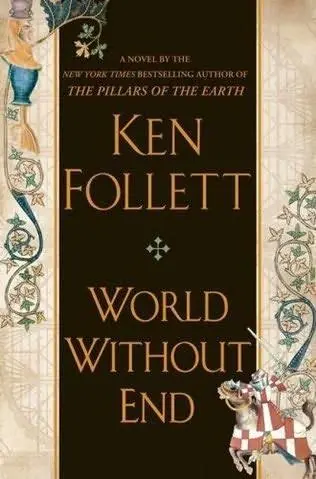
- Название:World Without End
- Автор:
- Жанр:
- Год:неизвестен
- ISBN:нет данных
- Рейтинг книги:5 / 5. Голосов: 1
-
Избранное:Добавить в избранное
- Отзывы:
-
Ваша оценка:
World Without End: краткое содержание, описание и аннотация
Предлагаем к чтению аннотацию, описание, краткое содержание или предисловие (зависит от того, что написал сам автор книги «World Without End»). Если вы не нашли необходимую информацию о книге — напишите в комментариях, мы постараемся отыскать её.
Ken Follett has 90 million readers worldwide. The Pillars of the Earth is his bestselling book of all time. Now, eighteen years after the publication of The Pillars of the Earth, Ken Follett has written the most-anticipated sequel of the year, World Without End.
In 1989 Ken Follett astonished the literary world with The Pillars of the Earth, a sweeping epic novel set in twelfth-century England centered on the building of a cathedral and many of the hundreds of lives it affected. Critics were overwhelmed-"it will hold you, fascinate you, surround you" (Chicago Tribune)-and readers everywhere hoped for a sequel.
World Without End takes place in the same town of Kingsbridge, two centuries after the townspeople finished building the exquisite Gothic cathedral that was at the heart of The Pillars of the Earth. The cathedral and the priory are again at the center of a web of love and hate, greed and pride, ambition and revenge, but this sequel stands on its own. This time the men and women of an extraordinary cast of characters find themselves at a crossroad of new ideas-about medicine, commerce, architecture, and justice. In a world where proponents of the old ways fiercely battle those with progressive minds, the intrigue and tension quickly reach a boiling point against the devastating backdrop of the greatest natural disaster ever to strike the human race-the Black Death.
Three years in the writing, and nearly eighteen years since its predecessor, World Without End breathes new life into the epic historical novel and once again shows that Ken Follett is a masterful author writing at the top of his craft.
World Without End — читать онлайн бесплатно полную книгу (весь текст) целиком
Ниже представлен текст книги, разбитый по страницам. Система сохранения места последней прочитанной страницы, позволяет с удобством читать онлайн бесплатно книгу «World Without End», без необходимости каждый раз заново искать на чём Вы остановились. Поставьте закладку, и сможете в любой момент перейти на страницу, на которой закончили чтение.
Интервал:
Закладка:
Hunting was the answer. All noblemen, from the king down to minor lords such as Ralph, hunted whenever they got the chance, often several times a week. They enjoyed it, and it ensured they were fit for battle whenever called upon. Ralph hunted with Earl Roland on his frequent visits to Earlscastle, and often joined Lord William’s hunt at Casterham. When he was at his own village of Wigleigh, he went out with his squire, Alan, in the forests round about. They usually killed boar – there was not much meat on the wild pigs, but they were exciting to hunt because they put up a good fight. Ralph also went after foxes and the occasional, rare, wolf. But a deer was best: agile, fast, and a hundred pounds of good meat to take home.
Now Ralph thrilled to the feel of Griff beneath him, the horse’s weight and strength, the powerful action of its muscles and the drumbeat of its tread. The deer disappeared into the vegetation, but Barley knew where it had gone, and the horses followed the dogs. Ralph carried a spear ready in his right hand, a long shaft of ash with a fire-hardened point. As Griff swerved and jumped, Ralph ducked under overhanging branches and swayed with the horse, his boots firmly in the stirrups, keeping his seat effortlessly by the pressure of his knees.
In the undergrowth the horses were not as nimble as the deer, and they fell behind; but the dogs had the advantage, and Ralph heard frantic barking as they closed in. Then there was a lull, and in a few moments Ralph found out why: the deer had broken out of the vegetation on to a pathway, and was leaving the dogs behind. Here, however, the horses had the advantage, and they quickly passed the dogs and began to gain on the deer.
Ralph could see that the beast was weakening. He saw blood on its rump, and deduced that one of the dogs had got a bite. Its gait became irregular as it struggled to get away. It was a sprinter, made for the sudden quick dash, and it could not keep up its initial pace for long.
His blood raced as he closed on his prey. He tightened his grip on the lance. It took a great deal of strength to force a wooden point into the tough body of a big animal: the skin was leathery, the muscles dense, the bones hard. The neck was the softest target, if you could contrive to miss the vertebrae and hit the jugular vein. You had to choose the exact moment, then thrust quickly with all your might.
Seeing the horses almost upon it, the deer made a desperate turn into the bushes. This gave it a few seconds’ respite. The horses slowed as they crashed through undergrowth over which the deer had bounded without pause. But the dogs caught up again, and Ralph saw that the deer could not go much farther.
The usual pattern was that the dogs would inflict more and more wounds, slowing the deer until the horses could catch it and the hunter could deliver the death blow. But, on this occasion, there was an accident.
When the dogs and the horses were almost upon the deer, she dodged sideways. Blade, the younger dog, went after her with more enthusiasm than sense, and swerved in front of Griff. The horse was going too fast to stop or even avoid the dog, and kicked him with a mighty foreleg. The dog was a mastiff, weighing seventy or eighty pounds, and the impact caused the horse to stumble.
Ralph was thrown. He let go of his spear as he flew through the air. His greatest fear, in that instant, was that his horse would fall on him. But he saw, in the moment before he landed, that Griff had somehow regained his balance.
Ralph fell into a thorn bush. His hands and face were scratched painfully, but the branches broke his fall. All the same, he was enraged.
Alan reined in. Barley went after the deer but returned in a few moments: the beast had obviously got away. Ralph struggled to his feet, cursing. Alan caught Griff then dismounted, holding both horses.
Blade lay motionless on the dead leaves, blood dripping from his mouth. He had been struck on the head by Griff’s iron horseshoe. Barley went up to him, sniffed, nudged him with her nose and licked the blood on his face, then turned away, looking bewildered. Alan prodded the dog with the toe of his boot. There was no response. Blade was not breathing. “Dead,” Alan said.
“Damn fool dog deserved to die,” Ralph said.
They walked the horses through the woods, looking for a place to rest. After a while Ralph heard running water. Following the sound, he came to a fast-flowing stream. He recognized the stretch of water: they were only a little way beyond the fields of Wigleigh. “Let’s have some refreshment,” he said. Alan tied up the horses then took from his saddlebag a stoppered jug, two wooden cups and a canvas sack of food.
Barley went to the stream and lapped the cold water thirstily. Ralph sat on the bank, resting his back against a tree. Alan sat beside him and handed him a cup of ale and a wedge of cheese. Ralph took the drink and refused the food.
Alan knew his boss in a bad mood, and said nothing while Ralph drank, wordlessly refilling Ralph’s cup from the jug. In the silence they both heard female voices. Alan looked at Ralph with a raised eyebrow. Barley growled. Ralph stood up, shushing the dog, and walked softly in the direction of the sound. Alan followed.
A few yards downstream Ralph stopped, looking through the vegetation. A small group of village women were doing laundry on the near bank of the stream, where the water flowed fast over an outcrop of rocks. It was a damp October day, cool but not cold, and they wore their sleeves rolled up and the skirts of their shifts raised to thigh level to keep them dry.
Ralph studied them one by one. There was Gwenda, all muscular forearms and calves, with her baby – now four months old – strapped to her back. He identified Peg, the wife of Perkin, scrubbing her husband’s underdrawers with a stone. His own housemaid, Vira, was there, a hard-faced woman of about thirty who had looked so stonily at him when he patted her arse that he never touched her again. The voice that he had heard belonged to the widow Huberts, a great talker, no doubt because she lived alone. The widow was standing in midstream, calling out to the others, carrying on a gossipy conversation at a distance.
And there was Annet.
She stood on a rock, washing some small garment, bending to dip it in the stream then standing upright to scrub it. She had long, white legs that disappeared enchantingly into her rucked-up dress. Every time she bent over, her neckline fell open to reveal the pale fruit of her small breasts hanging like temptation on a tree. Her fair hair was wet at the ends, and there was a petulant look on her pretty face, as if she felt she had not been born for this kind of work.
They had been there for some time, Ralph guessed, and their presence might have remained unknown to him, had not Widow Huberts raised her voice to call out. He lowered himself to the ground and knelt behind a bush, peering through the leafless twigs. Alan squatted beside him.
Ralph liked spying on women. He had often done it as an adolescent. They scratched themselves, sprawled on the ground with their legs apart, and talked about things they would never speak of if they knew a man was listening. In fact they acted like men.
He feasted his eyes on the unsuspecting women of his village, and strained to hear what they were saying. He watched Gwenda, looking at her small, strong body, remembering her naked, kneeling on the bed, and reliving how it had felt to hold her hips and pull her to him. He recalled how her attitude had changed. At first she had been coldly passive, struggling to conceal her resentment and distaste for the act she was performing; then he had seen a slow alteration. The skin on her neck had flushed, her chest had betrayed her excited breathing, and she had bent her head and closed her eyes in what seemed to him to be a mixture of shame and pleasure. The memory made him breathe faster and brought out a film of perspiration on his brow, despite the chill October air. He wondered if he would get another chance to lie with Gwenda.
Читать дальшеИнтервал:
Закладка:
Похожие книги на «World Without End»
Представляем Вашему вниманию похожие книги на «World Without End» списком для выбора. Мы отобрали схожую по названию и смыслу литературу в надежде предоставить читателям больше вариантов отыскать новые, интересные, ещё непрочитанные произведения.

Обсуждение, отзывы о книге «World Without End» и просто собственные мнения читателей. Оставьте ваши комментарии, напишите, что Вы думаете о произведении, его смысле или главных героях. Укажите что конкретно понравилось, а что нет, и почему Вы так считаете.