Ken Follett - World Without End
Здесь есть возможность читать онлайн «Ken Follett - World Without End» весь текст электронной книги совершенно бесплатно (целиком полную версию без сокращений). В некоторых случаях можно слушать аудио, скачать через торрент в формате fb2 и присутствует краткое содержание. Жанр: Историческая проза, на английском языке. Описание произведения, (предисловие) а так же отзывы посетителей доступны на портале библиотеки ЛибКат.
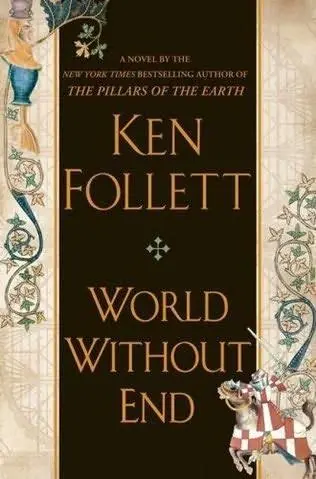
- Название:World Without End
- Автор:
- Жанр:
- Год:неизвестен
- ISBN:нет данных
- Рейтинг книги:5 / 5. Голосов: 1
-
Избранное:Добавить в избранное
- Отзывы:
-
Ваша оценка:
World Without End: краткое содержание, описание и аннотация
Предлагаем к чтению аннотацию, описание, краткое содержание или предисловие (зависит от того, что написал сам автор книги «World Without End»). Если вы не нашли необходимую информацию о книге — напишите в комментариях, мы постараемся отыскать её.
Ken Follett has 90 million readers worldwide. The Pillars of the Earth is his bestselling book of all time. Now, eighteen years after the publication of The Pillars of the Earth, Ken Follett has written the most-anticipated sequel of the year, World Without End.
In 1989 Ken Follett astonished the literary world with The Pillars of the Earth, a sweeping epic novel set in twelfth-century England centered on the building of a cathedral and many of the hundreds of lives it affected. Critics were overwhelmed-"it will hold you, fascinate you, surround you" (Chicago Tribune)-and readers everywhere hoped for a sequel.
World Without End takes place in the same town of Kingsbridge, two centuries after the townspeople finished building the exquisite Gothic cathedral that was at the heart of The Pillars of the Earth. The cathedral and the priory are again at the center of a web of love and hate, greed and pride, ambition and revenge, but this sequel stands on its own. This time the men and women of an extraordinary cast of characters find themselves at a crossroad of new ideas-about medicine, commerce, architecture, and justice. In a world where proponents of the old ways fiercely battle those with progressive minds, the intrigue and tension quickly reach a boiling point against the devastating backdrop of the greatest natural disaster ever to strike the human race-the Black Death.
Three years in the writing, and nearly eighteen years since its predecessor, World Without End breathes new life into the epic historical novel and once again shows that Ken Follett is a masterful author writing at the top of his craft.
World Without End — читать онлайн бесплатно полную книгу (весь текст) целиком
Ниже представлен текст книги, разбитый по страницам. Система сохранения места последней прочитанной страницы, позволяет с удобством читать онлайн бесплатно книгу «World Without End», без необходимости каждый раз заново искать на чём Вы остановились. Поставьте закладку, и сможете в любой момент перейти на страницу, на которой закончили чтение.
Интервал:
Закладка:
Edmund looked dubious. “If it’s so easy, why don’t more people do it?”
“Because they don’t have the money to lay out.”
“Nor do I!”
“You’ve got three pounds from Guillaume of London.”
“Am I to have nothing with which to buy wool next year?”
“At these prices, you’re better off out of the business.”
He laughed. “By the saints, you’re right. Very well, try it out with some cheap stuff. I’ve got five sacks of coarse Devon wool that the Italians never want. I’ll give you a sack of that, and see if you can do what you say.”
Two weeks later, Caris found Mark Webber smashing up his hand mill.
She was shocked to see a poor man destroying a valuable piece of equipment – so much so that, for a moment, she forgot her own troubles.
The hand mill consisted of two stone discs, each slightly roughened on one face. The smaller sat on the larger, fitting perfectly into a shallow indentation, rough side to rough. A protruding wooden handle enabled the upper stone to be turned while the lower remained still. Ears of grain placed between the two stones would be rapidly ground to flour.
Most Kingsbridge people of the lower class had a hand mill. The very poor could not afford one, and the affluent did not need one – they could buy flour already ground by a miller. But for families such as the Webbers, who needed every penny they earned to feed their children, a hand mill was a money-saving godsend.
Mark had laid his on the ground in front of his small house. He had borrowed from somewhere a long-handled sledgehammer with an iron head. Two of his children were watching, a thin girl in a ragged dress and a naked toddler. He lifted the hammer over his head and swung it in a long arc. It was a sight to see: he was the biggest man in Kingsbridge, with shoulders like a carthorse. The stone crazed like an eggshell and fell into pieces.
Caris said: “What on earth are you doing?”
“We must grind corn at the prior’s watermills, and forfeit one sack in twenty-four as a fee,” Mark replied.
He seemed phlegmatic about it, but she was horrified. “I thought the new rules applied only to unlicensed windmills and watermills.”
“Tomorrow I have to go around with John Constable, searching People’s homes, breaking up illicit hand mills. I can’t have them saying I’ve got one of my own. That’s why I’m doing this in the street, where everyone can see.”
“I didn’t realize Godwyn intended to take the bread out of the mouths of the poor,” Caris said grimly.
“Luckily for us, we’ve got some weaving to do – thanks to you.”
Caris turned her mind to her own business. “How are you getting on?”
“Finished.”
“That was quick!”
“It takes longer in winter. But in summer, with sixteen hours of daylight, I can weave six yards in a day, with Madge helping.”
“Wonderful!”
“Come inside and I’ll show you.”
His wife Madge was standing over the cooking fire at the back of the one-room house, with a baby on one arm and a shy boy at her side. Madge was shorter than her husband by more than a foot, but her build was chunky. She had a large bust and a jutting behind, and she made Caris think of a plump pigeon. Her protruding jaw gave her an aggressive air that was not entirely misleading. Although combative, she was good-hearted, and Caris liked her. She offered her visitor a cup of cider, which Caris refused, knowing the family could not afford it.
Mark’s loom was a wooden frame, more than a yard square, on a stand. It took up most of the living space. Behind it, close to the back door, was a table with two benches. Obviously they all slept on the floor around the loom.
“I make narrow dozens,” Mark explained. “A narrow dozen is a cloth a yard wide and twelve yards long. I can’t make broadcloth, because I haven’t room for such a wide loom.” Four rolls of brown burel were stacked against the wall. “One sack of wool makes four narrow dozens,” he said.
Caris had brought him the raw fleeces in a standard woolsack. Madge had arranged for the wool to be cleaned, sorted and spun into yarn. The spinning was done by the poor women of the town, and the cleaning and sorting by their children.
Caris felt the cloth. She was excited: she had completed the first stage of her plan. “Why is it so loosely woven?” she asked.
Mark bristled. “Loose? My burel is the tightest weave in Kingsbridge!”
“I know – I didn’t mean to sound critical. But Italian cloth feels so different – yet they make it from our wool.”
“Partly it depends on the weaver’s strength, and how hard he can press down the batten to pack the wool.”
“I don’t think the Italian weavers are all stronger than you.”
“Then it’s their machines. The better the loom, the closer the weave.”
“I was afraid of that.” The implication was that Caris could not compete with high-quality Italian wool unless she bought Italian looms, which seemed impossible.
One problem at a time, she told herself. She paid Mark, counting out four shillings, of which he would have to give about half to the women who had done the spinning. Caris had made eight shillings profit, Theoretically. Eight shillings would not pay for much work on the bridge. And at this rate it would take years to weave all her father’s surplus wool. “Is there any way we can produce cloth faster?” she said to Mark.
Madge answered. “There are other weavers in Kingsbridge, but most of them are committed to work for existing cloth merchants. I can find you more outside the town, though. The larger villages often have a weaver with a loom. He usually makes cloth for the villagers from their own yarn. Such men can easily switch to another job, if the money’s good.”
Caris concealed her anxiety. “All right,” she said. “I’ll let you know. Meanwhile, will you deliver these cloths to Peter Dyer for me?”
“Of course. I’ll take them now.”
Caris went home for dinner, deep in thought. To make any real difference, she would have to spend most of what money her father had left. If things went wrong, they would be even worse off. But what was the alternative? Her plan was risky, but no one else had any kind of plan at all.
When she arrived home, Petranilla was serving a mutton stew. Edmund sat at the head of the table. The financial setback of the Fleece Fair seemed to have affected him more severely than Caris would have expected. His normal exuberance was subdued, and he often appeared thoughtful, not to say distracted. Caris was worried about him.
“I saw Mark Webber smashing up his hand mill,” she said as she sat down. “Where’s the sense in that?”
Petranilla put her nose in the air. “Godwyn is entirely within his rights,” she said.
“Those rights are out of date – they haven’t been enforced for years. Where else does a priory do such things?”
“In St Albans,” Petranilla said triumphantly.
Edmund said: “I’ve heard of St Albans. The townspeople periodically riot against the monastery.”
“Kingsbridge Priory is entitled to recoup the money it spent building mills,” Petranilla argued. “Just as you, Edmund, want to get back the money you’re putting into the bridge. How would you feel if someone built a second bridge?”
Edmund did not answer her, so Caris did. “It would depend entirely on how soon it happened,” she said. “The priory’s mills were built hundreds of years ago, as were the warrens and fishponds. No one has the right to hold back the development of the town for ever.”
“The prior has a right to collect his dues,” she said stubbornly.
“Well, if he carries on like this, there will be no one to collect dues from. People will go and live in Shiring. They’re allowed hand mills there.”
Читать дальшеИнтервал:
Закладка:
Похожие книги на «World Without End»
Представляем Вашему вниманию похожие книги на «World Without End» списком для выбора. Мы отобрали схожую по названию и смыслу литературу в надежде предоставить читателям больше вариантов отыскать новые, интересные, ещё непрочитанные произведения.





Обсуждение, отзывы о книге «World Without End» и просто собственные мнения читателей. Оставьте ваши комментарии, напишите, что Вы думаете о произведении, его смысле или главных героях. Укажите что конкретно понравилось, а что нет, и почему Вы так считаете.