Bernard Cornwell - Excalibur
Здесь есть возможность читать онлайн «Bernard Cornwell - Excalibur» весь текст электронной книги совершенно бесплатно (целиком полную версию без сокращений). В некоторых случаях можно слушать аудио, скачать через торрент в формате fb2 и присутствует краткое содержание. Год выпуска: 1999, Издательство: MacMillan Publishers, Жанр: Историческая проза, на английском языке. Описание произведения, (предисловие) а так же отзывы посетителей доступны на портале библиотеки ЛибКат.
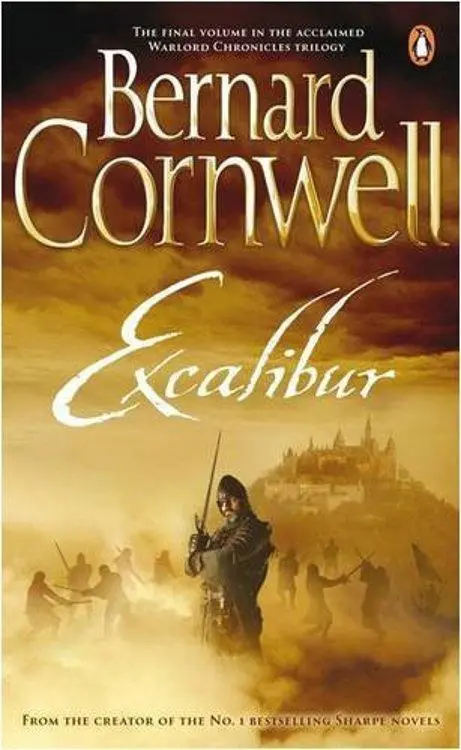
- Название:Excalibur
- Автор:
- Издательство:MacMillan Publishers
- Жанр:
- Год:1999
- ISBN:нет данных
- Рейтинг книги:4 / 5. Голосов: 2
-
Избранное:Добавить в избранное
- Отзывы:
-
Ваша оценка:
Excalibur: краткое содержание, описание и аннотация
Предлагаем к чтению аннотацию, описание, краткое содержание или предисловие (зависит от того, что написал сам автор книги «Excalibur»). Если вы не нашли необходимую информацию о книге — напишите в комментариях, мы постараемся отыскать её.
to Marion Zimmer Bradley's
, the legend of King Arthur has haunted and inspired generations of writers to reinvent the ancient story. In
and
, Bernard Cornwell demonstrated his astonishing ability to make the oft-told legend of King Arthur fresh and new for our time. Now, in this riveting final volume of the
, Cornwell tells the story of Arthur's desperate attempt to triumph over a ruined marriage and the Saxons' determination to destroy him.
Set against the backdrop of the Dark Ages, this brilliant saga continues as seen through the eyes of Derfel, an orphan brought up by Merlin and one of Arthur's warriors. In this book, the aging Arthur has been betrayed by, among others, his beloved Guinevere; but although he is alone and deeply saddened, he still embraces his dreams of a world in which civilization triumphs over brute force. Arthur and his warriors must face the dreaded Saxons — now allied with Arthur's betrayer Lancelot — for the throne of Britain.
This is the tale not only of a broken love remade but also of enemies more subtle than any Saxon spearman — of forces both earthly and unearthly that threaten everything Arthur stands for. When Merlin and Nimue embark on a dangerous quest to summon the Gods back to Britain, they unleash forces that will lead to a last desperate battle on the sands of Camlann, where it seems that Arthur must fail unless Merlin's final enchantment can avert the horror.
Peopled by princesses and bards, warriors and magicians, Excalibur is a story of love, war, loyalty, and betrayal, the unforgettable conclusion to a brilliant retelling of one of the most powerful legends of all time.
Excalibur — читать онлайн бесплатно полную книгу (весь текст) целиком
Ниже представлен текст книги, разбитый по страницам. Система сохранения места последней прочитанной страницы, позволяет с удобством читать онлайн бесплатно книгу «Excalibur», без необходимости каждый раз заново искать на чём Вы остановились. Поставьте закладку, и сможете в любой момент перейти на страницу, на которой закончили чтение.
Интервал:
Закладка:
The beacon fires still burned to tell us that the Saxons were coming, and I felt a terrible guilt that I had failed Arthur so badly. Later I learned that nearly every warrior in Dumnonia was similarly insensible that morning, though Sagramor’s hundred and twenty men had stayed sober and they dutifully fell back in front of the advancing Saxon armies, but the rest of us staggered, retched, gasped for breath and gulped water like dogs.
By midday most of my men were standing, though not all, and only a few were ready for a long march. My armour, shield and war spears were loaded on a pack-horse, while ten mules carried the baskets of food that Ceinwyn had been busy filling all morning. She would wait at Dun Caric, either for victory or, more likely, for a message telling her to flee.
Then, a few moments after midday, everything changed.
A rider came from the south on a sweating horse. He was Culhwch’s eldest son, Einion, and he had ridden himself and his horse close to exhaustion in his frantic attempt to reach us. He half fell from the saddle. ‘Lord,’ he gasped, then stumbled, found his feet and gave me a perfunctory bow. For a few heartbeats he was too breathless to speak, then the words tumbled out in frantic excitement, but he had been so eager to deliver his message and had so anticipated the drama of the moment that he was quite unable to make any sense, though I did understand he had come from the south and that the Saxons were marching there.
I led him to a bench beside the hall and sat him down. ‘Welcome to Dun Caric, Einion ap Culhwch,’ I said very formally, ‘and say all that again.’
‘The Saxons, Lord,’ he said, ‘have attacked Dunum.’
So Guinevere had been right and the Saxons had marched in the south. They had come from Cerdic’s land beyond Venta and were already deep inside Dumnonia. Dunum, our fortress close to the coast, had fallen in yesterday’s dawn. Culhwch had abandoned the fort rather than have his hundred men overwhelmed, and now he was falling back in front of the enemy. Einion, a young man with the same squat build as his father, looked up at me woefully. ‘There are just too many of them, Lord.’
The Saxons had made fools of us. First they had convinced us that they meant no mischief in the south, then they had attacked on our feast night when they knew we would mistake the distant beacon fires for the flames of Beltain, and now they were loose on our southern flank. Aelle, I guessed, was pushing down the Thames while Cerdic’s troops were rampaging free by the coast. Einion was not certain that Cerdic himself led the southern attack, for he had not seen the Saxon King’s banner of the red-painted wolf skull hung with a dead man’s flayed skin, but he had seen Lancelot’s flag of the sea eagle with the fish clutched in its talons. Culhwch believed that Lancelot was leading his own followers and two or three hundred Saxons besides.
‘Where were they when you left?’ I asked Einion.
‘Still south of Sorviodunum, Lord.’
‘And your father?’
‘He was in the town, Lord, but he dare not be trapped there.’
So Culhwch would yield the fortress of Sorviodunum rather than be trapped. ‘Does he want me to join him?’ I asked.
Einion shook his head. ‘He sent word to Durnovaria, Lord, telling the folk there to come north. He thinks you should protect them and take them to Corinium.’
‘Who’s at Durnovaria?’ I asked.
‘The Princess Argante, Lord.’
I swore softly. Arthur’s new wife could not just be abandoned and I understood now what Culhwch was suggesting. He knew Lancelot could not be stopped, so he wanted me to rescue whatever was valuable in Dumnonia’s heartland and retreat north towards Corinium while Culhwch did his best to slow the enemy. It was a desperately makeshift strategy, and at its end we would have yielded the greater part of Dumnonia to the enemy’s forces, but there was still the chance that we could all come together at Corinium to fight Arthur’s battle, though by rescuing Argante I abandoned Arthur’s plans to harass the Saxons in the hills south of the Thames. That was a pity, but war rarely goes according to plan.
‘Does Arthur know?’ I asked Einion.
‘My brother is riding to him,’ Einion assured me, which meant Arthur would still not have heard the news. It would be late afternoon before Einion’s brother reached Corinium, where Arthur had spent Beltain. Culhwch, meanwhile, was lost somewhere south of the great plain while Lancelot’s army was where? Aelle, presumably, was still marching west, and maybe Cerdic was with him, which meant Lancelot could either continue along the coast and capture Durnovaria, or else turn north and follow Culhwch towards Caer Cadarn and Dun Caric. But either way, I reflected, this landscape would be swarming with Saxon spearmen in only three or four days.
I gave Einion a fresh horse and sent him north to Arthur with a message that I would bring Argante to Corinium, but suggesting he might send horsemen to Aquae Sulis to meet us and then hurry her northwards. I then sent Issa and fifty of my fittest men south to Durnovaria. I ordered them to march fast and light, carrying only their weapons, and I warned Issa that he might expect to meet Argante and the other fugitives from Durnovaria coming north on the road. Issa was to bring them all to Dun Caric. ‘With good fortune,’ I told him, ‘you’ll be back here by tomorrow nightfall.’
Ceinwyn made her own preparations to leave. This was not the first time she had been a fugitive from war and she knew well enough that she and our daughters could take only what they could carry. Everything else must be abandoned, and so two spearmen dug a cave in the side of Dun Caric’s hill and there she hid our gold and silver, and afterwards the two men filled the hole and disguised it with turf. The villagers were doing the same with cooking pots, spades, sharpening stones, spindles, sieves, anything, indeed, that was too heavy to carry and too valuable to lose. All over Dumnonia such valuables were being buried.
There was little I could do at Dun Caric except wait for Issa’s return and so I rode south to Caer Cadarn and Lindinis. We kept a small garrison at Caer Cadarn, not for any military reason, but because the hill was our royal place and so deserved guarding. That garrison was composed of a score of old men, most of them crippled, and of the twenty only five or six would be truly useful in the shield wall, but I ordered them all north to Dun Caric, then turned the mare west towards Lindinis. Mordred had sensed the dire news. Rumour passes at unimaginable speed in the countryside, and though no messenger had come to the palace, he still guessed my mission. I bowed to him, then politely requested that he be ready to leave the palace within the hour.
‘Oh, that’s impossible!’ he said, his round face betraying his delight at the chaos that threatened Dumnonia. Mordred ever delighted in misfortune.
‘Impossible, Lord King?’ I asked.
He waved a hand about his throne room that was filled with Roman furniture, much of it chipped or with its inlay missing, but still lavish and beautiful. ‘I have things to pack,’ he said, ‘people to see. Tomorrow, maybe?’
‘You ride north to Corinium in one hour, Lord King,’ I said harshly. It was important to move Mordred out of the Saxon path, which was why I had come here rather than ridden south to meet Argante. If Mordred had stayed he would undoubtedly have been used by Aelle and Cerdic, and Mordred knew it. For a moment he looked as though he would argue, then he ordered me out of the room and shouted for a slave to lay out his armour. I sought out Lanval, the old spearman whom Arthur had placed in charge of the King’s guard. ‘You take every horse in the stables,’ I told Lanval, ‘and escort the little bastard to Corinium. You give him to Arthur personally.’
Читать дальшеИнтервал:
Закладка:
Похожие книги на «Excalibur»
Представляем Вашему вниманию похожие книги на «Excalibur» списком для выбора. Мы отобрали схожую по названию и смыслу литературу в надежде предоставить читателям больше вариантов отыскать новые, интересные, ещё непрочитанные произведения.





Обсуждение, отзывы о книге «Excalibur» и просто собственные мнения читателей. Оставьте ваши комментарии, напишите, что Вы думаете о произведении, его смысле или главных героях. Укажите что конкретно понравилось, а что нет, и почему Вы так считаете.