Bernard Cornwell - Excalibur
Здесь есть возможность читать онлайн «Bernard Cornwell - Excalibur» весь текст электронной книги совершенно бесплатно (целиком полную версию без сокращений). В некоторых случаях можно слушать аудио, скачать через торрент в формате fb2 и присутствует краткое содержание. Год выпуска: 1999, Издательство: MacMillan Publishers, Жанр: Историческая проза, на английском языке. Описание произведения, (предисловие) а так же отзывы посетителей доступны на портале библиотеки ЛибКат.
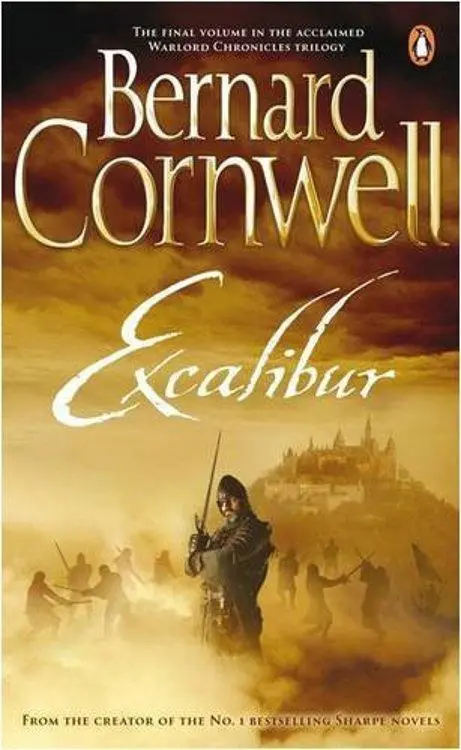
- Название:Excalibur
- Автор:
- Издательство:MacMillan Publishers
- Жанр:
- Год:1999
- ISBN:нет данных
- Рейтинг книги:4 / 5. Голосов: 2
-
Избранное:Добавить в избранное
- Отзывы:
-
Ваша оценка:
Excalibur: краткое содержание, описание и аннотация
Предлагаем к чтению аннотацию, описание, краткое содержание или предисловие (зависит от того, что написал сам автор книги «Excalibur»). Если вы не нашли необходимую информацию о книге — напишите в комментариях, мы постараемся отыскать её.
to Marion Zimmer Bradley's
, the legend of King Arthur has haunted and inspired generations of writers to reinvent the ancient story. In
and
, Bernard Cornwell demonstrated his astonishing ability to make the oft-told legend of King Arthur fresh and new for our time. Now, in this riveting final volume of the
, Cornwell tells the story of Arthur's desperate attempt to triumph over a ruined marriage and the Saxons' determination to destroy him.
Set against the backdrop of the Dark Ages, this brilliant saga continues as seen through the eyes of Derfel, an orphan brought up by Merlin and one of Arthur's warriors. In this book, the aging Arthur has been betrayed by, among others, his beloved Guinevere; but although he is alone and deeply saddened, he still embraces his dreams of a world in which civilization triumphs over brute force. Arthur and his warriors must face the dreaded Saxons — now allied with Arthur's betrayer Lancelot — for the throne of Britain.
This is the tale not only of a broken love remade but also of enemies more subtle than any Saxon spearman — of forces both earthly and unearthly that threaten everything Arthur stands for. When Merlin and Nimue embark on a dangerous quest to summon the Gods back to Britain, they unleash forces that will lead to a last desperate battle on the sands of Camlann, where it seems that Arthur must fail unless Merlin's final enchantment can avert the horror.
Peopled by princesses and bards, warriors and magicians, Excalibur is a story of love, war, loyalty, and betrayal, the unforgettable conclusion to a brilliant retelling of one of the most powerful legends of all time.
Excalibur — читать онлайн бесплатно полную книгу (весь текст) целиком
Ниже представлен текст книги, разбитый по страницам. Система сохранения места последней прочитанной страницы, позволяет с удобством читать онлайн бесплатно книгу «Excalibur», без необходимости каждый раз заново искать на чём Вы остановились. Поставьте закладку, и сможете в любой момент перейти на страницу, на которой закончили чтение.
Интервал:
Закладка:
‘Ceinwyn doesn’t,’ I said.
He gave me a sharp look. He must have been wondering if she had told me about his proposal of marriage, but my face betrayed nothing and he must have decided she had not spoken. ‘No,’ he said. He hesitated again, then laughed awkwardly. ‘Argante believes I should have stepped through the flames as a way of marking the marriage, but I told her I don’t need dead lambs to tell me I’m married.’
‘I never had a chance to congratulate you on your marriage,’ I said very formally, ‘so let me do so now. She’s a beautiful girl.’
That pleased him. ‘She is,’ he said, then blushed. ‘But only a child.’
‘Culhwch says they should all be taken young, Lord,’ I said lightly. He ignored my levity. ‘I hadn’t meant to marry,’ he said quietly. I said nothing. He was not looking at me, but staring across the fallow fields. ‘But a man should be married,’ he said firmly, as if trying to convince himself.
‘Indeed,’ I agreed.
‘And Oengus was enthusiastic. Come spring, Derfel, he’ll bring all his army. And they’re good fighters, the Blackshields.’
‘None better, Lord,’ I said, but I reflected that Oengus would have brought his warriors whether Arthur had married Argante or not. What Oengus had really wanted, of course, was Arthur’s alliance against Cuneglas of Powys, whose lands Oengus’s spearmen were forever raiding, but doubtless the wily Irish King had suggested to Arthur that the marriage would guarantee the arrival of his Blackshields for the spring campaign. The marriage had plainly been arranged in haste and now, just as plainly, Arthur was regretting it.
‘She wants children, of course,’ Arthur said, still thinking of the horrid rites that had bloodied Lindinis’s courtyard.
‘Don’t you, Lord?’
‘Not yet,’ he said curtly. ‘Better to wait, I think, till the Saxon business is over.’
‘Speaking of which,’ I said, ‘I have a request from the Lady Guinevere.’ Arthur gave me another sharp look, but said nothing. ‘Guinevere fears,’ I went on, ‘that she will be vulnerable if the Saxons attack in the south. She begs you to move her prison to a safer place.’
Arthur leaned forward to fondle his horse’s ears. I had expected him to be angry at the mention of Guinevere, but he showed no irritation. ‘The Saxons might attack in the south,’ he said mildly, ‘in fact I hope they do, for then they’ll split their forces into two and we can pluck them one at a time. But the greater danger, Derfel, is if they make one single attack along the Thames, and I must plan for the greater, not the lesser, danger.’
‘But it would surely be prudent,’ I urged him, ‘to move whatever is valuable from southern Dumnonia?’
He turned to look at me. His gaze was mocking, as though he despised me for showing sympathy to Guinevere. ‘Is she valuable, Derfel?’ he asked. I said nothing and Arthur turned away from me to stare across the pale fields where thrushes and blackbirds hunted the furrows for worms. ‘Should I kill her?’
he suddenly asked me.
‘Kill Guinevere?’ I responded, shocked at the suggestion, then decided that Argante was probably behind his words. She must have resented that Guinevere still lived after committing an offence for which her sister had died. ‘The decision, Lord,’ I said, ‘is not mine, but surely, if it was death she deserved, it should have been given months ago? Not now.’
He grimaced at that advice. ‘What will the Saxons do with her?’ he asked.
‘She thinks they’ll rape her. I suspect they’ll put her on a throne.’
He glowered across the pale landscape. He knew I meant Lancelot’s throne, and he was imagining the embarrassment of his mortal enemy on Dumnonia’s throne with Guinevere beside him and Cerdic holding their power. It was an unbearable thought. ‘If she’s in any danger of capture,’ he said harshly, ‘then you will kill her.’
I could hardly believe what I had heard. I stared at him, but he refused to look me in the eyes. ‘It’s simpler, surely,’ I said, ‘to move her to safety? Can’t she go to Glevum?’
‘I have enough to worry about,’ he snapped, ‘without wasting thought on the safety of traitors.’ For a few heartbeats his face looked as angry as I had ever seen it, but then he shook his head and sighed. ‘Do you know who I envy?’ he asked.
‘Tell me, Lord.’
‘Tewdric’
I laughed. ‘Tewdric! You want to be a constipated monk?’
‘He’s happy,’ Arthur said firmly, ‘he has found the life he always wanted. I don’t want the tonsure and I don’t care for his God, but I envy him all the same.’ He grimaced. ‘I wear myself out getting ready for a war no one except me believes we can win, and I want none of it. None of it! Mordred should be King, we took an oath to make him King, and if we beat the Saxons, Derfel, I’ll let him rule.’ He spoked defiantly, and I did not believe him. ‘All I ever wanted,’ he went on, ‘was a hall, some land, some cattle, crops in season, timber to burn, a smithy to work iron, a stream for water. Is it too much?’ He rarely indulged in such self-pity, and I just let his anger talk itself out. He had often expressed such a dream of a household tight in its own palisade, shielded from the world by deep woods and wide fields and filled with his own folk, but now, with Cerdic and Aelle gathering their spears, he must have known it was a hopeless dream. ‘I can’t hold Dumnonia for ever,’ he said, ‘and when we’ve beaten the Saxons it might be time to let other men bridle Mordred. As for me, I’ll follow Tewdric into happiness.’ He gathered his reins. ‘I can’t think about Guinevere now,’ he said, ‘but if she’s in any danger, you deal with her.’ And with that curt command he clapped his heels back and drove his horse away. I stayed where I was. I was appalled, but if I had thought beyond my disgust at his order, I should surely have known what was in his mind. He knew I would not kill Guinevere, and he knew therefore that she was safe, but by giving me the harsh order he was not required to betray any affection for her. Odi at amo, excrucior.
We killed nothing that morning.
In the afternoon the warriors gathered in the feasting-hall. Mordred was there, hunched in the chair that served as his throne. He had nothing to contribute for he was a king without a kingdom, yet Arthur accorded him a proper courtesy. Arthur began, indeed, by saying that when the Saxons came Mordred would ride with him and that the whole army would fight beneath Mordred’s banner of the red dragon. Mordred nodded his agreement, but what else could he do? In truth, and we all knew it, Arthur was not offering Mordred a chance of redeeming his reputation in battle, but ensuring that he could make no mischief. Mordred’s best chance of regaining his power was to ally himself with our enemies by offering himself as a puppet king to Cerdic, but instead he would be a prisoner of Arthur’s hard warriors. Arthur then confirmed that King Meurig of Gwent would not fight. That news, though no surprise, was met by a growl of hatred. Arthur hushed the protest. Meurig, he said, was convinced that the coming war was not Gwent’s battle, but the King had still given his grudging permission for Cuneglas to bring the army of Powys south across Gwent’s land and for Oengus to march his Blackshields through his kingdom. Arthur said nothing of Meurig’s ambition to rule Dumnonia, perhaps because he knew that such an announcement would only make us even angrier with the King of Gwent, and Arthur still hoped that somehow he could change Meurig’s mind and so did not want to provoke more hatred between us and Gwent. The forces of Powys and Demetia, Arthur said, would converge on Corinium, for that walled Roman city was to be Arthur’s base and the place where all our supplies were to be concentrated. ‘We start supplying Corinium tomorrow,’ Arthur said. ‘I want it crammed with food, for it’s there we shall fight our battle.’ He paused. ‘One vast battle,’ he said, ‘with all their forces against every man we can raise.’
Читать дальшеИнтервал:
Закладка:
Похожие книги на «Excalibur»
Представляем Вашему вниманию похожие книги на «Excalibur» списком для выбора. Мы отобрали схожую по названию и смыслу литературу в надежде предоставить читателям больше вариантов отыскать новые, интересные, ещё непрочитанные произведения.







Обсуждение, отзывы о книге «Excalibur» и просто собственные мнения читателей. Оставьте ваши комментарии, напишите, что Вы думаете о произведении, его смысле или главных героях. Укажите что конкретно понравилось, а что нет, и почему Вы так считаете.