Bernard Cornwell - Excalibur
Здесь есть возможность читать онлайн «Bernard Cornwell - Excalibur» весь текст электронной книги совершенно бесплатно (целиком полную версию без сокращений). В некоторых случаях можно слушать аудио, скачать через торрент в формате fb2 и присутствует краткое содержание. Год выпуска: 1999, Издательство: MacMillan Publishers, Жанр: Историческая проза, на английском языке. Описание произведения, (предисловие) а так же отзывы посетителей доступны на портале библиотеки ЛибКат.
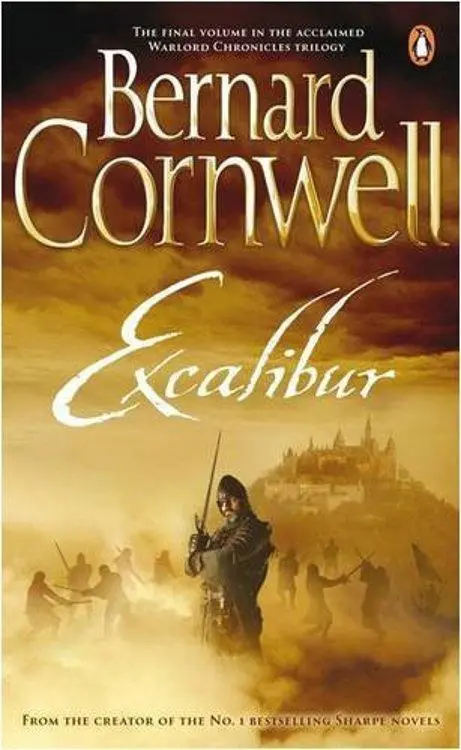
- Название:Excalibur
- Автор:
- Издательство:MacMillan Publishers
- Жанр:
- Год:1999
- ISBN:нет данных
- Рейтинг книги:4 / 5. Голосов: 2
-
Избранное:Добавить в избранное
- Отзывы:
-
Ваша оценка:
Excalibur: краткое содержание, описание и аннотация
Предлагаем к чтению аннотацию, описание, краткое содержание или предисловие (зависит от того, что написал сам автор книги «Excalibur»). Если вы не нашли необходимую информацию о книге — напишите в комментариях, мы постараемся отыскать её.
to Marion Zimmer Bradley's
, the legend of King Arthur has haunted and inspired generations of writers to reinvent the ancient story. In
and
, Bernard Cornwell demonstrated his astonishing ability to make the oft-told legend of King Arthur fresh and new for our time. Now, in this riveting final volume of the
, Cornwell tells the story of Arthur's desperate attempt to triumph over a ruined marriage and the Saxons' determination to destroy him.
Set against the backdrop of the Dark Ages, this brilliant saga continues as seen through the eyes of Derfel, an orphan brought up by Merlin and one of Arthur's warriors. In this book, the aging Arthur has been betrayed by, among others, his beloved Guinevere; but although he is alone and deeply saddened, he still embraces his dreams of a world in which civilization triumphs over brute force. Arthur and his warriors must face the dreaded Saxons — now allied with Arthur's betrayer Lancelot — for the throne of Britain.
This is the tale not only of a broken love remade but also of enemies more subtle than any Saxon spearman — of forces both earthly and unearthly that threaten everything Arthur stands for. When Merlin and Nimue embark on a dangerous quest to summon the Gods back to Britain, they unleash forces that will lead to a last desperate battle on the sands of Camlann, where it seems that Arthur must fail unless Merlin's final enchantment can avert the horror.
Peopled by princesses and bards, warriors and magicians, Excalibur is a story of love, war, loyalty, and betrayal, the unforgettable conclusion to a brilliant retelling of one of the most powerful legends of all time.
Excalibur — читать онлайн бесплатно полную книгу (весь текст) целиком
Ниже представлен текст книги, разбитый по страницам. Система сохранения места последней прочитанной страницы, позволяет с удобством читать онлайн бесплатно книгу «Excalibur», без необходимости каждый раз заново искать на чём Вы остановились. Поставьте закладку, и сможете в любой момент перейти на страницу, на которой закончили чтение.
Интервал:
Закладка:
Sagramor could have indeed been that dark God, for he was dressed in black leather and had a black-scabbarded sword at his hip. He had come to Lindinis with his big, placid Saxon wife, Malla, and the two stood apart from the rest of us at the far side of the courtyard. Sagramor worshipped Mithras but had little time for the British Gods, while Malla still prayed to Woden, Eostre, Thunor, Fir and Seaxnet: all Saxon deities.
All Arthur’s leaders were there, though, as I waited for Arthur, I thought of the men who were missing. Cei, who had grown up with Arthur in distant Gwynedd, had died in Dumnonian Isca during Lancelot’s rebellion. He had been murdered by Christians. Agravain, who for years had been the commander of Arthur’s horsemen, had died during the winter, struck down by a fever. Balin had taken over Agravain’s duties, and he had brought three wives to Lindinis, together with a tribe of small stocky children who stared in horror at Morfans, the ugliest man of Britain, whose face was now so familiar to the rest of us that we no longer noticed his hare lip, goitred neck or twisted jaw. Except for Gwydre, who was still a boy, I was probably the youngest man there and that realization shocked me. We needed new warlords, and I decided then and there that I would give Issa his own band of men as soon as the Saxon war was over. If Issa lived. If I lived.
Galahad was looking after Gwydre and the two of them came to stand with Ceinwyn and me. Galahad had always been a handsome man, but now, as he grew into his middle years, those good looks possessed a new dignity. His hair had turned from its bright gold into grey, and he now wore a small pointed beard. He and I had always been close, but in that difficult winter he was probably closer to Arthur than to anyone else. Galahad had not been present at the sea palace to see Arthur’s shame, and that, together with his calm sympathy, made him acceptable to Arthur. Ceinwyn, keeping her voice low so that Gwydre could not hear, asked him how Arthur was. ‘I wish I knew,’ Galahad said.
‘He’s surely happy,’ Ceinwyn observed.
‘Why?’
‘A new wife?’ Ceinwyn suggested.
Galahad smiled. ‘When a man makes a journey, dear Lady, and has his horse stolen in the course of it, he frequently buys a replacement too hastily.’
‘And doesn’t ride it thereafter, I hear?’ I put in brutally.
‘Do you hear that, Derfel?’ Galahad answered, neither confirming nor denying the rumour. He smiled.
‘Marriage is such a mystery to me,’ he added vaguely. Galahad himself had never married. Indeed he had never really settled since Ynys Trebes, his home, had fallen to the Franks. He had been in Dumnonia ever since and he had seen a generation of children grow to adulthood in that time, but he still seemed like a visitor. He had rooms in the palace at Durnovaria, but kept little furniture there and scant comfort. He rode errands for Arthur, travelling the length of Britain to resolve problems with other kingdoms, or else riding with Sagramor in raids across the Saxon frontier, and he seemed happiest when he was thus kept busy. I had sometimes suspected that he was in love with Guinevere, but Ceinwyn had always mocked that thought. Galahad, she said, was in love with perfection and was too fastidious to love an actual woman. He loved the idea of women, Ceinwyn said, but could not bear the reality of disease and blood and pain. He showed no revulsion at such things in battle, but that, Ceinwyn declared, was because in battle it was men who were bloody and men who were fallible, and Galahad had never idealized men, only women. And maybe she was right. I only knew that at times my friend had to be lonely, though he never complained. ‘Arthur’s very proud of Argante,’ he now said mildly, though in a tone which suggested he was leaving something unsaid.
‘But she’s no Guinevere?’ I suggested.
‘She’s certainly no Guinevere,’ Galahad agreed, grateful that I had voiced the thought, ‘though she’s not unlike her in some ways.’
‘Such as?’ Ceinwyn asked.
‘She has ambitions,’ Galahad said dubiously. ‘She thinks Arthur should cede Siluria to her father.’
‘Siluria isn’t his to yield!’ I said.
‘No,’ Galahad agreed, ‘but Argante thinks he could conquer it.’
I spat. To conquer Siluria, Arthur would need to fight Gwent and even Powys, the two countries that jointly ruled the territory. ‘Mad,’ I said.
‘Ambitious, if unrealistic,’ Galahad corrected me.
‘Do you like Argante?’ Ceinwyn asked him directly.
He was spared the need to answer because the palace door was suddenly thrown open and Arthur at last appeared. He was robed in his customary white, and his face that had grown so gaunt over the last months looked suddenly old. That was a cruel fate, for on his arm, robed in gold, was his new bride and that new bride was little more than a child.
That was the first time I saw Argante, Princess of the Ui Liathain and Iseult’s sister, and in many ways she resembled the doomed Iseult. Argante was a fragile creature poised between girlhood and womanhood, and on that night of Imbolc’s Eve she looked closer to childhood than adulthood for she was swathed in a great cloak of stiff linen that had surely once belonged to Guinevere. The robe was certainly too big for Argante, who walked awkwardly in its golden folds. I remembered seeing her sister hung with jewels and thinking that Iseult had looked like a child arrayed in its mother’s gold and Argante gave the same impression of being dressed up for play and, just like a child pretending to adulthood, she carried herself with a self-absorbed solemnity to defy her innate lack of dignity. She wore her glossy black hair in a long tress that was twisted about her skull and held in place with a brooch of jet, the same colour as the shields of her father’s feared warriors, and the adult style sat uneasily on her young face, just as the heavy golden torque about her neck seemed too massive for her slender throat. Arthur led her to the dais and there bowed her into the left-hand chair and I doubt there was a single soul in the courtyard, whether guest, Druid or guard, who did not think how like father and daughter they appeared. There was a pause once Argante was seated. It was an awkward moment, as though a piece of ritual had been forgotten and a solemn ceremony was in danger of becoming ridiculous, but then there was a scuffle in the doorway, a snigger of laughter, and Mordred came into view. Our King limped on his clubbed foot and with a sly smile on his face. Like Argante he was playing a role, but unlike her he was an unwilling player. He knew that every man in that courtyard was Arthur’s man and that all hated him, and that while they pretended he was their King he lived only by their sufferance. He climbed the dais. Arthur bowed and we all followed suit. Mordred, his stiff hair as unruly as ever and his beard an ugly fringe to his round face, nodded curtly, then sat in the centre chair. Argante gave him a surprisingly friendly glance, Arthur took the last chair, and there they sat, Emperor, King and child bride.
I could not help thinking that Guinevere would have done all this so much better. There would have been heated mead to drink, more fires for warmth, and music to drown the awkward silences, but on this night no one seemed to know what was supposed to happen, until Argante hissed at her father’s Druid. Fergal glanced about nervously, then scuttled across the courtyard to snatch up one of the becketed torches. He used the torch to ignite the hoop, then muttered incomprehensible incantations as the flames seized the straw.
The five newborn lambs were carried from the pen by slaves. The ewes called miserably for their missing offspring that wriggled in the slaves’ arms. Fergal waited until the hoop was a complete circle of fire, then ordered the lambs be herded through the flames. Confusion followed. The lambs, having no idea that the fertility of Dumnonia depended on their obedience, scattered in every direction except towards the fire and Balin’s children happily joined the whooping hunt and only succeeded in compounding the confusion, but at last, one by one, the lambs were collected and shooed towards the hoop, and in time all five were persuaded to jump through the circlet of fire, but by then the courtyard’s intended solemnity had been shattered. Argante, who was doubtless accustomed to seeing such ceremonies performed much better in her native Demetia, frowned, but the rest of us laughed and chatted. Fergal restored the night’s dignity by suddenly uttering a feral scream that froze us all. The Druid was standing with his head thrown back so that he stared up at the clouds, and in his right hand there was lifted a broad flint knife, and in his left, where it struggled helplessly, was a lamb.
Читать дальшеИнтервал:
Закладка:
Похожие книги на «Excalibur»
Представляем Вашему вниманию похожие книги на «Excalibur» списком для выбора. Мы отобрали схожую по названию и смыслу литературу в надежде предоставить читателям больше вариантов отыскать новые, интересные, ещё непрочитанные произведения.







Обсуждение, отзывы о книге «Excalibur» и просто собственные мнения читателей. Оставьте ваши комментарии, напишите, что Вы думаете о произведении, его смысле или главных героях. Укажите что конкретно понравилось, а что нет, и почему Вы так считаете.