Bernard Cornwell - Excalibur
Здесь есть возможность читать онлайн «Bernard Cornwell - Excalibur» весь текст электронной книги совершенно бесплатно (целиком полную версию без сокращений). В некоторых случаях можно слушать аудио, скачать через торрент в формате fb2 и присутствует краткое содержание. Год выпуска: 1999, Издательство: MacMillan Publishers, Жанр: Историческая проза, на английском языке. Описание произведения, (предисловие) а так же отзывы посетителей доступны на портале библиотеки ЛибКат.
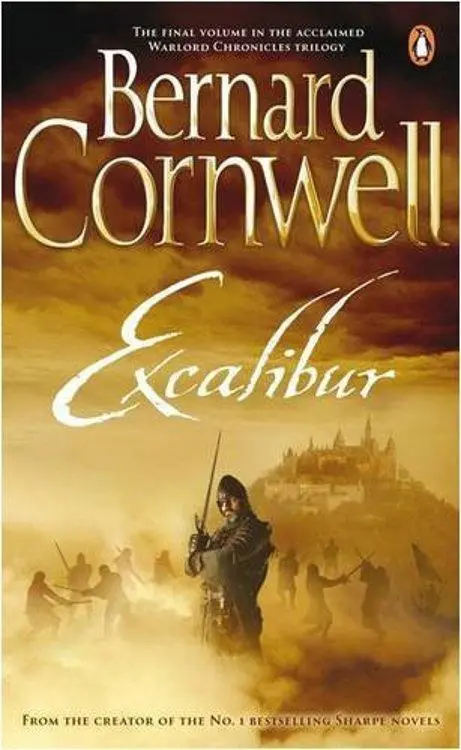
- Название:Excalibur
- Автор:
- Издательство:MacMillan Publishers
- Жанр:
- Год:1999
- ISBN:нет данных
- Рейтинг книги:4 / 5. Голосов: 2
-
Избранное:Добавить в избранное
- Отзывы:
-
Ваша оценка:
Excalibur: краткое содержание, описание и аннотация
Предлагаем к чтению аннотацию, описание, краткое содержание или предисловие (зависит от того, что написал сам автор книги «Excalibur»). Если вы не нашли необходимую информацию о книге — напишите в комментариях, мы постараемся отыскать её.
to Marion Zimmer Bradley's
, the legend of King Arthur has haunted and inspired generations of writers to reinvent the ancient story. In
and
, Bernard Cornwell demonstrated his astonishing ability to make the oft-told legend of King Arthur fresh and new for our time. Now, in this riveting final volume of the
, Cornwell tells the story of Arthur's desperate attempt to triumph over a ruined marriage and the Saxons' determination to destroy him.
Set against the backdrop of the Dark Ages, this brilliant saga continues as seen through the eyes of Derfel, an orphan brought up by Merlin and one of Arthur's warriors. In this book, the aging Arthur has been betrayed by, among others, his beloved Guinevere; but although he is alone and deeply saddened, he still embraces his dreams of a world in which civilization triumphs over brute force. Arthur and his warriors must face the dreaded Saxons — now allied with Arthur's betrayer Lancelot — for the throne of Britain.
This is the tale not only of a broken love remade but also of enemies more subtle than any Saxon spearman — of forces both earthly and unearthly that threaten everything Arthur stands for. When Merlin and Nimue embark on a dangerous quest to summon the Gods back to Britain, they unleash forces that will lead to a last desperate battle on the sands of Camlann, where it seems that Arthur must fail unless Merlin's final enchantment can avert the horror.
Peopled by princesses and bards, warriors and magicians, Excalibur is a story of love, war, loyalty, and betrayal, the unforgettable conclusion to a brilliant retelling of one of the most powerful legends of all time.
Excalibur — читать онлайн бесплатно полную книгу (весь текст) целиком
Ниже представлен текст книги, разбитый по страницам. Система сохранения места последней прочитанной страницы, позволяет с удобством читать онлайн бесплатно книгу «Excalibur», без необходимости каждый раз заново искать на чём Вы остановились. Поставьте закладку, и сможете в любой момент перейти на страницу, на которой закончили чтение.
Интервал:
Закладка:
‘A siege?’ Culhwch asked, surprised.
‘No,’ Arthur said. Instead, he explained, he intended to use Corinium as a lure. The Saxons would soon hear that the town was filled with salted meat, dried fish and grain, and, like any great horde on the march, they would be short of food themselves and so would be drawn to Corinium like a fox to a duckpond, and there he planned to destroy them. ‘They will besiege it,’ he said, ‘and Morfans will defend it.’ Morfans, forewarned of that duty, nodded his agreement. ‘But the rest of us,’ Arthur went on,
‘will be in the hills north of the city. Cerdic will know he has to destroy us and he’ll break off his siege to do that. Then we’ll fight him on ground of our choosing.’
The whole plan depended on both Saxon armies advancing up the valley of the Thames, and all the signs indicated that this was indeed the Saxon intention. They were piling supplies into London and Pontes, and making no preparations on the southern frontier. Culhwch, who guarded that southern border, had raided deep into Lloegyr and told us that he had found no concentration of spearmen, nor any indication that Cerdic was hoarding grain or meat in Venta or any other of the frontier towns. Everything pointed, Arthur said, to a simple, brutal and overwhelming assault up the Thames aimed at the shore of the Severn Sea with the decisive battle being fought somewhere near Corinium. Sagramor’s men had already built great warning beacons on the hilltops on either side of the Thames valley, and still more beacons had been made on the hills spreading south and west into Dumnonia, and when we saw the smoke of those fires we were all to march to our places.
‘That won’t be until after Beltain,’ Arthur said. He had spies in both Aelle’s and Cerdic’s halls, and all had reported that the Saxons would wait until after the feast of their Goddess Eostre which would be celebrated a whole week after Beltain. The Saxons wished the Goddess’s blessing, Arthur explained, and they wanted to give the new season’s boats time to come across the sea with their hulls packed with yet more hungry fighting men.
But after Eostre’s feast, he said, the Saxons would advance and he would let them come deep into Dumnonia without a battle, though he planned to harass them all the way. Sagramor, with his battle-hardened spearmen, would retreat in front of the Saxon horde and offer whatever resistance he could short of a shield wall, while Arthur gathered the allied army at Corinium. Culhwch and I had different orders. Our task was to defend the hills south of the Thames valley. We could not expect to defeat any determined Saxon thrust that came south through those hills, but Arthur did not expect any such attack. The Saxons, he said again and again, would keep marching westwards, ever westwards along the Thames, but they were bound to send raiding parties into the southern hills in search of grain and cattle. Our task was to stop those raiding parties, thus forcing the scavengers to go north instead. That would take the Saxons across the Gwentian border and might spur Meurig into a declaration of war. The unspoken thought in that hope, though each of us in that smoky room nevertheless understood it, was that without Gwent’s well-trained spearmen the great battle near Corinium would be a truly desperate affair. ‘So fight them hard,’ Arthur told Culhwch and me. ‘Kill their foragers, scare them, but don’t be caught in battle. Harass them, frighten them, but once they’re within a day’s march of Corinium, leave them alone. Just march to join me.’ He would need every spear he could gather to fight that great battle outside Corinium, and Arthur seemed sure that we could win it so long as our forces had the high ground.
It was, in its way, a good plan. The Saxons would be lured deep into Dumnonia and there be forced to attack up some steep hill, but the plan depended on the enemy doing exactly as Arthur wanted, and Cerdic, I thought, was not an obliging man. Yet Arthur seemed confident enough, and that, at least, was comforting.
We all went home. I made myself unpopular by searching all the houses in my district and confiscating grain, salted meat and dried fish. We left enough supplies to keep the folk alive, but sent the rest to Corinium where it would feed Arthur’s army. It was a distasteful business, for peasants fear hunger almost as much as they fear enemy spearmen, and we were forced to search for hiding places and ignore the screams of women who accused us of tyranny. But better our searches, I told them, than Saxon ravages.
We also readied ourselves for battle. I laid out my wargear and my slaves oiled the leather jerkin, polished the mail coat, combed out the wolf-hair plume on the helmet and repainted the white star on my heavy shield. The new year came with the blackbird’s first song. Missel thrushes called from the high twigs of the larches behind Dun Caric’s hill, and we paid the children of the village to run with pots and sticks through the apple orchards to scare away the bullfinches that would steal the tiny fruit buds. Sparrows nested and the stream glinted with the returning salmon. The dusks were made noisy by flocks of pied wagtails. Within a few weeks there were blossoms on the hazel, dog violets in the woods and gold-touched cones on the sallow trees. Buck hares danced in the fields where the lambs played. In March there was a swarm of toads and I feared what it meant, but there was no Merlin to ask, for he, with Nimue, had vanished and it seemed we must fight without his help. Larks sang, and the predatory magpies hunted for new-laid eggs along hedgerows that still lacked their cover of foliage. The leaves came at last, and with them news of the first warriors arriving south from Powys. They were few in number, for Cuneglas did not want to exhaust the food supplies being piled in Corinium, but their arrival gave promise of the greater army that Cuneglas would lead south after Beltain. Our calves were born, butter was churned and Ceinwyn busied herself cleaning out the hall after the long smoky winter.
They were odd and bittersweet days, for there was the promise of war in a new spring that was suddenly glorious with sundrenched skies and flower-bright meadows. The Christians preach of’the last days’, by which they mean those times before the world’s ending, and maybe folk will feel then as we did in that soft and lovely spring. There was an unreal quality to everyday life which made every small task special. Maybe this would be the last time we would ever burn winter straw from our bedding and maybe the last time we would ever heave a calf all bloody from its mother’s womb into the world. Everything was special, because everything was threatened.
We also knew that the coming Beltain might be the last we would ever know as a family and so we tried to make it memorable. Beltain greets the new year’s life, and on the eve of the feast we let all the fires die in Dun Caric. The kitchen fires, that had burned all winter long, went unfed all day and by night they were nothing but embers. We raked them out, swept the hearths clean, then laid new fires, while on a hill to the east of the village we heaped two great piles of firewood, one of them stacked about the sacred tree that Pyrlig, our bard, had selected. It was a young hazel that we had cut down and carried ceremonially through the village, across the stream and up the hill. The tree was hung with scraps of cloth, and all the houses, like the hall itself, were decked with new young hazel boughs. That night, all across Britain, the fires were dead. On Beltain Eve darkness rules. The feast was laid in our hall, but there was no fire to cook it and no flame to light the high rafters. There was no light anywhere, except in the Christian towns where folks heaped their fires to defy the Gods, but in the countryside all was dark. At dusk we had climbed the hill, a mass of villagers and spearmen driving cattle and sheep that were folded into wattle enclosures. Children played, but once the great dark fell the smallest children fell asleep and their little bodies lay in the grass as the rest of us gathered about the unlit fires and there sang the Lament of Annwn.
Читать дальшеИнтервал:
Закладка:
Похожие книги на «Excalibur»
Представляем Вашему вниманию похожие книги на «Excalibur» списком для выбора. Мы отобрали схожую по названию и смыслу литературу в надежде предоставить читателям больше вариантов отыскать новые, интересные, ещё непрочитанные произведения.








Обсуждение, отзывы о книге «Excalibur» и просто собственные мнения читателей. Оставьте ваши комментарии, напишите, что Вы думаете о произведении, его смысле или главных героях. Укажите что конкретно понравилось, а что нет, и почему Вы так считаете.