Bernard Cornwell - Excalibur
Здесь есть возможность читать онлайн «Bernard Cornwell - Excalibur» весь текст электронной книги совершенно бесплатно (целиком полную версию без сокращений). В некоторых случаях можно слушать аудио, скачать через торрент в формате fb2 и присутствует краткое содержание. Год выпуска: 1999, Издательство: MacMillan Publishers, Жанр: Историческая проза, на английском языке. Описание произведения, (предисловие) а так же отзывы посетителей доступны на портале библиотеки ЛибКат.
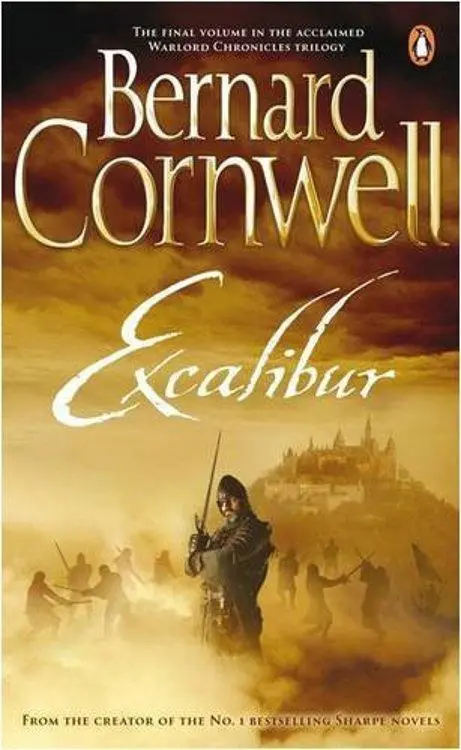
- Название:Excalibur
- Автор:
- Издательство:MacMillan Publishers
- Жанр:
- Год:1999
- ISBN:нет данных
- Рейтинг книги:4 / 5. Голосов: 2
-
Избранное:Добавить в избранное
- Отзывы:
-
Ваша оценка:
Excalibur: краткое содержание, описание и аннотация
Предлагаем к чтению аннотацию, описание, краткое содержание или предисловие (зависит от того, что написал сам автор книги «Excalibur»). Если вы не нашли необходимую информацию о книге — напишите в комментариях, мы постараемся отыскать её.
to Marion Zimmer Bradley's
, the legend of King Arthur has haunted and inspired generations of writers to reinvent the ancient story. In
and
, Bernard Cornwell demonstrated his astonishing ability to make the oft-told legend of King Arthur fresh and new for our time. Now, in this riveting final volume of the
, Cornwell tells the story of Arthur's desperate attempt to triumph over a ruined marriage and the Saxons' determination to destroy him.
Set against the backdrop of the Dark Ages, this brilliant saga continues as seen through the eyes of Derfel, an orphan brought up by Merlin and one of Arthur's warriors. In this book, the aging Arthur has been betrayed by, among others, his beloved Guinevere; but although he is alone and deeply saddened, he still embraces his dreams of a world in which civilization triumphs over brute force. Arthur and his warriors must face the dreaded Saxons — now allied with Arthur's betrayer Lancelot — for the throne of Britain.
This is the tale not only of a broken love remade but also of enemies more subtle than any Saxon spearman — of forces both earthly and unearthly that threaten everything Arthur stands for. When Merlin and Nimue embark on a dangerous quest to summon the Gods back to Britain, they unleash forces that will lead to a last desperate battle on the sands of Camlann, where it seems that Arthur must fail unless Merlin's final enchantment can avert the horror.
Peopled by princesses and bards, warriors and magicians, Excalibur is a story of love, war, loyalty, and betrayal, the unforgettable conclusion to a brilliant retelling of one of the most powerful legends of all time.
Excalibur — читать онлайн бесплатно полную книгу (весь текст) целиком
Ниже представлен текст книги, разбитый по страницам. Система сохранения места последней прочитанной страницы, позволяет с удобством читать онлайн бесплатно книгу «Excalibur», без необходимости каждый раз заново искать на чём Вы остановились. Поставьте закладку, и сможете в любой момент перейти на страницу, на которой закончили чтение.
Интервал:
Закладка:
Mordred left within the hour. The King rode in his armour and with his standard flying. I almost ordered him to furl the standard, for the sight of the dragon would only provoke more rumours in the country, but maybe it was no bad thing to spread alarm because folk needed time to prepare and to hide their valuables. I watched the King’s horses clatter through the gate and turn north, then I went back into the palace where the steward, a lamed spearman named Dyrrig, was shouting at slaves to gather the palace’s treasures. Candle-stands, pots and cauldrons were being carried to the back garden to be concealed in a dry well, while bedspreads, linens and clothes were being piled on carts to be hidden in the nearby woods. ‘The furniture can stay,’ Dyrrig told me sourly, ‘the Saxons are welcome to it.’
I wandered through the palace’s rooms and tried to imagine the Saxons whooping between the pillars, smashing the fragile chairs and shattering the delicate mosaics. Who would live here, I wondered? Cerdic? Lancelot? If anyone, I decided, it would be Lancelot, for the Saxons seemed to have no taste for Roman luxury. They left places like Lindinis to rot and built their own timber and thatch halls nearby. I lingered in the throne room, trying to imagine it lined with the mirrors that Lancelot so loved. He existed in a world of polished metal so that he could ever admire his own beauty. Or perhaps Cerdic would destroy the palace to show that the old world of Britain was ended and that the new brutal reign of the Saxons had begun. It was a melancholy, self-indulgent moment, broken when Dyrrig shuffled into the room trailing his maimed leg. ‘I’ll save the furniture if you want,’ he said grudgingly.
‘No,’ I said.
Dyrrig plucked a blanket off a couch. ‘The little bastard left three girls here, and one of them’s pregnant. I suppose I’ll have to give them gold. He won’t. Now, what’s this?’ He had stopped behind the carved chair that served as Mordred’s throne and I joined him to see that there was a hole in the floor. ‘Wasn’t there yesterday,’ Dyrrig insisted.
I knelt down and found that a complete section of the mosaic floor had been lifted. The section was at the edge of the room, where bunches of grapes formed a border to the central picture of a reclining God attended by nymphs, and one whole bunch of grapes had been carefully lifted out from the border. I saw that the small tiles had been glued to a piece of leather cut to the shape of the grapes, and beneath them there had been a layer of narrow Roman bricks that were now scattered under the chair. It was a deliberate hiding place, giving access to the flues of the old heating chamber that ran beneath the floor. Something glinted at the bottom of the heating chamber and I leaned down and groped among the dust and debris to bring up two small gold buttons, a scrap of leather and what, with a grimace, I realized were mice droppings. I brushed my hands clean, then handed one of the buttons to Dyrrig. The other, which I examined, showed a bearded, belligerent, helmeted face. It was crude work, but powerful in the intensity of the stare. ‘Saxon made,’ I said.
‘This one too, Lord,’ Dyrrig said, and I saw that his button was almost identical to mine. I peered again into the heating chamber, but could see no more buttons or coins. Mordred had plainly hidden a hoard of gold there, but the mice had nibbled the leather bag so that when he lifted the treasure free a couple of the buttons had fallen out.
‘So why does Mordred have Saxon gold?’ I asked.
‘You tell me, Lord,’ Dyrrig said, spitting into the hole.
I carefully propped the Roman bricks on the low stone arches that supported the floor, then pulled the leather-backed tiles into place. I could guess why Mordred had gold, and I did not like the answer. Mordred had been present when Arthur revealed the plans of his campaign against the Saxons, and that, I thought, was why the Saxons had been able to catch us off balance. They had known we would concentrate our forces on the Thames, so all the while they had let us believe that was where the assault would come and Cerdic had slowly and secretly built up his forces in the south. Mordred had betrayed us. I could not be certain of that for two golden buttons did not constitute proof, but it made a grim sense. Mordred wanted his power back, and though he would not gain all that power from Cerdic he would certainly get the revenge on Arthur that he craved. ‘How would the Saxons have managed to talk with Mordred?’ I asked Dyrrig.
‘Simple, Lord. There are always visitors here,’ Dyrrig said. ‘Merchants, bards, jugglers, girls.’
‘We should have slit his throat,’ I said bitterly, pocketing the button.
‘Why didn’t you?’ Dyrrig asked.
‘Because he’s Uther’s grandson,’ I said, ‘and Arthur would never permit it.’ Arthur had taken an oath to protect Mordred, and that oath bound Arthur for life. Besides, Mordred was our real King, and in him ran the blood of all our Kings back to Beli Mawr himself, and though Mordred was rotten, his blood was sacred and so Arthur kept him alive. ‘Mordred’s task,’ I said to Dyrrig, ‘is to whelp an heir of a proper wife, but once he’s given us a new King he would be well advised to wear an iron collar.’
‘No wonder he doesn’t marry,’ Dyrrig said. ‘And what happens if he never does? Suppose there’s no heir?’
‘That’s a good question,’ I said, ‘but let’s beat the Saxons before we worry about answering it.’
I left Dyrrig disguising the old dry well with brush. I could have ridden straight back to Dun Caric for I had looked after the urgent needs of the moment; Issa was on his way to escort Argante to safety, Mordred was safely gone north, but I still had one piece of unfinished business and so I rode north on the Fosse Way that ran beside the great swamps and lakes that edged Ynys Wydryn. Warblers were noisy among the reeds while sickle-winged martins were busy pecking beakfuls of mud to make their new nests beneath our eaves. Cuckoos called from the willows and birches that edged the marshland. The sun shone on Dumnonia, the oaks were in new green leaf and the meadows to my east were bright with cowslips and daisies. I did not ride hard, but let my mare amble until, a few miles north of Lindinis, I turned west onto the land bridge that reached towards Ynys Wydryn. So far I had been serving Arthur’s best interests by ensuring Argante’s safety and by securing Mordred, but now I risked his displeasure. Or maybe I did exactly what he had always wanted me to do.
I went to the shrine of the Holy Thorn, where I found Morgan preparing to leave. She had heard no definite news, but rumour had done its work and she knew Ynys Wydryn was threatened. I told her what little I knew and after she had heard that scanty news she peered up at me from behind her golden mask.
‘So where is my husband?’ she demanded shrilly.
‘I don’t know, Lady,’ I said. So far as I knew Sansum was still a prisoner in Bishop Emrys’s house in Durnovaria.
‘You don’t know,’ Morgan snapped at me, ‘and you don’t care!’
‘In truth, Lady, I don’t,’ I told her. ‘But I assume he’ll flee north like everyone else.’
‘Then tell him we’ve gone to Siluria. To Isca.’ Morgan, naturally, was quite prepared for the emergency. She had been packing the shrine’s treasures in anticipation of the Saxon invasion, and boatmen were ready to carry those treasures and the Christian women across Ynys Wydryn’s lakes to the coast where other boats were waiting to carry them north across the Severn Sea to Siluria. ‘And tell Arthur I’m praying for him,’ Morgan added, ‘though he doesn’t deserve my prayers. And tell him I have his whore safe.’
‘No, Lady,’ I said, for that was why I had ridden to Ynys Wydryn. To this day I am not exactly sure why I did not let Guinevere go with Morgan, but I think the Gods guided me. Or else, in the welter of confusion as the Saxons tore our careful preparations to tatters, I wanted to give Guinevere one last gift. We had never been friends, but in my mind I associated her with the good times, and though it was her foolishness that brought on the bad, I had seen how stale Arthur had been ever since Guinevere’s eclipse. Or perhaps I knew that in this terrible time we needed every strong soul we could muster, and there were few souls as tough as that of the Princess Guinevere of Henis-Wyren.
Читать дальшеИнтервал:
Закладка:
Похожие книги на «Excalibur»
Представляем Вашему вниманию похожие книги на «Excalibur» списком для выбора. Мы отобрали схожую по названию и смыслу литературу в надежде предоставить читателям больше вариантов отыскать новые, интересные, ещё непрочитанные произведения.





Обсуждение, отзывы о книге «Excalibur» и просто собственные мнения читателей. Оставьте ваши комментарии, напишите, что Вы думаете о произведении, его смысле или главных героях. Укажите что конкретно понравилось, а что нет, и почему Вы так считаете.