Bernard Cornwell - Excalibur
Здесь есть возможность читать онлайн «Bernard Cornwell - Excalibur» весь текст электронной книги совершенно бесплатно (целиком полную версию без сокращений). В некоторых случаях можно слушать аудио, скачать через торрент в формате fb2 и присутствует краткое содержание. Год выпуска: 1999, Издательство: MacMillan Publishers, Жанр: Историческая проза, на английском языке. Описание произведения, (предисловие) а так же отзывы посетителей доступны на портале библиотеки ЛибКат.
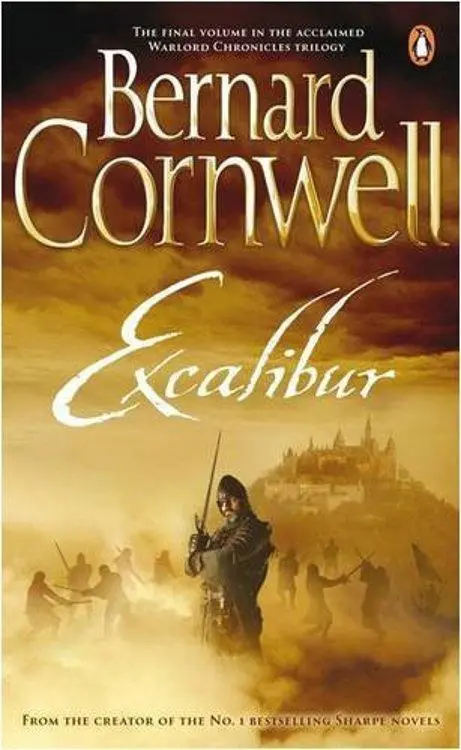
- Название:Excalibur
- Автор:
- Издательство:MacMillan Publishers
- Жанр:
- Год:1999
- ISBN:нет данных
- Рейтинг книги:4 / 5. Голосов: 2
-
Избранное:Добавить в избранное
- Отзывы:
-
Ваша оценка:
Excalibur: краткое содержание, описание и аннотация
Предлагаем к чтению аннотацию, описание, краткое содержание или предисловие (зависит от того, что написал сам автор книги «Excalibur»). Если вы не нашли необходимую информацию о книге — напишите в комментариях, мы постараемся отыскать её.
to Marion Zimmer Bradley's
, the legend of King Arthur has haunted and inspired generations of writers to reinvent the ancient story. In
and
, Bernard Cornwell demonstrated his astonishing ability to make the oft-told legend of King Arthur fresh and new for our time. Now, in this riveting final volume of the
, Cornwell tells the story of Arthur's desperate attempt to triumph over a ruined marriage and the Saxons' determination to destroy him.
Set against the backdrop of the Dark Ages, this brilliant saga continues as seen through the eyes of Derfel, an orphan brought up by Merlin and one of Arthur's warriors. In this book, the aging Arthur has been betrayed by, among others, his beloved Guinevere; but although he is alone and deeply saddened, he still embraces his dreams of a world in which civilization triumphs over brute force. Arthur and his warriors must face the dreaded Saxons — now allied with Arthur's betrayer Lancelot — for the throne of Britain.
This is the tale not only of a broken love remade but also of enemies more subtle than any Saxon spearman — of forces both earthly and unearthly that threaten everything Arthur stands for. When Merlin and Nimue embark on a dangerous quest to summon the Gods back to Britain, they unleash forces that will lead to a last desperate battle on the sands of Camlann, where it seems that Arthur must fail unless Merlin's final enchantment can avert the horror.
Peopled by princesses and bards, warriors and magicians, Excalibur is a story of love, war, loyalty, and betrayal, the unforgettable conclusion to a brilliant retelling of one of the most powerful legends of all time.
Excalibur — читать онлайн бесплатно полную книгу (весь текст) целиком
Ниже представлен текст книги, разбитый по страницам. Система сохранения места последней прочитанной страницы, позволяет с удобством читать онлайн бесплатно книгу «Excalibur», без необходимости каждый раз заново искать на чём Вы остановились. Поставьте закладку, и сможете в любой момент перейти на страницу, на которой закончили чтение.
Интервал:
Закладка:
‘Cynyr was the greatest of all the bards,’ he said wistfully, ‘though some say Amairgin of Gwynedd was better. I wish I’d heard either of them.’
‘My brother,’ Ceinwyn remarked, ‘says there is an even greater bard in Powys now. And just a young man, too.’
‘Who?’ Pyrlig demanded, scenting an unwelcome rival.
‘Taliesin is his name,’ Ceinwyn said.
‘Taliesin!’ Guinevere repeated the name, liking it. It meant ‘shining brow’.
‘I’ve never heard of him,’ Pyrlig said stiffly.
‘When we’ve beaten the Saxons,’ I said, ‘we shall demand a song of victory from this Taliesin. And from you too, Pyrlig,’ I added hastily.
‘I once heard Amairgin sing,’ Guinevere said.
‘You did, Lady?’ Pyrlig asked, again impressed.
‘I was only a child,’ she said, ‘but I remember he could make a hollow roaring sound. It was very frightening. His eyes would go very wide, he swallowed air, then he bellowed like a bull.’
‘Ah, the old style,’ Pyrlig said dismissively. ‘These days, Lady, we seek harmony of words rather than mere volume of sound.’
‘You should seek both,’ Guinevere said sharply. ‘I’ve no doubt this Taliesin is a master of the old style as well as being skilled at metre, but how can you hold an audience enthralled if all you offer them is clever rhythm? You must make their blood run cold, you must make them cry, you must make them laugh!’
‘Any man can make a noise, Lady,’ Pyrlig defended his craft, ‘but it takes a skilled craftsman to imbue words with harmony.’
‘And soon the only people who can understand the intricacies of the harmony,’ Guinevere argued, ‘are other skilled craftsmen, and so you become ever more clever in an effort to impress your fellow poets, but you forget that no one outside the craft has the first notion of what you’re doing. Bard chants to bard while the rest of us wonder what all the noise is about. Your task, Pyrlig, is to keep the people’s stories alive, and to do that you cannot be rarefied.’
‘You would not have us be vulgar, Lady!’ Pyrlig said and, in protest, struck the horsehair strings of his harp.
‘I would have you be vulgar with the vulgar, and clever with the clever,’ Guinevere said, ‘and both, mark you, at the same time, but if you can only be clever then you deny the people their stories, and if you can only be vulgar then no lord or lady will toss you gold.’
‘Except the vulgar lords,’ Ceinwyn put in slyly.
Guinevere glanced at me and I saw she was about to launch an insult at me, and then she recognized the impulse herself and burst into laughter. ‘If I had gold, Pyrlig,’ she said instead, ‘I would reward you, for you sing beautifully, but alas, I have none.’
‘Your praise is reward enough, Lady,’ Pyrlig said.
Guinevere’s presence had startled my spearmen and all evening I saw small groups of men come to stare at her in wonderment. She ignored their gaze. Ceinwyn had welcomed her without any show of astonishment, and Guinevere had been clever enough to be kind to my daughters so that Morwenna and Seren both now slept on the ground beside her. They, like my spearmen, had been fascinated by the tall, red-haired woman whose reputation was as startling as her looks. And Guinevere was simply happy to be there. We had no tables or chairs in our hall, just the rush floor and woollen carpets, but she sat beside the fire and effortlessly dominated the hall. There was a fierceness in her eyes that made her daunting, her cascade of tangled red hair made her striking and her joy at being free was infectious.
‘How long will she stay free?’ Ceinwyn asked me later that night. We had given up our private chamber to Guinevere, and were in the hall with the rest of our people.
‘I don’t know.’
‘So what do you know?’ Ceinwyn asked.
‘We wait for Issa, then we go north.’
‘To Corinium?’
‘I shall go to Corinium, but I’ll send you and the families to Glevum. You’ll be close enough to the fighting there and if the worst happens, you can go north into Gwent.’
I began to fret next day as Issa still did not appear. In my mind we were racing the Saxons towards Corinium, and the longer I was delayed, the more likely that race would be lost. If the Saxons could pick us off warband by warband then Dumnonia would fall like a rotted tree, and my warband, which was one of the strongest in the country, was stalled at Dun Caric because Issa and Argante had not appeared. At midday the urgency was even greater for it was then that we saw the first distant smears of smoke against the eastern and southern sky. No one commented on the tall, thin plumes, but we all knew that we saw burning thatch. The Saxons were destroying as they came, and they were close enough now for us to see their smoke.
I sent a horseman south to find Issa while the rest of us walked the two miles across the fields to the Fosse Way, the great Roman road that Issa should have been using. I planned to wait for him, then continue up the Fosse Way to Aquae Sulis which lay some twenty-five miles northwards, and then to Corinium which was another thirty miles further on. Fifty-five miles of road. Three days of long, hard effort.
We waited in a field of molehills beside the road. I had over a hundred spearmen and at least that number of women, children, slaves and servants. We had horses, mules and dogs, all waiting. Seren, Morwenna and the other children picked bluebells in a nearby wood while I paced up and down the broken stone of the road. Refugees were passing constantly, but none of them, even those who had come from Durnovaria, had any news of the Princess Argante. A priest thought he had seen Issa and his men arrive in that city because he had seen the five-pointed star on some spearmen’s shields, but he did not know if they were still there or had left. The one thing all the refugees were certain of was that the Saxons were near Durnovaria, though no one had actually seen a Saxon spearman. They had merely heard the rumours that had grown ever more wild as the hours passed. Arthur was said to be dead, or else he had fled to Rheged, while Cerdic was credited with possessing horses that breathed fire and magic axes that could cleave iron as though it were linen.
Guinevere had borrowed a bow from one of my huntsmen and was shooting arrows at a dead elm tree that grew beside the road. She shot well, putting shaft after shaft into the rotting wood, but when I complimented her on her skill, she grimaced. ‘I’m out of practice,’ she said, ‘I used to be able to take a running deer at a hundred paces, now I doubt I’d hit a standing one at fifty.’ She plucked the arrows from the tree. ‘But I think I might hit a Saxon, given the chance.’ She handed the bow back to my huntsman, who bowed and backed away. ‘If the Saxons are near Durnovaria,’ Guinevere asked me,
‘what do they do next?’
‘They come straight up this road,’ I said.
‘Not go further west?’
‘They know our plans,’ I said grimly, and told her about the golden buttons with the bearded faces that I had found in Mordred’s quarters. ‘Aelle’s marching towards Corinium while the others run ragged in the south. And we’re stuck here because of Argante.’
‘Let her rot,’ Guinevere said savagely, then shrugged. ‘I know you can’t. Does he love her?’
‘I wouldn’t know, Lady,’ I said.
‘Of course you’d know,’ Guinevere said sharply. ‘Arthur loves to pretend that he’s ruled by reason, but he yearns to be governed by passion. He would turn the world upside down for love.’
‘He hasn’t turned it upside down lately,’ I said.
‘He did for me, though,’ she said quietly, and not without a note of pride. ‘So where are you going?’
Читать дальшеИнтервал:
Закладка:
Похожие книги на «Excalibur»
Представляем Вашему вниманию похожие книги на «Excalibur» списком для выбора. Мы отобрали схожую по названию и смыслу литературу в надежде предоставить читателям больше вариантов отыскать новые, интересные, ещё непрочитанные произведения.




Обсуждение, отзывы о книге «Excalibur» и просто собственные мнения читателей. Оставьте ваши комментарии, напишите, что Вы думаете о произведении, его смысле или главных героях. Укажите что конкретно понравилось, а что нет, и почему Вы так считаете.