Bernard Cornwell - Excalibur
Здесь есть возможность читать онлайн «Bernard Cornwell - Excalibur» весь текст электронной книги совершенно бесплатно (целиком полную версию без сокращений). В некоторых случаях можно слушать аудио, скачать через торрент в формате fb2 и присутствует краткое содержание. Год выпуска: 1999, Издательство: MacMillan Publishers, Жанр: Историческая проза, на английском языке. Описание произведения, (предисловие) а так же отзывы посетителей доступны на портале библиотеки ЛибКат.
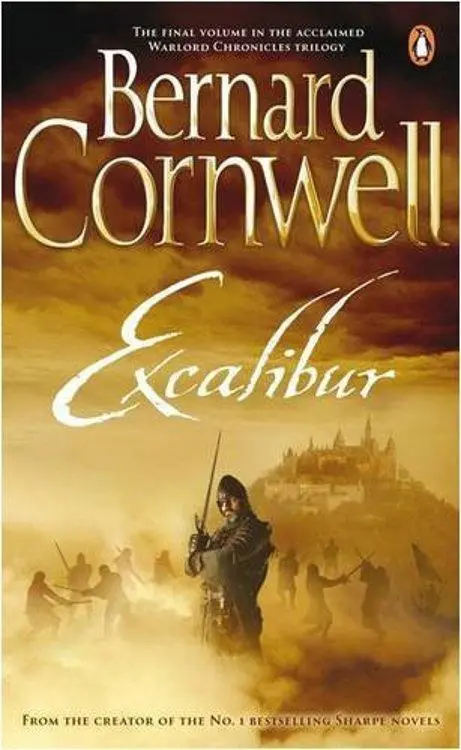
- Название:Excalibur
- Автор:
- Издательство:MacMillan Publishers
- Жанр:
- Год:1999
- ISBN:нет данных
- Рейтинг книги:4 / 5. Голосов: 2
-
Избранное:Добавить в избранное
- Отзывы:
-
Ваша оценка:
Excalibur: краткое содержание, описание и аннотация
Предлагаем к чтению аннотацию, описание, краткое содержание или предисловие (зависит от того, что написал сам автор книги «Excalibur»). Если вы не нашли необходимую информацию о книге — напишите в комментариях, мы постараемся отыскать её.
to Marion Zimmer Bradley's
, the legend of King Arthur has haunted and inspired generations of writers to reinvent the ancient story. In
and
, Bernard Cornwell demonstrated his astonishing ability to make the oft-told legend of King Arthur fresh and new for our time. Now, in this riveting final volume of the
, Cornwell tells the story of Arthur's desperate attempt to triumph over a ruined marriage and the Saxons' determination to destroy him.
Set against the backdrop of the Dark Ages, this brilliant saga continues as seen through the eyes of Derfel, an orphan brought up by Merlin and one of Arthur's warriors. In this book, the aging Arthur has been betrayed by, among others, his beloved Guinevere; but although he is alone and deeply saddened, he still embraces his dreams of a world in which civilization triumphs over brute force. Arthur and his warriors must face the dreaded Saxons — now allied with Arthur's betrayer Lancelot — for the throne of Britain.
This is the tale not only of a broken love remade but also of enemies more subtle than any Saxon spearman — of forces both earthly and unearthly that threaten everything Arthur stands for. When Merlin and Nimue embark on a dangerous quest to summon the Gods back to Britain, they unleash forces that will lead to a last desperate battle on the sands of Camlann, where it seems that Arthur must fail unless Merlin's final enchantment can avert the horror.
Peopled by princesses and bards, warriors and magicians, Excalibur is a story of love, war, loyalty, and betrayal, the unforgettable conclusion to a brilliant retelling of one of the most powerful legends of all time.
Excalibur — читать онлайн бесплатно полную книгу (весь текст) целиком
Ниже представлен текст книги, разбитый по страницам. Система сохранения места последней прочитанной страницы, позволяет с удобством читать онлайн бесплатно книгу «Excalibur», без необходимости каждый раз заново искать на чём Вы остановились. Поставьте закладку, и сможете в любой момент перейти на страницу, на которой закончили чтение.
Интервал:
Закладка:
The city magistrate, a flurried, nervous, middle-aged man named Cildydd who wore a Roman toga to mark his authority, hurried out of the temple to greet me. I knew him from the time of the rebellion when, despite being a Christian himself, he had fled from the crazed fanatics who had taken over the shrines of Aquae Sulis. He had been restored to the magistracy after the rebellion, but I guessed his authority was slight. He carried a scrap of slate on which he had made scores of marks, evidently the numbers’ of the levy that was assembled inside the shrine’s compound. ‘Repairs are in hand!’ Cildydd greeted me without any other courtesy. ‘I have men cutting timbers for the walls. Or I did. The flooding is a problem, indeed it is, but if the rain stops?’ He let the sentence trail away.
‘The flooding?’ I asked.
‘When the river rises, Lord,’ he explained, ‘the water backs up through the Roman sewers. It’s already in the lower part of the city. And not just water either, I fear. The smell, you see?’ He sniffed delicately.
‘The problem,’ I said, ‘is that the bridge arches are dammed with debris. It was your task to keep them clear. It was also your task to preserve the walls.’ His mouth opened and closed without a word. He hefted the slate as if to demonstrate his efficiency, then just blinked helplessly. ‘Not that it matters now,’ I went on, ‘the city can’t be defended.’
‘Can’t be defended!’ Cildydd protested. ‘Can’t be defended! It must be defended! We can’t just abandon the city!’
‘If the Saxons come,’ I said brutally, ‘you’ll have no choice.’
‘But we must defend it, Lord,’ Cildydd insisted.
‘With what?’ I asked.
‘Your men, Lord,’ he said, gesturing at my spearmen who had taken refuge from the rain under the temple’s high portico.
‘At best,’ I said, ‘we can garrison a quarter mile of the wall, or what’s left of it. So who defends the rest?’
‘The levy, of course.’ Cildydd waved his slate towards the drab collection of men who waited beside the bath-house. Few had weapons and even fewer possessed any body armour.
‘Have you ever seen the Saxons attack?’ I asked Cildydd. ‘They send big war-dogs first and they come behind with axes three feet long and spears on eight-foot shafts. They’re drunk, they’re maddened and they’ll want nothing but the women and the gold inside your city. How long do you think your levy will hold?’
Cildydd blinked at me. ‘We can’t just give up,’ he said weakly.
‘Does your levy have any real weapons?’ I asked, indicating the sullen-looking men waiting in the rain. Two or three of the sixty men had spears, I could see one old Roman sword, and most of the rest had axes or mattocks, but some men did not even possess those crude weapons, but merely held fire-hardened stakes that had been sharpened to black points.
‘We’re searching the city, Lord,’ Cildydd said. ‘There must be spears.’
‘Spears or not,’ I said brutally, ‘if you fight here you’ll all be dead men.’
Cildydd gaped at me. ‘Then what do we do?’ he finally asked.
‘Go to Glevum,’ I said.
‘But the city!’ He blanched. ‘There are merchants, goldsmiths, churches, treasures.’ His voice tailed away as he imagined the enormity of the city’s fall, but that fall, if the Saxons came, was inevitable. Aquae Sulis was no garrison city, just a beautiful place that stood in a bowl of hills. Cildydd blinked in the rain. ‘Glevum,’ he said glumly. ‘And you’ll escort us there, Lord?’
I shook my head. ‘I’m going to Corinium,’ I said, ‘but you go to Glevum.’ I was half tempted to send Argante, Guinevere, Ceinwyn and the families with him, but I did not trust Cildydd to protect them. Better, I decided, to take the women and families north myself, then send them under a small escort from Corinium to Glevum.
But at least Argante was taken from my hands, for as I was brutally destroying Cildydd’s slim hopes of garrisoning Aquae Sulis a troop of armoured horsemen clattered into the temple precinct. They were Arthur’s men, flying his banner of the bear, and they were led by Balin who was roundly cursing the press of refugees. He looked relieved when he saw me, then astonished as he recognized Guinevere. ‘Did you bring the wrong Princess, Derfel?’ he asked as he slid off his tired horse.
‘Argante’s inside the temple,’ I said, jerking my head towards the great building where Argante had taken refuge from the rain. She had not spoken to me all day.
‘I’m to take her to Arthur,’ Balin said. He was a bluff, bearded man with the tattoo of a bear on his forehead and a jagged white scar on his left cheek. I asked him for news and he told me what little he knew and none of it was good. ‘The bastards are coming down the Thames,’ he said, ‘we reckon they’re only three days’ march from Corinium, and there’s no sign of Cuneglas or Oengus yet. It’s chaos, Derfel, that’s what it is, chaos.’ He shuddered suddenly. ‘What’s the stink here?’
‘The sewers are backing up,’ I said.
‘All over Dumnonia,’ he said grimly. ‘I have to hurry,’ he went on, ‘Arthur wants his bride in Corinium the day before yesterday.’
‘Do you have orders for me?’ I called after him as he strode towards the temple steps.
‘Get yourself to Corinium! And hurry! And you’re to send what food you can!’ He shouted the last order as he disappeared through the temple’s great bronze doors. He had brought six spare horses, enough to saddle Argante, her maids and Fergal the Druid, which meant that the twelve men of Argante’s Blackshield escort were left with me. I sensed they were as glad as I was to be rid of their Princess. Balin rode north in the late afternoon. I had wanted to be on the road myself, but the children were tired, the rain was incessant, and Ceinwyn persuaded me that we would make better time if we all rested this night under Aquae Sulis’s roofs and marched fresh in the morning. I put guards on the bath-house and let the women and children go into the great steaming pool of hot water, then sent Issa and a score of men to hunt through the city for weapons to equip the levy. After that I sent for Cildydd and asked him how much food remained in the city. ‘Scarcely any, Lord!’ he insisted, claiming he had already sent sixteen wagons of grain, dried meat and salted fish north.
‘You searched folk’s houses?’ I asked. ‘The churches?’
‘Only the city granaries, Lord.’
‘Then let’s make a proper search,’ I suggested, and by dusk we had collected seven more wagonloads of precious supplies. I sent the wagons north that same evening, despite the lateness of the hour. Ox-carts are slow and it was better that they should start the journey at dusk than wait for the morning.
Issa waited for me in the temple precinct. His search of the city had yielded seven old swords and a dozen boar spears, while Cildydd’s men had turned up fifteen more spears, eight of them broken, but Issa also had news. ‘There’s said to be weapons hidden in the temple, Lord,’ he told me.
‘Who says?’
Issa gestured at a young bearded man who was dressed in a butcher’s bloody apron. ‘He reckons a hoard of spears was hidden in the temple after the rebellion, but the priest denies it.’
‘Where’s the priest?’
‘Inside, Lord. He told me to get out when I questioned him.’
I ran up the temple steps and through the big doors. This had once been a shrine to Minerva and Sulis, the first a Roman and the second a British Goddess, but the pagan deities had been ejected and the Christian God installed. When I had last been in the temple there had been a great bronze statue of Minerva attended by flickering oil lamps, but the statue had been destroyed during the Christian rebellion and now only the Goddess’s hollow head remained, and that had been impaled on a pole to stand as a trophy behind the Christian altar.
Читать дальшеИнтервал:
Закладка:
Похожие книги на «Excalibur»
Представляем Вашему вниманию похожие книги на «Excalibur» списком для выбора. Мы отобрали схожую по названию и смыслу литературу в надежде предоставить читателям больше вариантов отыскать новые, интересные, ещё непрочитанные произведения.








Обсуждение, отзывы о книге «Excalibur» и просто собственные мнения читателей. Оставьте ваши комментарии, напишите, что Вы думаете о произведении, его смысле или главных героях. Укажите что конкретно понравилось, а что нет, и почему Вы так считаете.