Bernard Cornwell - Excalibur
Здесь есть возможность читать онлайн «Bernard Cornwell - Excalibur» весь текст электронной книги совершенно бесплатно (целиком полную версию без сокращений). В некоторых случаях можно слушать аудио, скачать через торрент в формате fb2 и присутствует краткое содержание. Год выпуска: 1999, Издательство: MacMillan Publishers, Жанр: Историческая проза, на английском языке. Описание произведения, (предисловие) а так же отзывы посетителей доступны на портале библиотеки ЛибКат.
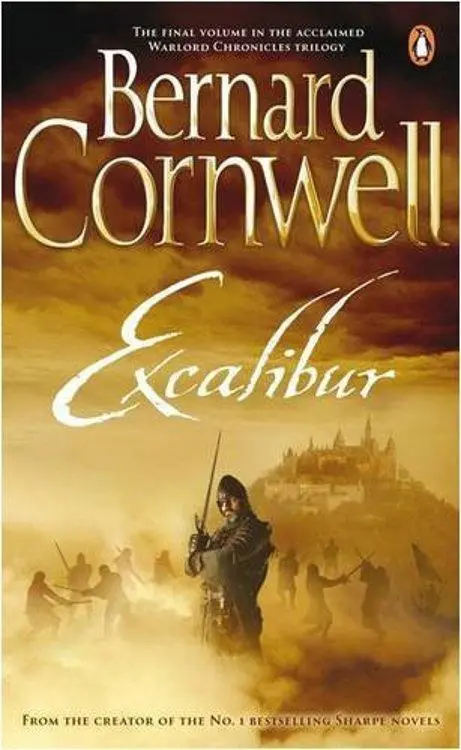
- Название:Excalibur
- Автор:
- Издательство:MacMillan Publishers
- Жанр:
- Год:1999
- ISBN:нет данных
- Рейтинг книги:4 / 5. Голосов: 2
-
Избранное:Добавить в избранное
- Отзывы:
-
Ваша оценка:
Excalibur: краткое содержание, описание и аннотация
Предлагаем к чтению аннотацию, описание, краткое содержание или предисловие (зависит от того, что написал сам автор книги «Excalibur»). Если вы не нашли необходимую информацию о книге — напишите в комментариях, мы постараемся отыскать её.
to Marion Zimmer Bradley's
, the legend of King Arthur has haunted and inspired generations of writers to reinvent the ancient story. In
and
, Bernard Cornwell demonstrated his astonishing ability to make the oft-told legend of King Arthur fresh and new for our time. Now, in this riveting final volume of the
, Cornwell tells the story of Arthur's desperate attempt to triumph over a ruined marriage and the Saxons' determination to destroy him.
Set against the backdrop of the Dark Ages, this brilliant saga continues as seen through the eyes of Derfel, an orphan brought up by Merlin and one of Arthur's warriors. In this book, the aging Arthur has been betrayed by, among others, his beloved Guinevere; but although he is alone and deeply saddened, he still embraces his dreams of a world in which civilization triumphs over brute force. Arthur and his warriors must face the dreaded Saxons — now allied with Arthur's betrayer Lancelot — for the throne of Britain.
This is the tale not only of a broken love remade but also of enemies more subtle than any Saxon spearman — of forces both earthly and unearthly that threaten everything Arthur stands for. When Merlin and Nimue embark on a dangerous quest to summon the Gods back to Britain, they unleash forces that will lead to a last desperate battle on the sands of Camlann, where it seems that Arthur must fail unless Merlin's final enchantment can avert the horror.
Peopled by princesses and bards, warriors and magicians, Excalibur is a story of love, war, loyalty, and betrayal, the unforgettable conclusion to a brilliant retelling of one of the most powerful legends of all time.
Excalibur — читать онлайн бесплатно полную книгу (весь текст) целиком
Ниже представлен текст книги, разбитый по страницам. Система сохранения места последней прочитанной страницы, позволяет с удобством читать онлайн бесплатно книгу «Excalibur», без необходимости каждый раз заново искать на чём Вы остановились. Поставьте закладку, и сможете в любой момент перейти на страницу, на которой закончили чтение.
Интервал:
Закладка:
The priest challenged me. ‘This is a house of God!’ he roared. He was celebrating a mystery at his altar, surrounded by weeping women, but he broke off his ceremonies to face me. He was a young man, full of passion, one of those priests who had stirred up the trouble in Dumnonia and whom Arthur had allowed to live so that the bitterness of the failed rebellion would not fester. This priest, however, had clearly lost none of his insurgent fervour. ‘A house of God!’ he shouted again, ‘and you defile it with sword and spear! Would you carry your weapons into your lord’s hall? So why carry them into my Lord’s house?’
‘In a week,’ I said, ‘it will be a temple of Thunor and they’ll be sacrificing your children where you stand. Are there spears here?’
‘None!’ he said defiantly. The women screamed and shrank away as I climbed the altar steps. The priest held a cross towards me. ‘In the name of God,’ he said, ‘and in the name of His holy Son, and in the name of the Holy Ghost. No!’ This last cry was because I had drawn Hywelbane and used her to strike the cross out of his hand. The scrap of wood skittered across the temple’s marble floor as I rammed the blade into his tangled beard. ‘I’ll pull this place down stone by stone to find the spears,’ I said, ‘and bury your miserable carcass under its rubble. Now where are they?’
His defiance crumpled. The spears, which he had been hoarding in hope of another campaign to put a Christian on Dumnonia’s throne, were concealed in a crypt beneath the altar. The entrance to the crypt was hidden, for it was a place where the treasures donated by folk seeking Sulis’s healing power had once been concealed, but the frightened priest showed us how to lift the marble slab to reveal a pit crammed with gold and weapons. We left the gold, but carried the spears out to Cildydd’s levy. I doubted the sixty men would be of any real use in battle, but at least a man armed with a spear looked like a warrior and, from a distance, they might give the Saxons pause. I told the levy to be ready to march in the morning and to pack as much food as they could find.
We slept that night in the temple. I swept the altar clear of its Christian trimmings and placed Minerva’s head between two oil lamps so that she would guard us through the night. Rain dripped from the roof and puddled on the marble, but sometime in the small hours the rain stopped and the dawn brought a clearing sky and a fresh chill wind from the east.
We left the city before the sun rose. Only forty of the city’s levy marched with us for the rest had melted away in the night, but it was better to have forty willing men than sixty uncertain allies. Our road was clear of refugees now, for I had spread the word that safety did not lie in Corinium but at Glevum, and so it was the western road that was crammed with cattle and folk. Our route took us east into the rising sun along the Fosse Way which here ran straight as a spear between Roman tombs. Guinevere translated the inscriptions, marvelling that men were buried here who had been born in Greece or Egypt or Rome itself. They were veterans of the Legions who had taken British wives and settled near the healing springs of Aquae Sulis, and their lichen-covered gravestones sometimes gave thanks to Minerva or to Sulis for the gift of years. After an hour we left the tombs behind and the valley narrowed as the steep hills north of the road came closer to the river meadows; soon, I knew, the road would turn abruptly north to climb into the hills that lay between Aquae Sulis and Corinium. It was when we reached the narrow part of the valley that the ox drivers came running back. They had left Aquae Sulis the previous day, but their slow wagons had reached no further than the northwards bend in the road, and now, in the dawn, they had abandoned their seven loads of precious food. ‘Sais!’
one man shouted as he ran towards us. ‘There are Sais!’
‘Fool,’ I muttered, then shouted at Issa to stop the fleeing men. I had allowed Guinevere to ride my horse, but now she slid off and I clumsily hauled my way onto the beast’s back and spurred her forward. The road turned northwards half a mile ahead. The oxen and their wagons had been abandoned just at the bend and I edged past them to peer up the slope. For a moment I could see nothing, then a group of horsemen appeared beside some trees at the crest. They were half a mile away, outlined against the brightening sky, and I could make out no details of their shields, but I guessed they were Britons rather than Saxons because our enemy did not deploy many horsemen.
I urged the mare up the slope. None of the horsemen moved. They just watched me, but then, away to my right, more men appeared at the hill’s crest. These were spearmen and above them hung a banner that told me the worst.
The banner was a skull hung with what looked like rags, and I remembered Cerdic’s wolf-skull standard with its ragged tail of flayed human skin. The men were Saxons and they barred our road. There were not many spearmen in sight, perhaps a dozen horsemen and fifty or sixty men on foot, but they had the high ground and I could not tell how many more might be hidden beyond the crest. I stopped the mare and stared at the spearmen, this time seeing the glint of sunlight on the broad axeblades some of the men carried. They had to be Saxons. But where had they come from? Balin had told me that both Cerdic and Aelle were advancing along the Thames, so it seemed likely that these men had come south from the wide river valley, but maybe they were some of Cerdic’s spearmen who served Lancelot. Not that it really mattered who they were; all that mattered was that our road was blocked. Still more of the enemy appeared, their spears pricking the skyline all along the ridge.
I turned the mare to see Issa bringing my most experienced spearmen past the blockage at the road’s turn. ‘Saxons!’ I called to him. ‘Form a shield wall here!’
Issa gazed up at the distant spearmen. ‘We fight them here, Lord?’ he asked.
‘No.’ I dared not fight in such a bad place. We would be forced to struggle uphill, and we would ever be worried about our families behind us.
‘We’ll take the road to Glevum instead?’ Issa suggested.
I shook my head. The Glevum road was thronged with refugees and if I had been the Saxon commander I would have wanted nothing more than to pursue an outnumbered enemy along that road. We could not outmarch him, for we would be obstructed by refugees, and he would find it a simple matter to cut through those panicked people to bring us death. It was possible, even likely, that the Saxons would not make any pursuit at all, but would be tempted to plunder the city instead, but it was a risk I dared not take. I gazed up the long hill and saw yet more of the enemy coming to the sun-bright crest. It was impossible to count them, but it was no small warband. My own men were making a shield wall, but I knew I could not fight here. The Saxons had more men and they had the high ground. To fight here was to die.
I twisted in the saddle. A half-mile away, just to the north of the Fosse Way, was one of the old people’s fortresses, and its ancient earth wall — much eroded now — stood at the crest of a steep hill. I pointed to the grass ramparts. ‘We’ll go there,’ I said.
‘There, Lord?’ Issa was puzzled.
‘If we try to escape them,’ I explained, ‘they’ll follow us. Our children can’t move fast and eventually the bastards will catch us. We’ll be forced to make a shield wall, put our families in the centre, and the last of us to die will hear the first of our women screaming. Better to go to a place where they’ll hesitate to attack. Eventually they’ll have to make a choice. Either they leave us alone and go north, in which case we follow, or else they fight, and if we’re on a hilltop we stand a chance of winning. A better chance,’ I added, ‘because Culhwch will come this way. In a day or two we might even outnumber them.’
Читать дальшеИнтервал:
Закладка:
Похожие книги на «Excalibur»
Представляем Вашему вниманию похожие книги на «Excalibur» списком для выбора. Мы отобрали схожую по названию и смыслу литературу в надежде предоставить читателям больше вариантов отыскать новые, интересные, ещё непрочитанные произведения.






Обсуждение, отзывы о книге «Excalibur» и просто собственные мнения читателей. Оставьте ваши комментарии, напишите, что Вы думаете о произведении, его смысле или главных героях. Укажите что конкретно понравилось, а что нет, и почему Вы так считаете.