Bernard Cornwell - Excalibur
Здесь есть возможность читать онлайн «Bernard Cornwell - Excalibur» весь текст электронной книги совершенно бесплатно (целиком полную версию без сокращений). В некоторых случаях можно слушать аудио, скачать через торрент в формате fb2 и присутствует краткое содержание. Год выпуска: 1999, Издательство: MacMillan Publishers, Жанр: Историческая проза, на английском языке. Описание произведения, (предисловие) а так же отзывы посетителей доступны на портале библиотеки ЛибКат.
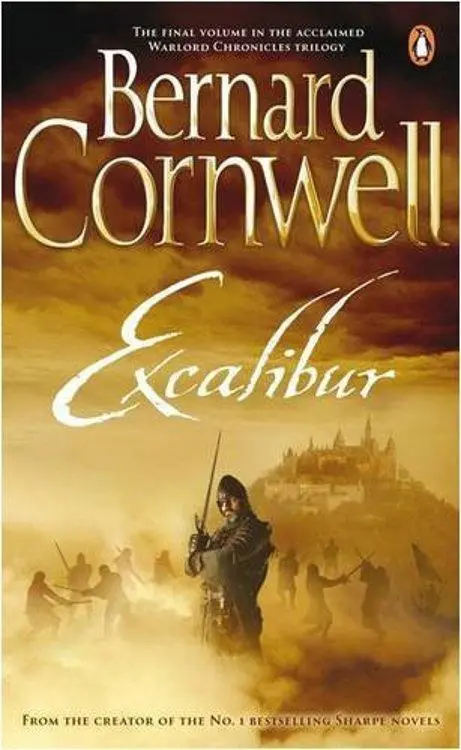
- Название:Excalibur
- Автор:
- Издательство:MacMillan Publishers
- Жанр:
- Год:1999
- ISBN:нет данных
- Рейтинг книги:4 / 5. Голосов: 2
-
Избранное:Добавить в избранное
- Отзывы:
-
Ваша оценка:
Excalibur: краткое содержание, описание и аннотация
Предлагаем к чтению аннотацию, описание, краткое содержание или предисловие (зависит от того, что написал сам автор книги «Excalibur»). Если вы не нашли необходимую информацию о книге — напишите в комментариях, мы постараемся отыскать её.
to Marion Zimmer Bradley's
, the legend of King Arthur has haunted and inspired generations of writers to reinvent the ancient story. In
and
, Bernard Cornwell demonstrated his astonishing ability to make the oft-told legend of King Arthur fresh and new for our time. Now, in this riveting final volume of the
, Cornwell tells the story of Arthur's desperate attempt to triumph over a ruined marriage and the Saxons' determination to destroy him.
Set against the backdrop of the Dark Ages, this brilliant saga continues as seen through the eyes of Derfel, an orphan brought up by Merlin and one of Arthur's warriors. In this book, the aging Arthur has been betrayed by, among others, his beloved Guinevere; but although he is alone and deeply saddened, he still embraces his dreams of a world in which civilization triumphs over brute force. Arthur and his warriors must face the dreaded Saxons — now allied with Arthur's betrayer Lancelot — for the throne of Britain.
This is the tale not only of a broken love remade but also of enemies more subtle than any Saxon spearman — of forces both earthly and unearthly that threaten everything Arthur stands for. When Merlin and Nimue embark on a dangerous quest to summon the Gods back to Britain, they unleash forces that will lead to a last desperate battle on the sands of Camlann, where it seems that Arthur must fail unless Merlin's final enchantment can avert the horror.
Peopled by princesses and bards, warriors and magicians, Excalibur is a story of love, war, loyalty, and betrayal, the unforgettable conclusion to a brilliant retelling of one of the most powerful legends of all time.
Excalibur — читать онлайн бесплатно полную книгу (весь текст) целиком
Ниже представлен текст книги, разбитый по страницам. Система сохранения места последней прочитанной страницы, позволяет с удобством читать онлайн бесплатно книгу «Excalibur», без необходимости каждый раз заново искать на чём Вы остановились. Поставьте закладку, и сможете в любой момент перейти на страницу, на которой закончили чтение.
Интервал:
Закладка:
‘I don’t know.’
‘You think they’ll eventually go north to join their main army?’
I had thought that, but the arrival of more Saxons had given me doubts. Now I suspected that we faced a big enemy warband that had been trying to march southwards around Corinium, looping deep into the hills to re-emerge at Glevum and so threaten Arthur’s rear. I could think of no other reason why so many Saxons were in Aquae Sulis’s valley, but that did not explain why they had not kept marching. Instead they were making shelters, which suggested they wanted to besiege us. In which case, I thought, perhaps we were doing Arthur a service by staying here. We were keeping a large number of his enemies away from Corinium, though if our estimation of the enemy forces was right then the Saxons had more than enough men to overwhelm both Arthur and us.
Ceinwyn and I fell silent. The twelve Blackshields had begun to sing, and when their song was done my men answered with the war chant of Ultydd. Pyrlig, my bard, accompanied the singing on his harp. He had found a leather breastplate and armed himself with a shield and spear, but the wargear looked strange on his thin frame. I hoped he would never have to abandon his harp and use the spear, for by then all hope would be lost. I imagined Saxons swarming across the hilltop, whooping their delight at finding so many women and children, then blotted the horrid thought out. We had to stay alive, we had to hold our walls, we had to win.
Next morning, under a sky of grey clouds through which a freshening wind brought snatches of rain from the west, I donned my wargear. It was heavy, and I had deliberately not worn it till now, but the arrival of the Saxon reinforcements had convinced me that we would have to fight and so, to put heart into my men, I chose to wear my finest armour. First, over my linen shirt and woollen trews, I pulled a leather tunic that fell to my knees. The leather was thick enough to stop a sword slash, though not a spear thrust. Over the tunic I pulled the precious coat of heavy Roman mail that my slaves had polished so that the small links seemed to shine. The mail coat was trimmed with golden loops at its hem, its sleeves and its neck. It was an expensive coat, one of the richest in Britain, and forged well enough to stop all but the most savage spear thrusts. My knee-length boots were sewn with bronze strips to cheat the lunging blade that comes low under the shield wall, and I had elbow-length gloves with iron plates to protect my forearms. My helmet was decorated with silver dragons that climbed up to its golden peak where the wolf-tail helm was fixed. The helmet came down over my ears, had a flap of mail to shield the back of my neck, and silvered cheekpieces that could be swung over my face so that an enemy did not see a man, but a metal-clad killer with two black shadows for eyes. It was the rich armour of a great warlord and it was designed to put fear into an enemy. I strapped Hywelbane’s belt around the mail, tied a cloak about my neck and hefted my largest war spear. Then, thus dressed for battle and with my shield slung on my back, I walked the ring of Mynydd Baddon’s walls so that all my men and all the watching enemy would see me and know that a lord of warriors waited for the fight. I finished my circuit at the southern peak of our defences and there, standing high above the enemy, I lifted the skirts of mail and leather to piss down the hill towards the Saxons.
I had not known Guinevere was close, and the first I knew was when she laughed and that laughter rather spoiled my gesture for I was embarrassed. She brushed away my apology. ‘You do look fine, Derfel,’ she said.
I swung the helmet’s cheekpieces open. ‘I had hoped, Lady,’ I said, ‘never to wear this gear again.’
‘You sound just like Arthur,’ she said wryly, then walked behind me to admire the strips of hammered silver that formed Ceinwyn’s star on my shield. ‘I never understand,’ she said, coming back to face me,
‘why you dress like a pigherder most of the time, but look so splendid for war.’
‘I don’t look like a pigherder,’ I protested.
‘Not like mine,’ she said, ‘because I can’t abide having grubby people about me, even if they are swineherds, and so I always made certain they had decent clothes.’
‘I had a bath last year,’ I insisted.
‘As recently as that!’ she said, pretending to be impressed. She was carrying her hunter’s bow and had a quiver of arrows at her back. ‘If they come,’ she said, ‘I intend to send some of their souls to the Other world.’
‘If they come,’ I said, knowing that they would, ‘all you’ll see is helmets and shields and you’ll waste your arrows. Wait till they raise their heads to fight our shield wall, then aim for their eyes.’
‘I won’t waste arrows, Derfel,’ she promised grimly.
The first threat came from the north where the newly arrived Saxons formed a shield wall among the trees above the saddle that separated Mynydd Baddon from the high ground. Our most copious spring was in that saddle and perhaps the Saxons intended to deny us its use, for just after midday their shield wall came down into the small valley. Niall watched them from our ramparts. ‘Eighty men,’ he told me. I brought Issa and fifty of my men across to the northern rampart, more than enough spearmen to see off eighty Saxons labouring uphill, but it soon became obvious that the Saxons did not intend to attack, but wanted to lure us down into the saddle where they could fight us on more equal terms. And no doubt once we were down there more Saxons would burst from the high trees to ambush us. ‘You stay here,’ I told my men, ‘you don’t go down! You stay!’
The Saxons jeered us. Some knew a few words of the British tongue, sufficient to call us cowards or women or worms. Sometimes a small group would climb halfway up our slope to tempt us to break ranks and rush down the hill, but Niall, Issa and I kept our men calm. A Saxon wizard shuffled up the wet slope towards us in short nervous rushes, jabbering incantations. He was naked beneath a wolfskin cape and had his hair dunged into a single tall spike. He shrilled his curses, wailed his charm words and then hurled a handful of small bones towards our shields, but still none of us moved. The wizard spat three times, then ran shivering down to the saddle, where a Saxon chieftain now tried to tempt one of us to single combat. He was a burly man with a tangled mane of greasy, dirt-matted golden hair that hung down past a lavish golden collar. His beard was plaited with black ribbons, his breastplate was of iron, his greaves of decorated Roman bronze, and his shield was painted with the mask of a snarling wolf. His helmet had bull’s horns mounted on its sides and was surmounted by a wolf’s skull to which he had tied a mass of black ribbons. He had strips of black fur tied around his upper arms and thighs, carried a huge double-bladed war axe, while from his belt hung a long sword and one of the short, broad-bladed knives called a seax, the weapon that gave the Saxons their name. For a time he demanded that Arthur himself come down and fight him, and when he tired of that he challenged me, calling me a coward, a chicken-hearted slave and the son of a leprous whore. He spoke in his own tongue which meant that none of my men knew what he said and I just let his words whip past me in the wind. Then, in the middle of the afternoon, when the rain had ended and the Saxons were bored with trying to lure us down to battle, they brought three captured children to the saddle. The children were very young, no more than five or six years old, and they were held with seaxs at their throats. ‘Come down,’
the big Saxon chieftain shouted, ‘or they die!’
Issa looked at me. ‘Let me go, Lord,’ he pleaded.
Читать дальшеИнтервал:
Закладка:
Похожие книги на «Excalibur»
Представляем Вашему вниманию похожие книги на «Excalibur» списком для выбора. Мы отобрали схожую по названию и смыслу литературу в надежде предоставить читателям больше вариантов отыскать новые, интересные, ещё непрочитанные произведения.







Обсуждение, отзывы о книге «Excalibur» и просто собственные мнения читателей. Оставьте ваши комментарии, напишите, что Вы думаете о произведении, его смысле или главных героях. Укажите что конкретно понравилось, а что нет, и почему Вы так считаете.