Bernard Cornwell - Excalibur
Здесь есть возможность читать онлайн «Bernard Cornwell - Excalibur» весь текст электронной книги совершенно бесплатно (целиком полную версию без сокращений). В некоторых случаях можно слушать аудио, скачать через торрент в формате fb2 и присутствует краткое содержание. Год выпуска: 1999, Издательство: MacMillan Publishers, Жанр: Историческая проза, на английском языке. Описание произведения, (предисловие) а так же отзывы посетителей доступны на портале библиотеки ЛибКат.
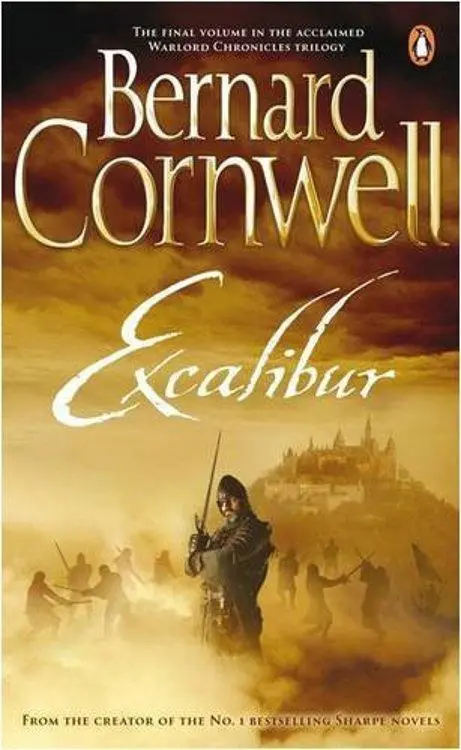
- Название:Excalibur
- Автор:
- Издательство:MacMillan Publishers
- Жанр:
- Год:1999
- ISBN:нет данных
- Рейтинг книги:4 / 5. Голосов: 2
-
Избранное:Добавить в избранное
- Отзывы:
-
Ваша оценка:
Excalibur: краткое содержание, описание и аннотация
Предлагаем к чтению аннотацию, описание, краткое содержание или предисловие (зависит от того, что написал сам автор книги «Excalibur»). Если вы не нашли необходимую информацию о книге — напишите в комментариях, мы постараемся отыскать её.
to Marion Zimmer Bradley's
, the legend of King Arthur has haunted and inspired generations of writers to reinvent the ancient story. In
and
, Bernard Cornwell demonstrated his astonishing ability to make the oft-told legend of King Arthur fresh and new for our time. Now, in this riveting final volume of the
, Cornwell tells the story of Arthur's desperate attempt to triumph over a ruined marriage and the Saxons' determination to destroy him.
Set against the backdrop of the Dark Ages, this brilliant saga continues as seen through the eyes of Derfel, an orphan brought up by Merlin and one of Arthur's warriors. In this book, the aging Arthur has been betrayed by, among others, his beloved Guinevere; but although he is alone and deeply saddened, he still embraces his dreams of a world in which civilization triumphs over brute force. Arthur and his warriors must face the dreaded Saxons — now allied with Arthur's betrayer Lancelot — for the throne of Britain.
This is the tale not only of a broken love remade but also of enemies more subtle than any Saxon spearman — of forces both earthly and unearthly that threaten everything Arthur stands for. When Merlin and Nimue embark on a dangerous quest to summon the Gods back to Britain, they unleash forces that will lead to a last desperate battle on the sands of Camlann, where it seems that Arthur must fail unless Merlin's final enchantment can avert the horror.
Peopled by princesses and bards, warriors and magicians, Excalibur is a story of love, war, loyalty, and betrayal, the unforgettable conclusion to a brilliant retelling of one of the most powerful legends of all time.
Excalibur — читать онлайн бесплатно полную книгу (весь текст) целиком
Ниже представлен текст книги, разбитый по страницам. Система сохранения места последней прочитанной страницы, позволяет с удобством читать онлайн бесплатно книгу «Excalibur», без необходимости каждый раз заново искать на чём Вы остановились. Поставьте закладку, и сможете в любой момент перейти на страницу, на которой закончили чтение.
Интервал:
Закладка:
‘Then why did he?’ I asked gloomily.
Sagramor shrugged. ‘To spite Guinevere? To please Oengus? To show us that he doesn’t need Guinevere?’
‘To slap bellies with a pretty girl?’ Culhwch suggested.
‘If he even does that,’ Sagramor said.
Culhwch stared at the Numidian in apparent shock. ‘Of course he does,’ Culhwch said. Sagramor shook his head. ‘I hear he doesn’t. Only rumour, of course, and rumour is least trustworthy when it comes to the ways of a man and his woman. But I think this Princess is too young for Arthur’s tastes.’
‘They’re never too young,’ Culhwch growled. Sagramor just shrugged. He was a far more subtle man than Culhwch and that gave him a much greater insight into Arthur, who liked to appear so straightforward, but whose soul was in truth as complicated as the twisted curves and spooling dragons that decorated Excali-bur’s blade.
We parted in the morning, our spear and sword blades still reddened with the blood of the sacrificed bull. Issa was excited. A few years before he had been a farm boy, but now he was an adept of Mithras and soon, he had told me, he would be a father for Scarach, his wife, was pregnant. Issa, given confidence by his initiation into Mithras, was suddenly sure we could beat the Saxons without Gwent’s help, but I had no such belief. I might not have liked Guinevere, but I had never thought her a fool, and I was worried about her forecast that Cerdic would attack in the south. The alternative made sense, of course; Cerdic and Aelle were reluctant allies and would want to keep a careful eye on each other. An overwhelming attack along the Thames would be the quickest way to reach the Severn Sea and so split the British kingdoms into two parts, and why should the Saxons sacrifice their advantage of numbers by dividing their forces into two smaller armies that Arthur might defeat one after the other? Yet if Arthur expected just one attack, and only guarded against that one attack, the advantages of a southern assault were overwhelming. While Arthur was tangled with one Saxon army in the Thames valley, the other could hook around his right flank and reach the Severn almost unopposed. Issa, though, was not worried by such things. He only imagined himself in the shield wall where, ennobled by Mithras’s acceptance, he would cut down Saxons like a farmer reaping hay.
The weather stayed cold after the season of the solstice. Day after day dawned frozen and pale with the sun little more than a reddened disc hanging low in the southern clouds. Wolves scavenged deep into the farmlands, hunting for our sheep that we had penned into hurdle folds, and one glorious day we hunted down six of the grey beasts and so secured six new wolf tails for my warband’s helmets. My men had begun to wear such tails on their helmet crests in the deep woods of Armorica where we had fought the Franks and, because we had raided them like scavenging beasts, they had called us wolves and we had taken the insult as a compliment. We were the Wolftails, though our shields, instead of bearing a wolf mask, were painted with a five-pointed star as a tribute to Ceinwyn. Ceinwyn was still insistent that she would not flee to Powys in the spring. Morwenna and Seren could go, she said, but she would stay. I was angry at that decision. ‘So the girls can lose both mother and father?’ I demanded.
‘If that’s what the Gods decree, yes,’ she said placidly, then shrugged. ‘I may be being selfish, but that is what I want.’
‘You want to die? That’s selfish?’
‘I don’t want to be so far away, Derfel,’ she said. ‘Do you know what it’s like to be in a distant country when your man is fighting? You wait in terror. You fear every messenger. You listen to every rumour. This time I shall stay.’
‘To give me something else to worry about?’
‘What an arrogant man you are,’ she said calmly. ‘You think I can’t look after myself?’
‘That little ring won’t keep you safe from Saxons,’ I said, pointing to the scrap of agate on her finger.
‘So I shall keep myself safe. Don’t worry, Derfel, I won’t be under your feet, and I won’t let myself be taken captive.’
Next day the first lambs were born in a sheepfold hard under Dun Caric’s hill. It was very early for such births, but I took it as a good sign from the Gods. Before Ceinwyn could forbid it, the firstborn of those lambs was sacrificed to ensure that the rest of the lambing season would go well. The little beast’s bloody pelt was nailed to a willow beside the stream and beneath it, next day, a wolfsbane bloomed, its small yellow petals the first flash of colour in the turning year. That day, too, I saw three kingfishers flickering bright by the icy edges of the stream. Life was stirring. In the dawn, after the cockerels had woken us, we could again hear the songs of thrushes, robins, larks, wrens and sparrows. Arthur sent for us two weeks after those first lambs were born. The snow had thawed, and his messenger had struggled through the muddy roads to bring us the summons that demanded our presence at the palace of Lindinis. We were to be there for the feast of Imbolc, the first feast after the solstice and one that is devoted to the Goddess of fertility. At Imbolc we drive newborn lambs through burning hoops and afterwards, when they think no one is watching, the young girls will leap through the smouldering hoops and touch their fingers to the ashes of Imbolc’s fires and smear the grey dust high between their thighs. A child born in November is called a child of Imbolc and has ash as its mother and fire as its father. Ceinwyn and I arrived in the afternoon of Imbolc Eve as the wintry sun was throwing long shadows across the pale grass. Arthur’s spearmen surrounded the palace, guarding him against the sullen hostility of people who remembered Merlin’s magical invocation of the glowing girl in the palace courtyard.
To my surprise, I discovered the courtyard was prepared for Imbolc. Arthur had never cared for such things, leaving most religious observances to Guinevere, and she had never celebrated the crude country festivals like Imbolc; but now a great hoop of plaited straw stood ready for the flames in the centre of the yard while a handful of newborn lambs were penned with their mothers in a small hurdle enclosure. Culhwch greeted us, giving a sly nod to the hoop. ‘A chance for you to have another baby,’ he said to Ceinwyn.
‘Why else would I be here?’ she responded, giving him a kiss. ‘And how many do you have now?’
‘Twenty-one,’ he said proudly.
‘From how many mothers?’
‘Ten,’ he grinned, then slapped my back. ‘We’re to get our orders tomorrow.’
‘We?’
‘You, me, Sagramor, Galahad, Lanval, Balin, Morfans,’ Culhwch shrugged, ‘everyone.’
‘Is Argante here?’ I asked.
‘Who do you think put up the hoop?’ he asked. ‘This is all her idea. She’s brought a Druid out of Demetia, and before we all eat tonight we have to worship Nantosuelta.’
‘Who?’ Ceinwyn asked.
‘A Goddess,’ Culhwch said carelessly. There were so many Gods and Goddesses that it was impossible for anyone but a Druid to know all their names and neither Ceinwyn nor I had ever heard of Nantosuelta before.
We did not see either Arthur or Argante until after dark when Hygwydd, Arthur’s servant, summoned us all into the courtyard that was lit with pitch-soaked torches flaming in their iron beckets. I remembered Merlin’s night here, and the crowd of awed folk who had lifted their maimed and sick babies to Olwen the Silver. Now an assembly of lords and their ladies waited awkwardly on either side of the plaited hoop, while set on a dais at the courtyard’s western end were three chairs draped with white linen. A Druid stood beside the hoop and I presumed he was the sorcerer whom Argante had fetched from her father’s kingdom. He was a short, squat man with a wild black beard in which tufts of fox hair and bunches of small bones were plaited. ‘He’s called Fergal,’ Galahad told me, ‘and he hates Christians. He spent all afternoon casting spells against me, then Sagramor arrived and Fergal almost fainted with horror. He thought it was Crom Dubh come in person.’ Galahad laughed.
Читать дальшеИнтервал:
Закладка:
Похожие книги на «Excalibur»
Представляем Вашему вниманию похожие книги на «Excalibur» списком для выбора. Мы отобрали схожую по названию и смыслу литературу в надежде предоставить читателям больше вариантов отыскать новые, интересные, ещё непрочитанные произведения.




Обсуждение, отзывы о книге «Excalibur» и просто собственные мнения читателей. Оставьте ваши комментарии, напишите, что Вы думаете о произведении, его смысле или главных героях. Укажите что конкретно понравилось, а что нет, и почему Вы так считаете.