Bernard Cornwell - Excalibur
Здесь есть возможность читать онлайн «Bernard Cornwell - Excalibur» весь текст электронной книги совершенно бесплатно (целиком полную версию без сокращений). В некоторых случаях можно слушать аудио, скачать через торрент в формате fb2 и присутствует краткое содержание. Год выпуска: 1999, Издательство: MacMillan Publishers, Жанр: Историческая проза, на английском языке. Описание произведения, (предисловие) а так же отзывы посетителей доступны на портале библиотеки ЛибКат.
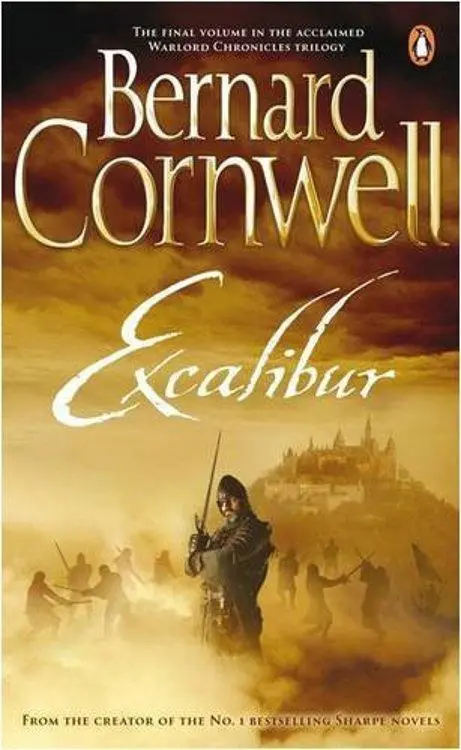
- Название:Excalibur
- Автор:
- Издательство:MacMillan Publishers
- Жанр:
- Год:1999
- ISBN:нет данных
- Рейтинг книги:4 / 5. Голосов: 2
-
Избранное:Добавить в избранное
- Отзывы:
-
Ваша оценка:
Excalibur: краткое содержание, описание и аннотация
Предлагаем к чтению аннотацию, описание, краткое содержание или предисловие (зависит от того, что написал сам автор книги «Excalibur»). Если вы не нашли необходимую информацию о книге — напишите в комментариях, мы постараемся отыскать её.
to Marion Zimmer Bradley's
, the legend of King Arthur has haunted and inspired generations of writers to reinvent the ancient story. In
and
, Bernard Cornwell demonstrated his astonishing ability to make the oft-told legend of King Arthur fresh and new for our time. Now, in this riveting final volume of the
, Cornwell tells the story of Arthur's desperate attempt to triumph over a ruined marriage and the Saxons' determination to destroy him.
Set against the backdrop of the Dark Ages, this brilliant saga continues as seen through the eyes of Derfel, an orphan brought up by Merlin and one of Arthur's warriors. In this book, the aging Arthur has been betrayed by, among others, his beloved Guinevere; but although he is alone and deeply saddened, he still embraces his dreams of a world in which civilization triumphs over brute force. Arthur and his warriors must face the dreaded Saxons — now allied with Arthur's betrayer Lancelot — for the throne of Britain.
This is the tale not only of a broken love remade but also of enemies more subtle than any Saxon spearman — of forces both earthly and unearthly that threaten everything Arthur stands for. When Merlin and Nimue embark on a dangerous quest to summon the Gods back to Britain, they unleash forces that will lead to a last desperate battle on the sands of Camlann, where it seems that Arthur must fail unless Merlin's final enchantment can avert the horror.
Peopled by princesses and bards, warriors and magicians, Excalibur is a story of love, war, loyalty, and betrayal, the unforgettable conclusion to a brilliant retelling of one of the most powerful legends of all time.
Excalibur — читать онлайн бесплатно полную книгу (весь текст) целиком
Ниже представлен текст книги, разбитый по страницам. Система сохранения места последней прочитанной страницы, позволяет с удобством читать онлайн бесплатно книгу «Excalibur», без необходимости каждый раз заново искать на чём Вы остановились. Поставьте закладку, и сможете в любой момент перейти на страницу, на которой закончили чтение.
Интервал:
Закладка:
At last Sansum went and Igraine made a face at his retreating back. ‘Tell me, Derfel,’ she said when the saint was out of earshot, ‘what should I do for the birth?’
‘Why on earth do you ask me?’ I said in amazement. ‘I know nothing about childbirth, thank God!
I’ve never even seen a child born, and I don’t want to.’
‘But you know about the old things,’ she said urgently, ‘that’s what I mean.’
‘The women in your caer will know much more than I do,’ I said, ‘but whenever Ceinwyn gave birth we always made sure there was iron in the bed, women’s urine on the doorstep, mugwort on the fire, and, of course, we had a virgin girl ready to lift the newborn child from the birth-straw. Most important of all,’ I went on sternly, ‘there must be no men in the room. Nothing brings so much ill-luck as having a man present at a birth.’ I touched the protruding nail in my writing desk to avert the evil fortune of even mentioning such an unlucky circumstance. We Christians, of course, do not believe that touching iron will affect any fortune, whether evil or good, but the nailhead on my desk is still much polished by my touching. ‘Is it true about the Saxons?’ I asked.
Igraine nodded. ‘They’re getting closer, Derfel.’
I rubbed the nailhead again. ‘Then warn your husband to have sharp spears.’
‘He needs no warning,’ she said grimly.
I wonder if the war will ever end. For as long as I have lived the Britons have fought the Saxons, and though we did win one great victory over them, in the years since that victory we have seen more land lost and, with the land, the stories that were attached to the valleys and hilltops have been lost as well. History is not just a tale of men’s making, but is a thing tied to the land. We call a hill by the name of a hero who died there, or name a river after a princess who fled beside its banks, and when the old names vanish, the stories go with them and the new names carry no reminder of the past. The Sais take our land and our history. They spread like a contagion, and we no longer have Arthur to protect us. Arthur, scourge of the Sais, Lord of Britain and the man whose love hurt him more than any wound from sword or spear. How I do miss Arthur.
The winter solstice is when we prayed that the Gods would not abandon the earth to the great darkness. In the bleakest of winters those prayers often seemed like pleas of despair, and that was never more so than in the year before the Saxons attacked when our world was deadened beneath a shell of ice and crusted snow. For those of us who were adepts of Mithras the solstice had a double meaning, for it is also the time of our God’s birth, and after the big solstice feast at Dun Caric I took Issa west to the caves where we held our most solemn ceremonies and there I inducted him into the worship of Mithras. He endured the ordeals successfully and so was welcomed into that band of elite warriors who keep the God’s mysteries. We feasted afterwards. I killed the bull that year, first hamstringing the beast so that it could not move, then swinging the axe in the low cave to sever its spine. The bull, I recall, had a shrivelled liver, which was reckoned a bad omen, but there were no good omens that cold winter. Forty men attended the rites, despite the bitter weather. Arthur, though long an initiate, did not arrive, but Sagramor and Culhwch had come from their frontier posts for the ceremonies. At the end of the feasting, when most of the warriors were sleeping off the effects of the mead, we three withdrew to a low tunnel where the smoke was not thick and we could talk privately.
Both Sagramor and Culhwch were certain that the Saxons would attack directly along the valley of the Thames. ‘What I hear,’ Sagramor told us, ‘is that they’re filling London and Pontes with food and supplies.’ He paused to tear some meat from a bone with his teeth. It had been months since I had seen Sagramor, and I found his company reassuring; the Numidian was the toughest and most fearsome of all Arthur’s warlords, and his prowess was reflected in his narrow, axe-sharp face. He was the most loyal of men, a staunch friend, and a wondrous teller of stories, but above everything he was a natural warrior who could outfox and outfight any enemy. The Saxons were terrified of Sagramor, believing he was a dark demon from their Otherworld. We were happy that they should live in such numbing fear and it was a comfort that, even though outnumbered, we would have his sword and his experienced spearmen on our side.
‘Won’t Cerdic attack in the south?’ I asked.
Culhwch shook his head. ‘He’s not making any show of it. Nothing stirring in Venta.’
‘They don’t trust each other,’ Sagramor spoke of Cerdic and Aelle. ‘They daren’t let one another out of their sight. Cerdic fears we’ll buy off Aelle, and Aelle fears that Cerdic will cheat him of the spoils, so they’re going to stick closer than brothers.’
‘So what will Arthur do?’ I asked.
‘We hoped you’d tell us that,’ Culhwch answered.
‘Arthur doesn’t speak to me these days,’ I said, not bothering to hide my bitterness.
‘That makes two of us,’ Culhwch growled.
‘Three,’ Sagramor said. ‘He comes to see me, he asks questions, he rides on raids and then he goes away. He says nothing.’
‘Let’s hope he’s thinking,’ I said.
‘Too busy with that new bride, probably,’ Culhwch offered sourly.
‘Have you met her?’ I asked.
‘An Irish kitten,’ he said dismissively, ‘with claws.’ Culhwch told us he had visited Arthur and his new bride on his way north to this meeting with Mithras. ‘She’s pretty enough,’ he said grudgingly. ‘If you took her slave you’d probably want to make sure she stayed in your own kitchen for a while. Well, I would. You wouldn’t, Derfel.’ Culhwch often teased me about my loyalty to Ceinwyn, though I was not so very unusual in my fidelity. Sagramor had taken a captured Saxon for a wife and, like me, was famously loyal to his woman. ‘What use is a bull that only serves one cow?’ Culhwch now asked, but neither of us responded to his jibe.
‘Arthur is frightened,’ Sagramor said instead. He paused, gathering his thoughts. The Numidian spoke the British tongue well, though with a wretched accent, but it was not his natural language, and he often spoke slowly to make certain he was expressing his exact ideas. ‘He has defied the Gods, and not just at Mai Dun, but by taking Mordred’s power. The Christians hate him and now the pagans say he is their enemy. Do you see how lonely that makes him?’
‘The trouble with Arthur is that he doesn’t believe in the Gods,’ Culhwch said dismissively.
‘He believes in himself,’ Sagramor said, ‘and when Guinevere betrayed him, he took a blow to the heart. He is ashamed. He lost much pride, and he’s a proud man. He thinks we all laugh at him, and so he is distant from us.’
‘I don’t laugh at him,’ I protested.
‘I do,’ Culhwch said, flinching as he straightened his wounded leg. ‘Stupid bastard. Should have taken his sword belt to Guinevere’s back a few times. That would have taught the bitch a lesson.’
‘Now,’ Sagramor went on, blithely ignoring Culhwch’s predictable opinion, ‘he fears defeat. For what is he if he is not a soldier? He likes to think he is a good man, that he rules because he is a natural ruler, but it is the sword that has carried him to power. In his soul he knows that, and if he loses this war then he loses the thing he cares about most; his reputation. He will be remembered as the usurper who was not good enough to hold what he usurped. He is terrified of a second defeat for his reputation.’
‘Maybe Argante can heal the first defeat,’ I said.
‘I doubt it,’ Sagramor said. ‘Galahad tells me that Arthur didn’t really want to marry her.’
Читать дальшеИнтервал:
Закладка:
Похожие книги на «Excalibur»
Представляем Вашему вниманию похожие книги на «Excalibur» списком для выбора. Мы отобрали схожую по названию и смыслу литературу в надежде предоставить читателям больше вариантов отыскать новые, интересные, ещё непрочитанные произведения.






Обсуждение, отзывы о книге «Excalibur» и просто собственные мнения читателей. Оставьте ваши комментарии, напишите, что Вы думаете о произведении, его смысле или главных героях. Укажите что конкретно понравилось, а что нет, и почему Вы так считаете.