Bernard Cornwell - The Winter King
Здесь есть возможность читать онлайн «Bernard Cornwell - The Winter King» весь текст электронной книги совершенно бесплатно (целиком полную версию без сокращений). В некоторых случаях можно слушать аудио, скачать через торрент в формате fb2 и присутствует краткое содержание. Год выпуска: 1997, Издательство: MacMillan Publishers, Жанр: Историческая проза, на английском языке. Описание произведения, (предисловие) а так же отзывы посетителей доступны на портале библиотеки ЛибКат.
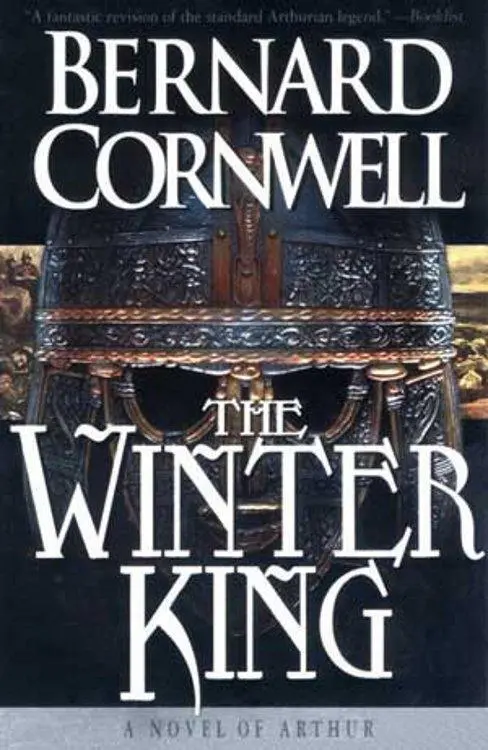
- Название:The Winter King
- Автор:
- Издательство:MacMillan Publishers
- Жанр:
- Год:1997
- ISBN:нет данных
- Рейтинг книги:4 / 5. Голосов: 1
-
Избранное:Добавить в избранное
- Отзывы:
-
Ваша оценка:
The Winter King: краткое содержание, описание и аннотация
Предлагаем к чтению аннотацию, описание, краткое содержание или предисловие (зависит от того, что написал сам автор книги «The Winter King»). Если вы не нашли необходимую информацию о книге — напишите в комментариях, мы постараемся отыскать её.
Fifth century Britain lies on the edge of darkness. Memories of Roman civilization are fading; the pagan Gods are retreating before the spread of Christianity; the Saxons are snapping and snarling at the borders. Only fragile bonds unite the unruly kingdoms of Britain against the invaders, bonds cemented by the vigour of the High King, Uther Pendragon. But the Pendragon is failing, and his heir is no strong leader but a child, born on a bitter winter night.
Only one man could keep Uther's throne safe,only he could hold the warring kingdoms together to face their true enemy, the Saxons. That man is Arthur: soldier, statesman, Merlin's protege, Uther's illegitimate son. But he has been banished, exiled by his own father to Brittany. Derfel, one of his spearmen, narrates the story of Arthur's return and of his quest for peace: embattled, bloody and, finally, triumphant.
The Winter King is a magnificent tale of the Dark Ages and the reality of war and political strife in a land where religion vied with magic for the souls of the people. It portrays Arthur the man rather than the legend, a military genius who, with a small band of warriors bound to him by loyalty and love, struggled to keep alive a flicker of civilization.
The Winter King — читать онлайн бесплатно полную книгу (весь текст) целиком
Ниже представлен текст книги, разбитый по страницам. Система сохранения места последней прочитанной страницы, позволяет с удобством читать онлайн бесплатно книгу «The Winter King», без необходимости каждый раз заново искать на чём Вы остановились. Поставьте закладку, и сможете в любой момент перейти на страницу, на которой закончили чтение.
Интервал:
Закладка:
He had spoken with a trace of mockery that had disturbed me. “Don't you believe in Merlin's dream?” I asked.
“I believe Merlin is the wisest man in Britain,” Arthur said seriously, 'and that he knows more than I might ever hope to know. I also know that my fate is twisted into his, just as yours, I think, is twisted into Nimue's, but I also think that Merlin was bored from the moment he was born, so Merlin is doing what the Gods do. He is amusing himself at our expense. Which means, Derfel, that when the moment comes to return Caledfwlch it will be at a time when I need the sword most."
“So what will you do?”
“I have no idea. None.” He seemed to find that thought amusing for he smiled, then put a hand on my shoulder. “Go and sleep, Derfel. I need your tongue tomorrow and I don't want it slurred by tiredness.” I left him, and somehow I did snatch a few moments' sleep in the moon-cast shadow of a looming stone, though before I slept I lay thinking about that far-off night when Merlin had made Arthur's arm ache with the weight of the sword and his soul heavy with the greater burden of fate. Why had Merlin chosen Arthur, I wondered, for it seemed to me now that Arthur and Merlin were opposed. Merlin believed that chaos could only be defeated by harnessing the powers of mystery, while Arthur believed in the powers of men. It could be, I thought, that Merlin had trained Arthur to rule men so as to leave himself free to rule the dark powers, but I also realized, however dimly, that the moment might come when we would all have to choose between them and I feared that moment. I prayed it would never come. Then I slept until the sun rose to lance the shadow of a single stone pillar that stood isolated outside the circle straight into the very heart of the Stones where we tired warriors guarded a kingdom's ransom. We drank water, ate hard bread, then buckled on our swords before spreading the gold on the dew-wet grass beside the altar stone. “What's to stop Aelle taking the gold and continuing his war?” I asked Arthur as we waited for the Saxon's arrival. Aelle, after all, had taken gold from us before and that had not stopped him from burning Durocobrivis.
Arthur shrugged. He was wearing his spare armour, a coat of Roman mail that was dented and scarred from frequent fights. He wore the heavy mail under one of his white cloaks. “Nothing,” he answered,
'except what little honour he might have. Which is why we might have to offer him more than gold."
“More?” I asked, but Arthur did not reply because, on the dawn-blazoned eastern skyline, the Saxons had appeared.
They came in a long line spread across the horizon with their war drums beating and their spearmen arrayed for battle, though their weapons were tipped by leaves to show that they meant us no immediate harm. Aelle led them. He was the first of the two men I ever met who claimed the title Bretwalda. The other came later and was to give us more trouble, but Aelle was trouble enough. He was a tall man with a flat, hard face and dark eyes that revealed none of his thoughts. His beard was black, his cheeks were scarred from battle and two fingers were missing from his right hand. He wore a coat of black cloth that was belted with leather, boots of leather, an iron helmet on which bull horns were mounted, and over it all a bearskin cloak that he dropped when the heat of the day became too much for such a flamboyant garment. His banner was a blood-daubed bull's skull held aloft on a spear-shaft. His war-band numbered two hundred men, maybe a few more, and over half those men had great war dogs leashed with leather ropes. Behind the warriors was a horde of women, children and slaves. There were more than enough Saxons to overwhelm us now, but Aelle had given his word that we were at peace, at least until he had decided our fate, and his men made no hostile show. Their line stopped outside the circling ditch while Aelle, his council, an interpreter and a pair of wizards came to meet Arthur. The wizards had hair stiffened into spikes with dung and wore ragged cloaks of wolfskin. When they whirled around to say their charms, the legs, tails and faces of the wolves flared out from their painted bodies. They shouted those charms as they came closer, nullifying any magic we might be working against their leader. Nimue crouched behind us and chanted her own counter charms The two leaders weighed each other up. Arthur was taller and Aelle broader. Arthur's face was striking, but Aelle's was terrifying. It was implacable, the face of a man who had come from beyond the sea to carve out a kingdom in a strange land, and he had made that kingdom with a savage and direct brutality.
“I should kill you now, Arthur,” he said, 'and have one less enemy to destroy." His wizards, naked beneath their moth-eaten skins, crouched behind him. One chewed a mouthful of earth, the other rolled his eyes while Nimue, her empty eye-socket bared, hissed at them. The struggle between Nimue and the wizards was a private war that the two leaders ignored.
“The time will come, Aelle,” Arthur said, 'when maybe we shall meet in battle. But for now I offer you peace." I had half expected Arthur to bow to Aelle who was, unlike Arthur, a king, but Arthur treated the Bretwalda as an equal and Aelle accepted the treatment without protest.
“Why?” Aelle asked bluntly. Aelle used no circumlocutions like we British favoured. I came to notice that difference between ourselves and the Saxons. The British thought in curves, like the intricate whorls of their jewellery, while Saxons were blunt and straight, as crude as their heavy gold brooches and chunky neck chains. Britons rarely broached a subject headlong, but talked around it, wrapping it with hints and allusions, always looking for manoeuvre, but Saxons thrust subtlety aside. Arthur once claimed I had that same Saxon straightforwardness and I think he meant it as a compliment. Arthur ignored Aelle's question. “I thought we had peace already. We had an agreement sealed with gold.”
Aelle's face betrayed no shame at having broken the truce. He merely shrugged, as though a broken peace was a small thing. “So if one truce fails, why buy another?” he asked.
“Because I have a quarrel with Gorfyddyd,” Arthur replied, adopting the Saxon's blunt manner, 'and I seek your help in that quarrel."
Aelle nodded. “But if I help you destroy Gorfyddyd I make you stronger. Why should I do that?”
“Because if you do not then Gorfyddyd will destroy me and he will then be stronger.” Aelle laughed, displaying a mouth of rotting teeth. “Does a dog care which of two rats it kills?” he asked. I translated that as does a dog care which stag it pulls down. It seemed more tactful and I noted that Aelle's interpreter, a British slave, did not tell his master.
“No,” Arthur allowed, 'but the stags are not equal.“ Aelle's interpreter said the rats were not equal and I did not tell Arthur. ”At best, Lord Aelle,“ Arthur went on, ”I preserve Dumnonia and make Powys and Siluria my allies. But if Gorfyddyd wins he will unite Elmet, Rheged, Powys, Siluria and Dumnonia against you."
“But you will also have Gwent on your side,” Aelle said. He was a shrewd man, and quick.
“True, but so will Gorfyddyd if it comes to a war between the British and the Saxons.” Aelle grunted. The present situation, with the British fighting amongst themselves, served him best, but he knew that the British wars would eventually cease. Since it now seemed Gorfyddyd must win those wars soon, Arthur's presence gave him a way of prolonging his enemies' conflict. “So what do you want of me?” he asked. His wizards were now leaping up and down on all fours like human grasshoppers while Nimue was arranging pebbles on the ground. The pebbles' pattern must have disturbed the Saxon sorcerers for they began to utter small yelps of distress. Aelle ignored them.
Читать дальшеИнтервал:
Закладка:
Похожие книги на «The Winter King»
Представляем Вашему вниманию похожие книги на «The Winter King» списком для выбора. Мы отобрали схожую по названию и смыслу литературу в надежде предоставить читателям больше вариантов отыскать новые, интересные, ещё непрочитанные произведения.




Обсуждение, отзывы о книге «The Winter King» и просто собственные мнения читателей. Оставьте ваши комментарии, напишите, что Вы думаете о произведении, его смысле или главных героях. Укажите что конкретно понравилось, а что нет, и почему Вы так считаете.