Thomas Keneally - Schindler's Ark
Здесь есть возможность читать онлайн «Thomas Keneally - Schindler's Ark» весь текст электронной книги совершенно бесплатно (целиком полную версию без сокращений). В некоторых случаях можно слушать аудио, скачать через торрент в формате fb2 и присутствует краткое содержание. Город: London, Год выпуска: 1982, ISBN: 1982, Издательство: Hodder and Stoughton, Жанр: Историческая проза, на английском языке. Описание произведения, (предисловие) а так же отзывы посетителей доступны на портале библиотеки ЛибКат.
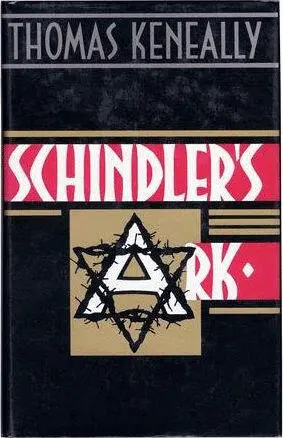
- Название:Schindler's Ark
- Автор:
- Издательство:Hodder and Stoughton
- Жанр:
- Год:1982
- Город:London
- ISBN:0-340-27838-2
- Рейтинг книги:4 / 5. Голосов: 1
-
Избранное:Добавить в избранное
- Отзывы:
-
Ваша оценка:
Schindler's Ark: краткое содержание, описание и аннотация
Предлагаем к чтению аннотацию, описание, краткое содержание или предисловие (зависит от того, что написал сам автор книги «Schindler's Ark»). Если вы не нашли необходимую информацию о книге — напишите в комментариях, мы постараемся отыскать её.
Schindler’s List
Working with the actual testimony of Schindler’s Jews, Thomas Keneally artfully depicts the courage and shrewdness of an unlikely savior, a man who is a flawed mixture of hedonism and decency and who, in the presence of unutterable evil, transcends the limits of his own humanity. From From
A mesmerizing novel based on the true story of Oskar Schindler, a German industralist who saved and succored more than 1000 Jews from the Nazis at enormous financial and emotional expense. How the German Oskar Schindler came to save more than one thousand Polish Jews during the Holocaust is one of the most fascinating stories of the century. Although millions are now learning about Schindler through Steven Spielberg’s recent Academy Award-winning film, his achievement first gained prominence with Keneally’s 1982 “facticious” novel (which is also the basis for the film). Keneally’s account is less melodramatic than the motion picture, and although he does not fully explain how a hedonistic German could have been so altered by the plight of the Jewish workers in his factory, he does make Schindler less enigmatic than the big-screen version. Ben Kingsley, one of the film's stars, reads in a calculatedly matter-of-fact tone, letting the story's power alone convey its complicated emotions. Highly recommended.
Michael Adams, Fairleigh Dickinson Univ. Lib., Madison, N.J.
Schindler's Ark — читать онлайн бесплатно полную книгу (весь текст) целиком
Ниже представлен текст книги, разбитый по страницам. Система сохранения места последней прочитанной страницы, позволяет с удобством читать онлайн бесплатно книгу «Schindler's Ark», без необходимости каждый раз заново искать на чём Вы остановились. Поставьте закладку, и сможете в любой момент перейти на страницу, на которой закончили чтение.
Интервал:
Закладка:
Goeth began cursing prosaically.
“Donnerwetter! Zum Teufel!” It seemed to Levartov that at any second Amon would begin to run down faulty modern workmanship, as if they were two tradesmen trying to bring off some simple effect—the threading of a pipe, a drill hole in the wall. Amon put the faulty pistol away in its black holster and withdrew from a jacket pocket a pearl-handled revolver, of a type Rabbi Levartov had only read of in the Westerns of his boyhood. Clearly, he thought, there are going to be no remissions due to technical failure. He’ll keep on.
I’ll die by cowboy revolver, and even if all the firing pins are filed down, Hauptsturmführer Goeth will fall back on more primitive weapons.
As Stern relayed it to Schindler, when Goeth aimed again and fired, Menasha Levartov had already begun to look about in case there was some object in the neighborhood that could be used, together with these two astounding failures of Goeth’s service pistol, as a lever. By the corner of the wall stood a pile of coal, an unpromising item in itself. “Herr Commandant,” Levartov began to say, but he could already hear the small murderous hammers and springs of the barroom pistol acting on each other. And again the click of a defective cigarette lighter. Amon, raging, seemed to be attempting to tear the barrel of the thing from its socket.
Now Rabbi Levartov adopted the stance he had seen the supervisors in the metalworks assume. “Herr Commandant, I would beg to report that my heap of hinges was so unsatisfactory for the reason that the machines were being recalibrated this morning. And therefore instead of hinge-work I was put on to shoveling that coal.” It seemed to Levartov that he had violated the rules of the game they had been playing together, the game that was to be closed by Levartov’s reasonable death just as surely as Snakes and Ladders ends with the throwing of a six. It was as if the rabbi had hidden the dice and now there could be no conclusion. Amon hit him on the face with a free left hand, and Levartov tasted blood in his mouth, lying on the tongue like a guarantee.
Hauptsturmführer Goeth then simply abandoned Levartov against the wall. The contest, however, as both Levartov and Stern could tell, had merely been suspended.
Stern whispered this narrative to Oskar in the Building Office of Płaszów. Stern, stooping, eyes raised, hands joined, was as generous with detail as ever. “It’s no problem,” Oskar murmured. He liked to tease Stern. “Why the long story? There’s always room at Emalia for someone who can turn out a hinge in less than a minute.”
When Levartov and his wife came to the Emalia factory subcamp in the summer of ‘43, he had to suffer what at first he believed to be Schindler’s little religious witticisms. On Friday afternoons, in the munitions hall of DEF where Levartov operated a lathe, Schindler would say, “You shouldn’t be here, Rabbi.
You should be preparing for Shabbat.” But when Oskar slipped him a bottle of wine for use in the ceremonies, Levartov knew that the Herr Direktor was not joking. Before dusk on Fridays, the rabbi would be dismissed from his workbench and would go to his barracks behind the wire in the backyard of DEF. There, under the strings of sourly drying laundry, he would recite Kiddush over a cup of wine among the roof-high tiers of bunks. Under, of course, the shadow of an SS watchtower.
CHAPTER 24
The Oskar Schindler who dismounted from his horse these days in the factory yard of Emalia was still the prototypical tycoon. He looked sleekly handsome in the style of the film stars George Sanders and Curt Jürgens, to both of whom people would always compare him. His hacking jacket and jodhpurs were tailored; his riding boots had a high shine. He looked like a man to whom it was profit all the way.
Yet he would return from his rural rides and go upstairs to face the sort of bills novel even to the history of an eccentric enterprise like DEF.
Bread shipments from the bakery at Płaszów to the factory camp in Lipowa Street, Zablocie, were a few hundred loaves delivered twice a week and an occasional token half-truckload of turnips. These few high-backed and lightly laden trucks were no doubt written large and multiplied in Commandant Goeth’s books, and such trusties as Chilowicz sold off on behalf of the Herr Hauptsturmführer the difference between the mean supplies that arrived at Lipowa Street and the plenteous and phantom convoys that Goeth put down on paper. If Oskar had depended on Amon for prison food, his 900 internees would each have been fed perhaps three-quarters of a kilo of bread a week and soup every third day. On missions of his own and through his manager, Oskar was spending 50,000 zł. a month on black-market food for his camp kitchen. Some weeks he had to find more than three thousand round loaves. He went to town and spoke to the German supervisors in the big bakeries, and had in his briefcase Reichsmarks and two or three bottles.
Oskar did not seem to realize that throughout Poland that summer of 1943, he was one of the champion illicit feeders of prisoners; that the malign pall of hunger which should by SS policy hang over the great death factories and over every one of the little, barbed-wired forced-labor slums was lacking in Lipowa Street in a way that was dangerously visible. That summer a host of incidents occurred which augmented the Schindler mythology, the almost religious supposition among many prisoners of Płaszów and the entire population of Emalia that Oskar was a provider of outrageous salvation.
Early in the career of every subcamp, senior officers from the parent camp, or Lager, paid a visit to ensure that the energy of the slave laborers was stimulated in the most radical and exemplary manner. It is not certain exactly which members of Płaszów’s senior staff visited Emalia, but some prisoners and Oskar himself would always say that Goeth was one of them. And if not Goeth it was Leo John, or Scheidt. Or else Josef Neuschel, Goeth’s protégé. It is no injustice to mention any of their names in connection with “stimulating energy in a radical and exemplary manner.” Whoever they were, they had already in the history of Płaszów taken or condoned fierce action. And now, visiting Emalia, they spotted in the yard a prisoner named Lamus pushing a barrow too slowly across the factory yard. Oskar himself later declared that it was Goeth who was there that day and saw Lamus’ slow trundling and turned to a young NCO named Grün—Grün being another Goeth protégé, his bodyguard, a former wrestler. It was certainly Grün who was ordered to execute Lamus.
So Grün made the arrest, and the inspectors continued on into other parts of the factory camp. It was someone from the metal hall who rushed up to the Herr Direktor’s office and alerted Schindler. Oskar came roaring down the stairs even faster than on the day Miss Regina Perlman had visited, and reached the yard just as Grün was positioning Lamus against the wall. Oskar called out, You can’t do that here. I won’t get work out of my people if you start shooting. I’ve got high-priority war contracts, et cetera. It was the standard Schindler argument and carried the suggestion that there were senior officers known to Oskar to whom Grün’s name would be given if he impeded production in Emalia.
Grün was cunning. He knew the other inspectors had passed on to the workshops, where the whumping of metal presses and the roaring of lathes would cover any noise he chose, or failed, to make. Lamus was such a small concern to men like Goeth and John that no investigation would be made afterward. “What’s in it for me?” the SS man asked Oskar. “Would vodka do?” said Oskar.
To Grün it was a substantial prize. For working all day behind the machine guns during Aktions, the massed and daily executions in the East—for shooting hundreds—you were given half a liter of vodka. The boys lined up to be on the squad so that they could take that prize of liquor back to their messes in the evening. And here the Herr Direktor offered him three times that for one act of omission.
Читать дальшеИнтервал:
Закладка:
Похожие книги на «Schindler's Ark»
Представляем Вашему вниманию похожие книги на «Schindler's Ark» списком для выбора. Мы отобрали схожую по названию и смыслу литературу в надежде предоставить читателям больше вариантов отыскать новые, интересные, ещё непрочитанные произведения.










Обсуждение, отзывы о книге «Schindler's Ark» и просто собственные мнения читателей. Оставьте ваши комментарии, напишите, что Вы думаете о произведении, его смысле или главных героях. Укажите что конкретно понравилось, а что нет, и почему Вы так считаете.