Thomas Keneally - Schindler's Ark
Здесь есть возможность читать онлайн «Thomas Keneally - Schindler's Ark» весь текст электронной книги совершенно бесплатно (целиком полную версию без сокращений). В некоторых случаях можно слушать аудио, скачать через торрент в формате fb2 и присутствует краткое содержание. Город: London, Год выпуска: 1982, ISBN: 1982, Издательство: Hodder and Stoughton, Жанр: Историческая проза, на английском языке. Описание произведения, (предисловие) а так же отзывы посетителей доступны на портале библиотеки ЛибКат.
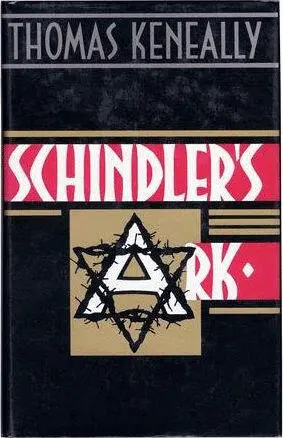
- Название:Schindler's Ark
- Автор:
- Издательство:Hodder and Stoughton
- Жанр:
- Год:1982
- Город:London
- ISBN:0-340-27838-2
- Рейтинг книги:4 / 5. Голосов: 1
-
Избранное:Добавить в избранное
- Отзывы:
-
Ваша оценка:
Schindler's Ark: краткое содержание, описание и аннотация
Предлагаем к чтению аннотацию, описание, краткое содержание или предисловие (зависит от того, что написал сам автор книги «Schindler's Ark»). Если вы не нашли необходимую информацию о книге — напишите в комментариях, мы постараемся отыскать её.
Schindler’s List
Working with the actual testimony of Schindler’s Jews, Thomas Keneally artfully depicts the courage and shrewdness of an unlikely savior, a man who is a flawed mixture of hedonism and decency and who, in the presence of unutterable evil, transcends the limits of his own humanity. From From
A mesmerizing novel based on the true story of Oskar Schindler, a German industralist who saved and succored more than 1000 Jews from the Nazis at enormous financial and emotional expense. How the German Oskar Schindler came to save more than one thousand Polish Jews during the Holocaust is one of the most fascinating stories of the century. Although millions are now learning about Schindler through Steven Spielberg’s recent Academy Award-winning film, his achievement first gained prominence with Keneally’s 1982 “facticious” novel (which is also the basis for the film). Keneally’s account is less melodramatic than the motion picture, and although he does not fully explain how a hedonistic German could have been so altered by the plight of the Jewish workers in his factory, he does make Schindler less enigmatic than the big-screen version. Ben Kingsley, one of the film's stars, reads in a calculatedly matter-of-fact tone, letting the story's power alone convey its complicated emotions. Highly recommended.
Michael Adams, Fairleigh Dickinson Univ. Lib., Madison, N.J.
Schindler's Ark — читать онлайн бесплатно полную книгу (весь текст) целиком
Ниже представлен текст книги, разбитый по страницам. Система сохранения места последней прочитанной страницы, позволяет с удобством читать онлайн бесплатно книгу «Schindler's Ark», без необходимости каждый раз заново искать на чём Вы остановились. Поставьте закладку, и сможете в любой момент перейти на страницу, на которой закончили чтение.
Интервал:
Закладка:
“I don’t see the bottle,” he said. Herr Schindler was already nudging Lamus away from the wall and pushing him out of range. “Disappear!” Grün yelled at the wheelbarrow man. “You may collect the bottle,” said Oskar, “from my office at the end of the inspection.”
Oskar took part in a similar transaction when the Gestapo raided the apartment of a forger and discovered, among other false documents completed or near-completed, a set of Aryan papers for a family called the Wohlfeilers—mother, father, three adolescent children, all of them workers at Schindler’s camp. Two Gestapo men therefore came to Lipowa Street to collect the family for an interrogation which would lead, through Montelupich prison, to Chujowa Górka. Three hours after entering Oskar’s office both men left, reeling on the stairs, beaming with the temporary bonhomie of cognac and, for all anyone knew, of a payoff. The confiscated papers now lay on Oskar’s desk, and he picked them up and put them in the fire.
Next, the brothers Danziger, who cracked a metal press one Friday. Honest, bemused men, semiskilled, looking up with staring shtetl eyes from the machine they had just loudly shattered. The Herr Direktor was away on business, and someone—a factory spy, Oskar would always say—denounced the Danzigers to the administration in Płaszów. The brothers were taken from Emalia and their hanging advertised at the next morning’s roll call in Płaszów. Tonight (it was announced), the people of Płaszów will witness the execution of two saboteurs. What of course qualified the Danzigers above all for execution was their Orthodox aura.
Oskar returned from his business trip to Sosnowiec at three o’clock on Saturday afternoon, three hours before the promised execution. News of the sentence was waiting on his desk. He drove out through the suburbs to Płaszów at once, taking cognac with him and some fine kielbasa sausage. He parked by the Administration Building and found Goeth in his office. He was pleased not to have to rouse the Commandant from an afternoon nap. No one knows the extent of the deal that was struck in Goeth’s office that afternoon, in that office akin to Torquemada’s, where Goeth had had ringbolts attached to the wall from which to hang people for discipline or instruction. It is hard to believe, however, that Amon was satisfied simply with cognac and sausage. In any case, his concern for the integrity of the Reich’s metal presses was soothed by the interview, and at six o’clock, the hour of their execution, the Danziger brothers returned in the back seat of Oskar’s plush limousine to the sweet squalor of Emalia.
All these triumphs were, of course, partial. It is an aspect of Caesars, Oskar knew, to remit as irrationally as they condemn. Emil Krautwirt, by day an engineer in the radiator factory beyond the Emalia barracks, was an inmate of Oskar’s SS subcamp. He was young, having got his diploma in the late Thirties. Krautwirt, like the others in Emalia, called the place Schindler’s camp, but by taking Krautwirt away to Płaszów for an exemplary hanging, the SS demonstrated whose camp it really was, at least for some aspects of its existence. For the fraction of Płaszów people who would live on into the Peace, the hanging of engineer Krautwirt was the first story, other than their own intimate stories of pain and humiliation, which they would relate. The SS were ever economical with their scaffolds, and at Płaszów the gallows resembled a long, low set of goalposts, lacking the majesty of the gibbets of history, of the Revolutionary guillotine, the Elizabethan scaffold, the tall solemnity of jailhouse gallows in the sheriff’s backyard.
Seen in peacetime, the gallows of Płaszów and Auschwitz would intimidate not by their solemnity but by their ordinariness. But as mothers of children would discover in Płaszów, it was still possible, even with such a banal structure, for five-year-olds to see too much of an execution from within the mass of prisoners on the Appellplatz. With Krautwirt, a sixteen-year-old boy named Haubenstock was also to be hanged. Krautwirt had been condemned for some letters he had written to seditious persons in the city of Cracow. But with Haubenstock, it was that he had been heard singing “Volga, Volga,” “Kalinka Maya,” and other banned Russian songs with the intention, according to his death sentence, of winning the Ukrainian guards over to Bolshevism.
The rules for the rite of execution inside Płaszów involved silence. Unlike the festive hangings of earlier times, the drop was performed in utter stillness. The prisoners stood in phalanxes, and were patrolled by men and women who knew the extent of their power: by Hujar and John; by Scheidt and Grün; by the NCO’S Landsdorfer, Amthor, and Grimm, Ritschek and Schreiber; and by the SS women supervisors recently assigned to Płaszów, both of them accomplished with the truncheon—Alice Orlowski and Luise Danz. Under such supervision, the pleadings of the condemned were heard in silence. Engineer Krautwirt himself seemed at first stunned and had nothing to say, but the boy was vocal. In an uneven voice he reasoned with the Hauptsturmführer, who stood beside the scaffold. “I am not a Communist, Herr Commandant. I hate Communism. They were just songs. Ordinary songs.” The hangman, a Jewish butcher of Cracow, pardoned for some earlier crime on condition that he undertake this work, stood Haubenstock on a stool and placed the noose around his neck. He could tell Amon wanted the boy hanged first, didn’t want the debate to drag on. When the butcher kicked the support out from beneath Haubenstock, the rope broke, and the boy, purple and gagging, noose around his neck, crawled on his hands and knees to Goeth, continuing his pleadings, ramming his head against the Commandant’s ankles and hugging his legs. It was the most extreme submission; it conferred on Goeth again the kingship he’d been exercising these fevered months past. Amon, in an Appellplatz of gaping mouths uttering no sound but a low hiss, a susurrus like a wind in sand dunes, took his pistol from his holster, kicked the boy away, and shot him through the head.
When poor engineer Krautwirt saw the horror of the boy’s execution, he took a razor blade that he’d concealed in his pocket and slashed his wrists. Those prisoners at the front could tell that Krautwirt had injured himself fatally in both arms. But Goeth ordered the hangman to proceed in any case, and splashed with the gore from Krautwirt’s injuries, two Ukrainians lifted him to the scaffold, where, gushing from both wrists, he strangled in front of the Jews of southern Poland.
It was natural to believe with one part of the mind that each such barbarous exhibition might be the last, that there might be a reversal of methods and attitudes even in Amon, or if not in him, then in those unseen officials who in some high office with French windows and waxed floors, overlooking a square where old women sold flowers, must formulate half of what happened in Płaszów and condone the rest.
On the second visit of Dr. Sedlacek from Budapest to Cracow, Oskar and the dentist devised a scheme which might to a more introverted man than Schindler have seemed naive. Oskar suggested to Sedlacek that perhaps one of the reasons Amon Goeth behaved so savagely was the bad liquor he drank, the gallons of local so-called cognac which weakened even further Amon’s faulty sense of ultimate consequences. With a portion of the Reichsmarks Dr. Sedlacek had just brought to Emalia and handed to Oskar, a crate of first-rate cognac should be bought—not such an easy or inexpensive item in post-Stalingrad Poland. Oskar should deliver it to Amon, and in the progress of conversation suggest to Goeth that one way or another the war would end at some time, and that there would be investigations into the actions of individuals. That perhaps even Amon’s friends would remember the times he’d been too zealous. It was Oskar’s nature to believe that you could drink with the devil and adjust the balance of evil over a snifter of cognac. It was not that he found more radical methods frightening. It was that they did not occur to him. He’d always been a man of transactions.
Читать дальшеИнтервал:
Закладка:
Похожие книги на «Schindler's Ark»
Представляем Вашему вниманию похожие книги на «Schindler's Ark» списком для выбора. Мы отобрали схожую по названию и смыслу литературу в надежде предоставить читателям больше вариантов отыскать новые, интересные, ещё непрочитанные произведения.











Обсуждение, отзывы о книге «Schindler's Ark» и просто собственные мнения читателей. Оставьте ваши комментарии, напишите, что Вы думаете о произведении, его смысле или главных героях. Укажите что конкретно понравилось, а что нет, и почему Вы так считаете.