Frances Itani - Requiem
Здесь есть возможность читать онлайн «Frances Itani - Requiem» весь текст электронной книги совершенно бесплатно (целиком полную версию без сокращений). В некоторых случаях можно слушать аудио, скачать через торрент в формате fb2 и присутствует краткое содержание. Город: Toronto, Год выпуска: 2012, ISBN: 2012, Издательство: A Phyllis Bruce Book, Жанр: Историческая проза, на английском языке. Описание произведения, (предисловие) а так же отзывы посетителей доступны на портале библиотеки ЛибКат.
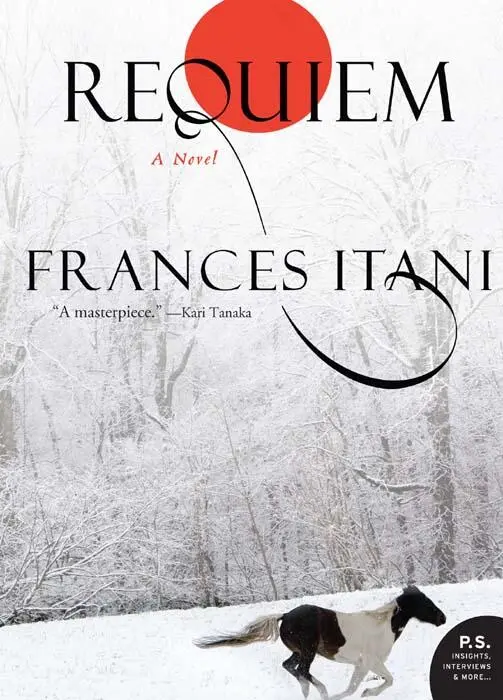
- Название:Requiem
- Автор:
- Издательство:A Phyllis Bruce Book
- Жанр:
- Год:2012
- Город:Toronto
- ISBN:978-1-44340-690-1
- Рейтинг книги:4 / 5. Голосов: 1
-
Избранное:Добавить в избранное
- Отзывы:
-
Ваша оценка:
Requiem: краткое содержание, описание и аннотация
Предлагаем к чтению аннотацию, описание, краткое содержание или предисловие (зависит от того, что написал сам автор книги «Requiem»). Если вы не нашли необходимую информацию о книге — напишите в комментариях, мы постараемся отыскать её.
delicately probes the complex adjustments we make to live with our sorrows…. [A] perfectly modulated novel.”
—
An extraordinary researcher and scholar of detail, Frances Itani—author of the best-selling novel
—excels at weaving breathtaking fiction from true-life events. In her new novel, she traces the lives, loves, and secrets in one Japanese-Canadian family during and after their internment in the 1940s.
In 1942, in retaliation for the attack on Pearl Harbor, the Canadian government removed Bin Okuma’s family from their home on British Columbia’s west coast and forced them into internment camps. They were allowed to take only the possessions they could carry, and Bin, as a young boy, was forced to watch neighbors raid his family’s home before the transport boats even undocked. One hundred miles from the “Protected Zone,” they had to form new makeshift communities without direct access to electricity, plumbing, or food—for five years.
Fifty years later, after his wife’s sudden death, Bin travels across Canada to find the biological father who has been lost to him. Both running from grief and driving straight toward it, Bin must ask himself whether he truly wants to find First Father, the man who made a fateful decision that almost destroyed his family all those years ago. With his wife’s persuasive voice in his head and the echo of their love in his heart, Bin embarks on an unforgettable journey into his past that will throw light on a dark time in history.
Requiem — читать онлайн бесплатно полную книгу (весь текст) целиком
Ниже представлен текст книги, разбитый по страницам. Система сохранения места последней прочитанной страницы, позволяет с удобством читать онлайн бесплатно книгу «Requiem», без необходимости каждый раз заново искать на чём Вы остановились. Поставьте закладку, и сможете в любой момент перейти на страницу, на которой закончили чтение.
Интервал:
Закладка:
He had also accomplished what he had set out to do: he had ensured that I completed my formal education; he had sent me to university; he had helped me to begin the exhilarating study of art. He had provided me with a home, and he had supported me in every way.
The week I spent with Okuma-san was the last week of his life, though I did not know this at the time. He had a friend, Mari, and the three of us ate most of our meals together. Mari was a widow, and she and Okuma-san spent much of their time in each other’s company. During that week, he and I walked the pathways along the Ottawa River, talking, discussing music and art. He was curious to hear about my latest enthusiasms. He also wanted me to visit Paris, Florence, Berlin, Vienna, Rome, Amsterdam, the great cities of Europe. He spoke about the birthplace of Beethoven in Bonn, the life mask, the ear trumpets, the grandfather clock, the four-stringed piano, all of which I would later see for myself. I had saved as much money as I could towards travel expenses, and Peter had found a McGill student named Lena to take over my room in Montreal during the year I would be away. I did not meet Lena before I left the country, but Peter told me she was a history major, a Montrealer who wanted to move out of her parents’ home so that she would be closer to the campus.
Two days after I said goodbye to Okuma-san in Ottawa, I was in Montreal, packing my belongings in a trunk that was to be left behind with Peter. The phone rang and it was Mari. Okuma-san had died suddenly, from a heart attack. I was on a train, returning to Ottawa, within hours of the call.
At the funeral, I sat beside Mari, who had arranged for the musicians—all friends of Okuma-san—to play the last movement of the String Quartet in F major. It was performed expertly, the grace and power of Beethoven flowing into every sorrowful space inside the church. From the oak pew, I thought about the grace and power that had also been Okuma-san’s. He had met adversity with stoicism and with hope. He had set the example of never giving in to anger, even though he knew I had anger of my own inside me. He had provided strength in my background, and I had relied upon him for stability, for support and for love.
As I sat there, I could not help but think of the shack in the camp, with its brittle needles of frost inside the ceiling and walls, the worn plank keyboard of ponderosa pine, the bruised hands, the attempts at the sonata, the cream-coloured paper he had slit from his best books so that I would be able to draw, the lone egg in the refrigerator, the first time I heard a recording of the Emperor Concerto and how we listened to it twice in the same evening in the fading light of the chicken coop. I wondered, too, if the plank keyboard even existed. We had left it in the chicken coop the day we departed British Columbia, and it might be there still. I doubted that any other tenant lived in that place after we left in 1951.
I thought of all the parts of our lives that Okuma-san and I had shared as father and son, for twenty-one years. And I was grateful.
Muss es sein? Es muss sein .
After the funeral, Mari gave me an envelope that had been found with Okuma-san’s papers and his will. Whatever he owned had been left to me. I opened the envelope later, when I was alone, after the mourners had departed, after the sushi and sandwiches had been served, after I had returned to the house in the early evening. My Dear Son , I read,
I have been troubled by a heart ailment for some time, and there is nothing more to do that has not already been done .
I am ready, but you have your entire life before you. You will be a fine artist, I am sure of this. Remember, always, that I have been grateful to have you as my honorary and beloved son .
The music has ended; the road widens. I am able to loosen my grip on the steering wheel as the car descends into the valley. I park at the side of what, surprisingly, is now a paved road. Why should this come as a surprise? It’s been more than half a century since I lived here.
Basil clambers out and we stand together and face the camp. Or what would have been the camp. But could sixty-one shacks have fit into this narrow space? I walk forward into the field where the huge tents were set up the fourth day after our arrival by train. At first, this is confusing, and I wonder if I can be in the right place.
Any structure we left behind has been razed to the ground. The field is run through with weeds and shrubs grown wild. There are bushes with red berries I don’t remember, and sagebrush and tumbleweed at the edges of the field. The slopes hold only a thin layer of trees. The ground is lumpy, but when I look more closely I see outlines of scooped-out places, now covered with tufted grass. And there’s the town, on the other side of the river. This has to be the camp. But the winds of fifty years have swept through and it has become a barren place.
I stand still and try to gather memory. Recognition comes slowly. My eyes follow contours and outlines on the surface of the field. I open a mental map and unfold it, square by careful square.
This is it , I tell myself, and I pace forward. I’m at the edge of a rounded hollow filled with clumps of earth, and I see a couple of pieces of old tin. I look to the left. A plank led to the bathhouse here. Ba and Ji’s shack there. Uncle Aki and Auntie Aya’s behind. At the foot of the hill, the site where the outhouses used to be. Outhouses with their snow chinks in winter, and always cold as fear. The trees have been cut down in the place where the ghosts were said to gather. There isn’t so much as a board anywhere, but I can trace the community; it’s all here.
And now that my eyes have adjusted, I see tarpaper fragments, a shallow indent hardly more than six feet square. I pick up a stick that fits to my palm, and use it to dig. And suddenly I’m unearthing a half century’s drifting silt. The end of the stick hits something that clinks, and I keep digging. Pieces of china now, and some heavier Japanese porcelain. A blue-and-white rice bowl that matches the one I saw in First Father’s kitchen last night. This one is whole except for a large triangular chip missing from the rim. Miraculously, I find the chip as well, and I stow both pieces to take back with me.
Bin, protector of fractured and broken goods .
This is the place. The buried place. With no trace of path worn smooth between three rows of shacks; no trace of bathhouse, outhouse, schoolhouse. No trace of Jack-pine pole, of water tank, of woodshed where a headless bear once hung upside down. No sign that a community endured, that Auntie Aya gave birth, that Baby Taro died and we searched the ashes for his teardrop shape. No sign of the funeral pyre, or of graves in the woods. No sign that elders died, that children played and shouted, that Ba waited for letters from Manzanar, or that Ying drove his truck to camp every week and laughing women gave orders for chimpo sausage. No sign that Mother wept, that First Father raged, that Hiroshi and Keiko and I and all of the others, young and old, had to set aside our dreams and our hopes.
I look up now, to the flat Bench where we picked berries on summer evenings. The camp was hemmed tightly between road and Bench here, the mountain rising up behind. But I’m astonished to see, beyond that, a second mountain behind the first. Another mountain was there all this time and I didn’t know, because I was too small to see. All those years and the mountain behind the mountain could not be seen.
I tug my shoulder pack from the car, lock the door, cross the road and search for the trail that leads to the river below. Basil, sometimes in front, sometimes behind, has no difficulty following the steep path. He is remarkably stable with his low centre of gravity and his large feet and claws.
Читать дальшеИнтервал:
Закладка:
Похожие книги на «Requiem»
Представляем Вашему вниманию похожие книги на «Requiem» списком для выбора. Мы отобрали схожую по названию и смыслу литературу в надежде предоставить читателям больше вариантов отыскать новые, интересные, ещё непрочитанные произведения.






Обсуждение, отзывы о книге «Requiem» и просто собственные мнения читателей. Оставьте ваши комментарии, напишите, что Вы думаете о произведении, его смысле или главных героях. Укажите что конкретно понравилось, а что нет, и почему Вы так считаете.