Frances Itani - Requiem
Здесь есть возможность читать онлайн «Frances Itani - Requiem» весь текст электронной книги совершенно бесплатно (целиком полную версию без сокращений). В некоторых случаях можно слушать аудио, скачать через торрент в формате fb2 и присутствует краткое содержание. Город: Toronto, Год выпуска: 2012, ISBN: 2012, Издательство: A Phyllis Bruce Book, Жанр: Историческая проза, на английском языке. Описание произведения, (предисловие) а так же отзывы посетителей доступны на портале библиотеки ЛибКат.
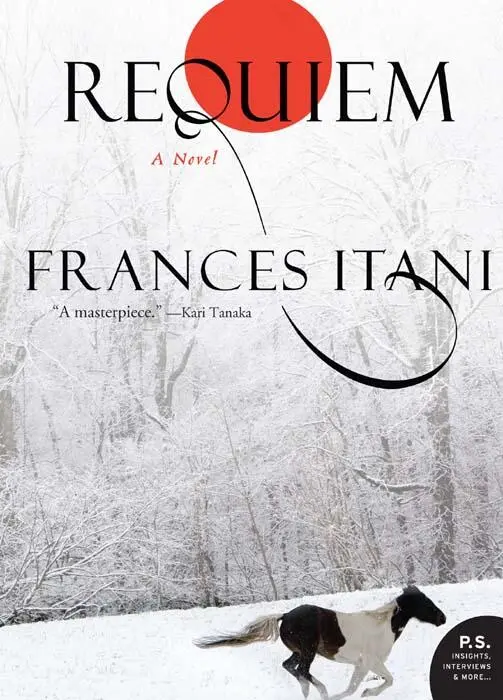
- Название:Requiem
- Автор:
- Издательство:A Phyllis Bruce Book
- Жанр:
- Год:2012
- Город:Toronto
- ISBN:978-1-44340-690-1
- Рейтинг книги:4 / 5. Голосов: 1
-
Избранное:Добавить в избранное
- Отзывы:
-
Ваша оценка:
Requiem: краткое содержание, описание и аннотация
Предлагаем к чтению аннотацию, описание, краткое содержание или предисловие (зависит от того, что написал сам автор книги «Requiem»). Если вы не нашли необходимую информацию о книге — напишите в комментариях, мы постараемся отыскать её.
delicately probes the complex adjustments we make to live with our sorrows…. [A] perfectly modulated novel.”
—
An extraordinary researcher and scholar of detail, Frances Itani—author of the best-selling novel
—excels at weaving breathtaking fiction from true-life events. In her new novel, she traces the lives, loves, and secrets in one Japanese-Canadian family during and after their internment in the 1940s.
In 1942, in retaliation for the attack on Pearl Harbor, the Canadian government removed Bin Okuma’s family from their home on British Columbia’s west coast and forced them into internment camps. They were allowed to take only the possessions they could carry, and Bin, as a young boy, was forced to watch neighbors raid his family’s home before the transport boats even undocked. One hundred miles from the “Protected Zone,” they had to form new makeshift communities without direct access to electricity, plumbing, or food—for five years.
Fifty years later, after his wife’s sudden death, Bin travels across Canada to find the biological father who has been lost to him. Both running from grief and driving straight toward it, Bin must ask himself whether he truly wants to find First Father, the man who made a fateful decision that almost destroyed his family all those years ago. With his wife’s persuasive voice in his head and the echo of their love in his heart, Bin embarks on an unforgettable journey into his past that will throw light on a dark time in history.
Requiem — читать онлайн бесплатно полную книгу (весь текст) целиком
Ниже представлен текст книги, разбитый по страницам. Система сохранения места последней прочитанной страницы, позволяет с удобством читать онлайн бесплатно книгу «Requiem», без необходимости каждый раз заново искать на чём Вы остановились. Поставьте закладку, и сможете в любой момент перейти на страницу, на которой закончили чтение.
Интервал:
Закладка:
Natalie Samson, writing in Quill & Quire , said, “ Requiem is an exploration of the places history is stored: letters, art, music, literature and the human body itself.” Did you set out to write about this, or did these ideas evolve?
I find it interesting that the reviewer chose to discuss one of the important sub-themes in Requiem . I was purposeful in creating Lena as historian. I wanted her approach to history to offset Bin’s. Bin tries to push away and forget. Lena wants to recount and store family history, and pass it on to future generations. The rest was unplanned on my part. At least at the beginning—one always gets hold of intertwining themes before the finish line! Music, for instance, is stored in the body in many ways, especially for composers and performers. The scene in which Lena and Bin return to their home and discuss how he first heard music (as a series of rhythms and taps against wood) brought me to tears in the writing, and still has that effect on me. Music on skin. A scene not at all planned. This is what I mean by the subconscious working for a writer. All of these threads tie in to the main theme. The throwing of the archival papers into the river, the Beethoven letters, the memory of the first recordings heard by the child.
In writing Requiem , how much did you struggle with separating family history from fiction?
It was difficult at times, because of a full awareness of my husband having lived his entire childhood in an internment camp. I wanted my character Bin Okuma to be unique—entirely different from family members and friends. I was not writing biography. I had done the research; I’d talked to and interviewed Japanese Canadians; I knew the historic events leading up to and subsequent to the attack on Pearl Harbor in 1941. I had witnessed, for more than forty years, how these events left their mark on personalities and on families. But my story depended entirely on my imagination. Fortunately, I’ve always loved invention.
Did your husband read early drafts?
I did not discuss the book with my husband over the four-year period of its creation. He knew the subject matter and the time period, but that was about all. My husband never reads my work until it’s between covers. In fact, I don’t show a word of an ongoing novel to anyone during its creation—a period that could last four to six years. The first two people to read my work are my agent and my publisher—and only when I feel I have a satisfactory draft ready to be seen. This could be my fiftieth or my hundredth draft. It all depends …
You completed an incredible amount of research for Requiem , and some of what you uncovered must have been heartbreaking. What kept you writing?
I never stopped believing that it was important for me to write this book. One of the reasons I created Requiem was to let people know what really went on. The main reason might have been my hope that what happened to my husband will never happen to our children or grandchildren because of the shape of their eyes and the colour of their skin.
Music is woven beautifully into the fabric of Requiem . Why did you decide that music would be an important part of Bin’s life?
To intertwine the events of the novel with music was an early decision and a natural unfolding. I kept thinking of a musician, a pianist imprisoned. How would he practise in a remote camp in the mountains? I decided he would make his own keyboard from the forest around him. I kept thinking: who would know about chaos, forgiveness, redemption—themes important to the novel? I discussed the underlying themes extensively with my son, who is a musician. It seemed that Beethoven was the composer who best understood. I listened to Beethoven’s music throughout the years it took me to write the book. I came to understand much more about Beethoven’s genius through his letters and various biographies—not to mention the brilliant recordings I now own.
I also chose Benny Goodman. Bin listens to Beethoven; Lena listens to Benny. Both choices reflect some of the music I love. I listen to classical, jazz, choral works—a wide selection, really, depending on the time of day or night, mood, whether I’m at my desk or not.
What differences are there between travelling as a writer/researcher, which you did in researching this novel, and travelling solely for pleasure?
Well, once a writer, always a writer. Every moment of my life, I’m a writer. So there isn’t too much difference, really. I have a notebook with me, always, and I did take notes while crossing Canada—but I would have done that anyway. I have crossed Canada about half a dozen times by car, and three or four times by train, so I know the terrain and I know the feeling of excitement that goes with travelling the expanse of this vast and beautiful country. During my most recent journey by car in 2009, I was perhaps more focused on how I would use certain western images for detail, especially images of the Fraser River.
Critics note that rivers are a recurring motif in your writing, and that’s also the case in Requiem . What fascinates you about rivers?
I grew up beside rivers: first the Moira River in Ontario, and then the Ottawa River in Quebec. My earliest memories are water-soaked. I have lived close to rivers in many countries. I love the metaphorical use of rivers in literature. As readers of Leaning, Leaning Over Water will know, rivers can give life and rivers can take life away. In rivers, there are hidden currents, possibilities of discovery. They also contain a last point of safety—or not. Rivers meander and flow through life. Anything can happen in rivers, on rivers, beside rivers … you can see that rivers are important to me. I love the forces inside a river, the dark places, the eternal flow. I expect that rivers will continue to meander through my future writing in the same way that rivers are important to Bin’s paintings in Requiem .
Requiem has touched readers deeply. What are some of the more memorable reader reactions you have received?
After giving a public reading from Requiem , I was thrilled when a Japanese Canadian man stood up and told the audience that he had read my book and that as a child, he had lived every detail of my story of the camps. I have been pleased to have children of Nisei parents who were interned write to me or phone to tell me, “Now, I finally understand what my parents went through. Now, I understand why they refused to talk about what happened.”
I have been thanked many times by non-Japanese and Japanese Canadians, all of whom want the stories told. And I believe that the stories should be told. They should not die off with each generation. Sometimes, older Caucasian readers approach me at public events and tell me that they lived through the news of the period but had no idea what the interned families actually experienced. They did not know about the stripping down of dignity, the shame, the total humiliation.
Finally, I loved receiving a phone call from a person unknown to me who had just finished reading Requiem and left this message: “I read your book, and wept.”
About the book
The Writing of Requiem: An Essay by Frances Itani
As early as the 1970s, I began to write about the Second World War removal, detention and imprisonment of North American citizens of Japanese ethnic origin. After Pearl Harbor, December 7, 1941, longstanding racism came to a head, especially up and down the West Coast. It was almost as if two governments were acting in concert, so aligned were the dates of the forced removal of citizens from their homes and businesses, from their farms and fishing villages, their schools and universities, and from their professions.
Читать дальшеИнтервал:
Закладка:
Похожие книги на «Requiem»
Представляем Вашему вниманию похожие книги на «Requiem» списком для выбора. Мы отобрали схожую по названию и смыслу литературу в надежде предоставить читателям больше вариантов отыскать новые, интересные, ещё непрочитанные произведения.





Обсуждение, отзывы о книге «Requiem» и просто собственные мнения читателей. Оставьте ваши комментарии, напишите, что Вы думаете о произведении, его смысле или главных героях. Укажите что конкретно понравилось, а что нет, и почему Вы так считаете.