Frances Itani - Requiem
Здесь есть возможность читать онлайн «Frances Itani - Requiem» весь текст электронной книги совершенно бесплатно (целиком полную версию без сокращений). В некоторых случаях можно слушать аудио, скачать через торрент в формате fb2 и присутствует краткое содержание. Город: Toronto, Год выпуска: 2012, ISBN: 2012, Издательство: A Phyllis Bruce Book, Жанр: Историческая проза, на английском языке. Описание произведения, (предисловие) а так же отзывы посетителей доступны на портале библиотеки ЛибКат.
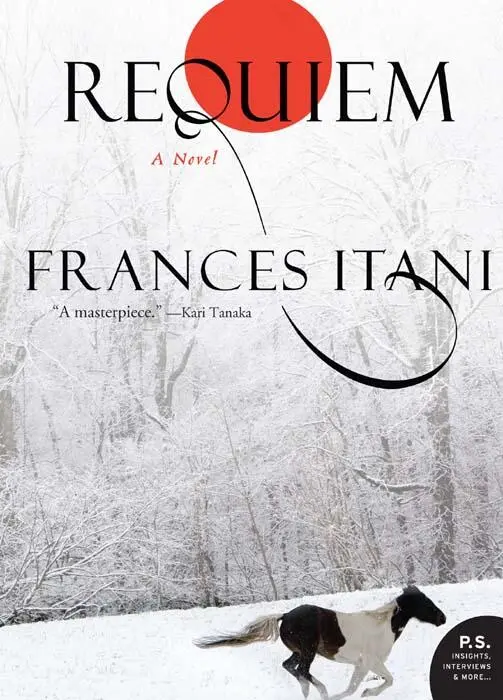
- Название:Requiem
- Автор:
- Издательство:A Phyllis Bruce Book
- Жанр:
- Год:2012
- Город:Toronto
- ISBN:978-1-44340-690-1
- Рейтинг книги:4 / 5. Голосов: 1
-
Избранное:Добавить в избранное
- Отзывы:
-
Ваша оценка:
Requiem: краткое содержание, описание и аннотация
Предлагаем к чтению аннотацию, описание, краткое содержание или предисловие (зависит от того, что написал сам автор книги «Requiem»). Если вы не нашли необходимую информацию о книге — напишите в комментариях, мы постараемся отыскать её.
delicately probes the complex adjustments we make to live with our sorrows…. [A] perfectly modulated novel.”
—
An extraordinary researcher and scholar of detail, Frances Itani—author of the best-selling novel
—excels at weaving breathtaking fiction from true-life events. In her new novel, she traces the lives, loves, and secrets in one Japanese-Canadian family during and after their internment in the 1940s.
In 1942, in retaliation for the attack on Pearl Harbor, the Canadian government removed Bin Okuma’s family from their home on British Columbia’s west coast and forced them into internment camps. They were allowed to take only the possessions they could carry, and Bin, as a young boy, was forced to watch neighbors raid his family’s home before the transport boats even undocked. One hundred miles from the “Protected Zone,” they had to form new makeshift communities without direct access to electricity, plumbing, or food—for five years.
Fifty years later, after his wife’s sudden death, Bin travels across Canada to find the biological father who has been lost to him. Both running from grief and driving straight toward it, Bin must ask himself whether he truly wants to find First Father, the man who made a fateful decision that almost destroyed his family all those years ago. With his wife’s persuasive voice in his head and the echo of their love in his heart, Bin embarks on an unforgettable journey into his past that will throw light on a dark time in history.
Requiem — читать онлайн бесплатно полную книгу (весь текст) целиком
Ниже представлен текст книги, разбитый по страницам. Система сохранения места последней прочитанной страницы, позволяет с удобством читать онлайн бесплатно книгу «Requiem», без необходимости каждый раз заново искать на чём Вы остановились. Поставьте закладку, и сможете в любой момент перейти на страницу, на которой закончили чтение.
Интервал:
Закладка:
Finally, with great affection, I acknowledge my agent, Jackie Kaiser, and my editor and publisher at HarperCollins, Phyllis Bruce. I know it’s there, always, during these long journeys: your unwavering support. I thank you both.
About the Author
FRANCES ITANIhad a spectacular international debut with her first novel, Deafening , which received a Commonwealth Writers’ Prize for Best Book (Canada and Caribbean region) and was shortlisted for the International IMPAC Dublin Literary Award. It became a #1 bestseller in Canada and was published in seventeen countries and in many languages. Her second novel, Remembering the Bones , also a bestseller, was shortlisted for a Commonwealth Writers’ Prize. Her short story collection, Poached Egg On Toast , won the Ottawa Book Award and the CAA Jubilee Award for Short Stories. A member of the Order of Canada, Itani lives in Ottawa.
A NOTE ON THE TYPE
This book is set in Dante, the first versions of which were the product of a collaboration between Giovanni Mardersteig, a printer, book and typeface designer, and Charles Malin, one of the great punch-cutters of the twentieth century.
Mardersteig drew on his experience of using Monotype Bembo and Centaur to design a new book face with an italic that worked harmoniously with the roman. Years of collaboration with Malin had taught him the nuances of letter construction, and the two worked closely to develop a design that was easy to read. Special care was taken in the design of the serifs and top curves of the lowercase to create a subtle horizontal stress, which helps the eye move smoothly across the page.
In 1955, after six years of work, the fonts were used to publish Boccaccio’s Trattatello in laude di Dante . The design took its name from this project.
P.S.
Ideas, interviews & features
About the author
Author Biography
FRANCES ITANI is the author of fourteen books: novels, poetry, short stories and children’s books. Born in Belleville, Ontario, she grew up in rural Quebec from the age of four. She has a BA in Psychology and English and an MA in English Literature. She is also a registered nurse, having studied at the Montreal General Hospital School of Nursing, McGill University and Duke University in North Carolina. She practised and taught nursing for eight years before becoming a writer.
Itani had a spectacular international debut with her first novel, Deafening , which received a Commonwealth Writers’ Prize for Best Book and was shortlisted for the 2005 International IMPAC Dublin Literary Award and the William Saroyan International Prize. Deafening was a #1 bestseller in Canada; it won the Kingston Reads Award and was named Book of the Year by Grant MacEwan University in Edmonton. In 2006, it was chosen in both English and French by CBC’s Canada Reads and Combat des livres . The novel was also optioned for film and has been translated and published in seventeen countries.
Her second novel, Remembering the Bones , also a bestseller, was published internationally and shortlisted for a Commonwealth Writers’ Prize. Itani’s stories have won two Ottawa Book Awards for English fiction, and she is a three-time winner of the CBC Literary Award. Her collection Poached Egg On Toast won the 2005 CAA Jubilee Award for best book of stories published in Canada. Leaning, Leaning Over Water was published internationally; it was a selection of The Times’ Book Group in the U.K. Itani has written two short novels for adult literacy classes: Listen! and Missing. Requiem has also been published in the U.S. and is forthcoming in Germany and Bulgaria.
Itani has contributed to The Washington Post, The Globe and Mail, The Walrus, Canadian Geographic, Saturday Night, Ottawa Citizen and many other publications. Currently, she is on the advisory board of Youth in Motion’s Top 20 Under 20 Award. A member of the Order of Canada, she lives in Ottawa.
Meet Frances Itani
How has your being part of a large family of Irish Canadian storytellers influenced you and your writing?
I was surrounded by kitchen-table narrative. My mother, my aunts and uncles were all storytellers. Our own family lived in Quebec and our relatives lived in Eastern Ontario, so it was during visits that I overheard multi-layered accounts of complicated lives. Everyone, it seemed, had stored up something to tell. I lived in the midst of stories from the past, stories created in the moment, imaginings into the future. I was on the sidelines trying to figure out how adults moved through this complex world of theirs—so totally unlike the world of children, which I knew intimately. But even in the separate world of children, stories were important. I was the middle child of five and I invented stories, wrote radio broadcasts with my sister, created theatre, read whatever books I could find—books were scarce during my childhood. Of course, I was also absorbing language, nuance, mood. I was absorbing voices, especially those of women of a particular place and time.
When did you begin writing?
I began to write poetry as a student when I was about eighteen. I didn’t pursue this further until my mid- to late twenties, when I returned to Canada after several years abroad. I switched careers and went back to school again. As part of my degree work at the University of Alberta, I enrolled in a writing course with W.O. Mitchell. Another possible world began to open up before me, and I slid into it sideways. I made the commitment. But it was also a difficult time for me; I had two young babies, I was completing my degrees and I was trying to believe that I could be a writer.
You start all your novels writing longhand in a notebook. What do you believe this brings to the creative process?
Writing longhand is the method I’m used to, and it’s not as dated as some may think. People do still hold pens in their hands—in my case, it’s a pen with real ink! I can switch over to the computer at any stage, but I still like to feel my way into the voice and direction of a story while sitting at a table, a spiral notebook before me. There’s something really lovely about the flowing of the mind right down through the ink. I try to find my way into the telling with my pen. I try to find my way into the voices. Who is going to tell each of the stories in the novel? When does each character take over his or her own voice?
Writing longhand is easy, too, when I’m travelling. There’s always a notebook in my shoulder bag. When I’m home, if I do switch to the computer, I sometimes stall. That’s when I move into another room entirely and go back to longhand.
You’ve said that you never use an outline, that you create your characters in an “organic” way. Can you explain your approach?
I start with an image, a theme, an idea. The first scene I create could end up in the last chapter of a book. I don’t want a plan and don’t make a plan. I don’t want a plot. None of my books has a plot. That is not to say that there isn’t action in my work. I just don’t want anything forced. I do, however, want my work to surprise me. I want the mystery of it. I want the doors open wide while I’m creating. I want edges and boundaries to fall away.
Having said that, theme is important from the beginning. Requiem began with themes of loss and anger—how would my main character handle these? When I’m starting out, I don’t yet know how the particulars of each person’s story will unfold. So much happens at the subconscious level, a level of creation that I deeply trust. Thematic structure changes and unfolds with the writing. Requiem ends with a theme of redemption that encompasses love and art and hope. As I progress through a novel, the basic ideas broaden out in all directions.
Читать дальшеИнтервал:
Закладка:
Похожие книги на «Requiem»
Представляем Вашему вниманию похожие книги на «Requiem» списком для выбора. Мы отобрали схожую по названию и смыслу литературу в надежде предоставить читателям больше вариантов отыскать новые, интересные, ещё непрочитанные произведения.




Обсуждение, отзывы о книге «Requiem» и просто собственные мнения читателей. Оставьте ваши комментарии, напишите, что Вы думаете о произведении, его смысле или главных героях. Укажите что конкретно понравилось, а что нет, и почему Вы так считаете.