Frances Itani - Requiem
Здесь есть возможность читать онлайн «Frances Itani - Requiem» весь текст электронной книги совершенно бесплатно (целиком полную версию без сокращений). В некоторых случаях можно слушать аудио, скачать через торрент в формате fb2 и присутствует краткое содержание. Город: Toronto, Год выпуска: 2012, ISBN: 2012, Издательство: A Phyllis Bruce Book, Жанр: Историческая проза, на английском языке. Описание произведения, (предисловие) а так же отзывы посетителей доступны на портале библиотеки ЛибКат.
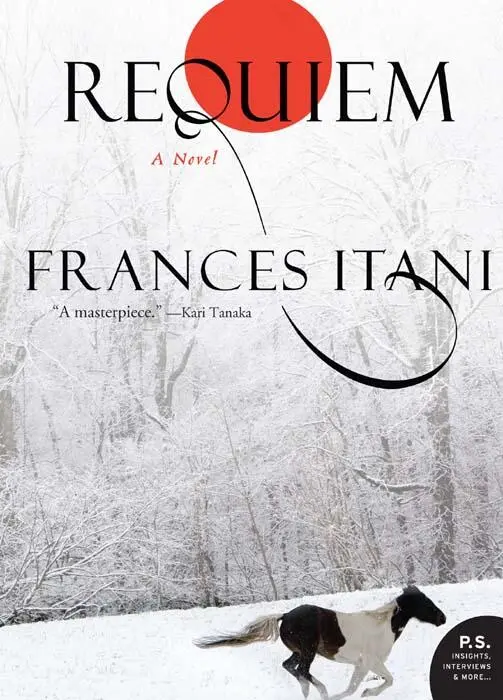
- Название:Requiem
- Автор:
- Издательство:A Phyllis Bruce Book
- Жанр:
- Год:2012
- Город:Toronto
- ISBN:978-1-44340-690-1
- Рейтинг книги:4 / 5. Голосов: 1
-
Избранное:Добавить в избранное
- Отзывы:
-
Ваша оценка:
Requiem: краткое содержание, описание и аннотация
Предлагаем к чтению аннотацию, описание, краткое содержание или предисловие (зависит от того, что написал сам автор книги «Requiem»). Если вы не нашли необходимую информацию о книге — напишите в комментариях, мы постараемся отыскать её.
delicately probes the complex adjustments we make to live with our sorrows…. [A] perfectly modulated novel.”
—
An extraordinary researcher and scholar of detail, Frances Itani—author of the best-selling novel
—excels at weaving breathtaking fiction from true-life events. In her new novel, she traces the lives, loves, and secrets in one Japanese-Canadian family during and after their internment in the 1940s.
In 1942, in retaliation for the attack on Pearl Harbor, the Canadian government removed Bin Okuma’s family from their home on British Columbia’s west coast and forced them into internment camps. They were allowed to take only the possessions they could carry, and Bin, as a young boy, was forced to watch neighbors raid his family’s home before the transport boats even undocked. One hundred miles from the “Protected Zone,” they had to form new makeshift communities without direct access to electricity, plumbing, or food—for five years.
Fifty years later, after his wife’s sudden death, Bin travels across Canada to find the biological father who has been lost to him. Both running from grief and driving straight toward it, Bin must ask himself whether he truly wants to find First Father, the man who made a fateful decision that almost destroyed his family all those years ago. With his wife’s persuasive voice in his head and the echo of their love in his heart, Bin embarks on an unforgettable journey into his past that will throw light on a dark time in history.
Requiem — читать онлайн бесплатно полную книгу (весь текст) целиком
Ниже представлен текст книги, разбитый по страницам. Система сохранения места последней прочитанной страницы, позволяет с удобством читать онлайн бесплатно книгу «Requiem», без необходимости каждый раз заново искать на чём Вы остановились. Поставьте закладку, и сможете в любой момент перейти на страницу, на которой закончили чтение.
Интервал:
Закладка:
There is the gravel bar. There are the jagged rocks, the muddy green water. I don’t need to look, not really. The river, the mind’s companion—fast and hard and unrelenting—is where it has always been.
There is no mist hovering, no rope of cloud stretched along its length. The small island, in the middle of the channel, has eroded along the edge but otherwise is much the same. I sit on the flat rock on the riverbank and open my pack. I should have brought Lena here a long time ago. I should have shared this place with her. I’ll bring Greg. We’ll manage a trip before long. And when he’s with me, we’ll keep going, all the way to the Pacific, to the coastal village on Vancouver Island where I was born, even though the house is gone. Or maybe we’ll start at the sea and work our way back. For now, this has to be enough.
From my pack, I pull out the manila folder that has Lena’s signature written across the cover. I begin to leaf through papers, copies of documents she was never able to persuade me to read. The ones from the archives. The ones with whole paragraphs censored and blacked out.
But Lena has highlighted lines of her own in faded blue, and these I can read.
—The file reveals that no crosscut saw was inventoried .
—The file reveals that no sewing machine was located .
—The file reveals no mention of a grandfather clock .
—When the area was visited by officials sent to appraise the property, no property could be identified at the location described .
—As you did not reply to our letter, it was understood that you agreed to the $8 value of the skiff, which was sold .
—The fishing vessel previously owned by you was sold through the Japanese Fishing Vessels Disposal Committee, the vessel having been requisitioned by Naval Service .
—Supervision costs of $41.50 have been charged to you. An additional $68.90 has also been withheld to cover possible repairs, and has been deducted from the sale price .
And the ultimate, repetitive replies to persistent requests after the war, also highlighted by Lena: The items found on the property were declared to be of no value .
I cram the papers back into the folder. Basil is joyously splashing, running from water to riverbank, from riverbank to water. I step down to the edge and raise my arms and I hear Lena’s voice.
You’re drowning your history, Bin. Think about it. This is your own history .
And I reply, “But maybe this is the way I can, finally, for all time, get rid of the ghosts.”
I pause for a moment, and then I let the folder fly. Papers scatter on the waves and bob and swirl as they rush downriver. The same direction as the body of the small boy who drowned and disappeared during the last year of the war.
Back up the bank now, I sprawl out on the rock shelf where Mother once sat in the sun. I take out the wooden box given to me by my own beloved son. I take out a charcoal pencil and the pad that has the thickest paper and I begin to draw. It is like naming, I think. And Lena’s voice says, Yes, but which name? You, for instance, have had so many .
I look around at the mountains and at the turbulent river rushing past on its long journey to the coast. I inhale the air, cool and clear. I think of the people I love and have loved, living and dead, and I think of the camp that once existed here but is nothing but shadows now, and I decide: REQUIEM. That will be the name of my exhibition. I’ll phone Nathan and Otto later this afternoon, and I’ll let them know so that they can get things moving at their end.
I focus on my drawing now. And listen to the soft, scratchy, satisfying sound of charcoal against paper. I look up, and then down again. This is what I have always known. This is what river is.
There is a familiar sound behind me, the crunch of footsteps on the trail. At first, I don’t look back, and then, as the noise becomes louder, I stand and face the path. Basil, alert, is at my side. First Father is wearing old fishing clothes and rubber boots; Uncle Kenji, his brother, is right behind him. They lumber down the path like two bears who have had no guidance in subtlety. Uncle Kenji’s face is unreadable. First Father speaks my name.
“Bin,” he says, and he moves towards me.
Do I take a step back? First Father’s voice an echo, a warp through time.
“We’re staying across the river,” he says. “We’re on our way home, and there’s only one hotel in town. Keiko called to say you might be here today or tomorrow, so we drove this far and watched for a car at the camp. We booked a room at the hotel for you, just one night. We’ll leave for Kamloops in the morning. Is that your hound?”
His hand grips my shoulder. I feel the warmth of his fingers pressing down.
“We caught fish,” says Uncle Kenji, determined to fill the spaces. “We were out on the boat. At sea again. You’ll have to come with us next time. And bring your boy. We haven’t met your boy.”
First Father is still a large man. Stooped, but not frail. Never frail. He doesn’t bother to wipe the tears that are streaming down his face.
I move towards him. Both of his arms pulling me in. A son, after all. Again. A father, a son.
ACKNOWLEDGEMENTS
On the subject of the expulsion and internment of approximately 21,000 Japanese Canadians and 114,000 Japanese Americans (total numbers on the West Coast at the time of the bombing of Pearl Harbor, December 1941, being approximately 22,000 and 120,000, respectively), I would like to acknowledge some books in particular, though my entire library on this subject contributed to background knowledge. Justice In Our Time by Roy Miki and Cassandra Kobayashi; Democracy Betrayed by the National Association of Japanese Canadians; The Politics of Racism by Ann Gomer Sunahara; Nikkei Legacy: The Story of Japanese Canadians from Settlement to Today by Toyo Takata; the very moving Teaching in Canadian Exile by Frank Moritsugu and The Ghost Town Teachers Historical Society; Manzanar by John Armor and Peter Wright, photographs by Ansel Adams and commentary by John Hersey; Spirit of the Nikkei Fleet: BC’s Japanese Canadian Fishermen by Masako Fukawa, Stanley Fukawa and the Nikkei Fishermen’s History Book Committee; Japanese Proverbs by Otoo Huzii, Board of Tourist Industry 1940, Japanese Government Railways; Sleeping Tigers , a National Film Board of Canada documentary; various issues of Nikkei Voice . I thank members of the second and third generations, Nisei and Sansei—including family members—who agreed to be interviewed and told their stories to help me understand the impact of the experiences endured between 1941 and 1950. I’m especially grateful to my late mother-in-law, Sumako (Oye) Itani, who, in interview, many years ago, unflinchingly recounted her experiences as a young woman uprooted from her home on Canada’s West Coast.
I acknowledge The Fraser by Bruce Hutchison; The Letters of Beethoven , 3 vols., collected, edited and translated by Emily Anderson; Heinrich Böll’s essay “The Place Was Incidental” in Missing Persons and Other Essays .
I appreciate the love, support and expertise of my husband, Ted, and my children. For answering my many questions about music, thanks to my son, Russell Satoshi Itani. To my daughter, Samantha Leiko Itani, thanks for constantly checking in and for responding to my queries about the natural world. Also, for advice, love and support sent my way, I thank composer Yehudi Wyner, and conductor Susan Davenny Wyner, both in Massachusetts; composer Gabriela Ortiz in Mexico City; pianist Emily Upham in New York. Many thanks to the Civitella Ranieri Foundation in New York, which generously provided me with a fellowship and residency at an Italian castle in Umbria: a wonderful retreat where I had the support of director and staff, and the company of fine artists in residence at the time. My gratitude and special thanks go to stroke expert Dr. Antoine Hakim, to artist Bobbie Oliver and to actor Eve Crawford. To artist Norman Takeuchi, I so appreciate our many discussions and the visits to your studio. I thank legal expert, Ilario Maiolo, who helped me to understand the laws of the period and what constitutes a Crime Against Humanity. Also, special thanks to: Craig Smith; Aileen Bramhall Itani; Joel Oliver; Judy Oliver; Orm and Barb Mitchell; Paul Kariya; Terry Gronbeck-Jones; my former professor Gordon Hirabayashi; Caroline Page and the original “Basil.” A few incidents in Requiem first saw the light of day in an earlier story called “Flashcards.” Resemblance to any person living or dead, or to any names found within, is entirely coincidental; this is a work of fiction. If there are errors in background or historical information, I take full responsibility.
Читать дальшеИнтервал:
Закладка:
Похожие книги на «Requiem»
Представляем Вашему вниманию похожие книги на «Requiem» списком для выбора. Мы отобрали схожую по названию и смыслу литературу в надежде предоставить читателям больше вариантов отыскать новые, интересные, ещё непрочитанные произведения.




Обсуждение, отзывы о книге «Requiem» и просто собственные мнения читателей. Оставьте ваши комментарии, напишите, что Вы думаете о произведении, его смысле или главных героях. Укажите что конкретно понравилось, а что нет, и почему Вы так считаете.