Frances Itani - Requiem
Здесь есть возможность читать онлайн «Frances Itani - Requiem» весь текст электронной книги совершенно бесплатно (целиком полную версию без сокращений). В некоторых случаях можно слушать аудио, скачать через торрент в формате fb2 и присутствует краткое содержание. Город: Toronto, Год выпуска: 2012, ISBN: 2012, Издательство: A Phyllis Bruce Book, Жанр: Историческая проза, на английском языке. Описание произведения, (предисловие) а так же отзывы посетителей доступны на портале библиотеки ЛибКат.
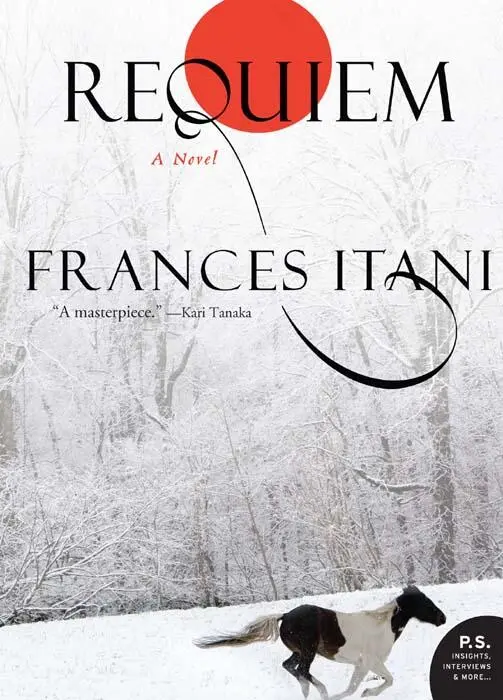
- Название:Requiem
- Автор:
- Издательство:A Phyllis Bruce Book
- Жанр:
- Год:2012
- Город:Toronto
- ISBN:978-1-44340-690-1
- Рейтинг книги:4 / 5. Голосов: 1
-
Избранное:Добавить в избранное
- Отзывы:
-
Ваша оценка:
Requiem: краткое содержание, описание и аннотация
Предлагаем к чтению аннотацию, описание, краткое содержание или предисловие (зависит от того, что написал сам автор книги «Requiem»). Если вы не нашли необходимую информацию о книге — напишите в комментариях, мы постараемся отыскать её.
delicately probes the complex adjustments we make to live with our sorrows…. [A] perfectly modulated novel.”
—
An extraordinary researcher and scholar of detail, Frances Itani—author of the best-selling novel
—excels at weaving breathtaking fiction from true-life events. In her new novel, she traces the lives, loves, and secrets in one Japanese-Canadian family during and after their internment in the 1940s.
In 1942, in retaliation for the attack on Pearl Harbor, the Canadian government removed Bin Okuma’s family from their home on British Columbia’s west coast and forced them into internment camps. They were allowed to take only the possessions they could carry, and Bin, as a young boy, was forced to watch neighbors raid his family’s home before the transport boats even undocked. One hundred miles from the “Protected Zone,” they had to form new makeshift communities without direct access to electricity, plumbing, or food—for five years.
Fifty years later, after his wife’s sudden death, Bin travels across Canada to find the biological father who has been lost to him. Both running from grief and driving straight toward it, Bin must ask himself whether he truly wants to find First Father, the man who made a fateful decision that almost destroyed his family all those years ago. With his wife’s persuasive voice in his head and the echo of their love in his heart, Bin embarks on an unforgettable journey into his past that will throw light on a dark time in history.
Requiem — читать онлайн бесплатно полную книгу (весь текст) целиком
Ниже представлен текст книги, разбитый по страницам. Система сохранения места последней прочитанной страницы, позволяет с удобством читать онлайн бесплатно книгу «Requiem», без необходимости каждый раз заново искать на чём Вы остановились. Поставьте закладку, и сможете в любой момент перейти на страницу, на которой закончили чтение.
Интервал:
Закладка:
I felt his happiness. I felt happiness for my son. And Lena’s voice prods me again.
Greg will be fine. And you won’t have to look for a bride. He’ll do it on his own, when he’s ready. All in good time .
I keep on until suddenly, starkly, I have a thrilling view of what appear to be walls of black slate. Pushed up by the earth’s internal forces. Dark silhouettes on my left, snow peaks on my right. A bit farther, and I see that some of the mountains are heavily treed. When I’m close to Jasper, several plump bighorn sheep bound past the car as if in welcome.
Something is settling into place. Neatly, the way Greg’s case of rock samples used to go snap, click in his palm. A familiarity roused from deep sleep as I drive farther into the mountains. As real and subtle and deep-down present, as if I had never left.
Uncle Kenji, I now recall, helped to build this road I’m on, the one that eventually became the corridor, the Yellowhead Highway. Uncle Kenji’s first camp was a road camp.
I drive and drive. Basil, content to look up from time to time, sniffs the air, looks out at shapes that block the sky, settles back.
“This is what it comes to, Basil,” I tell him. “I haul out a map of this outrageously vast country and get into my car and pack my friend the dog, and carve a route from east to west, and come upon an amazement of eruptions that have been thrust up out of our recent geologic past. And we drive through them as if there’s nothing that cannot be accomplished, as if there’s no mountain that cannot be moved.”
I hear a snuffle from the back. Look around again. I am in British Columbia and the sky has not fallen; the mountains have not crumbled. This is the province of my birth; the province of the birth of my parents, all three.
After a day’s drive, when I drop south, I realize that anything could be waiting on the other side. Mule deer, for a start. I see them standing under shelter of the trees. Yellow wildflowers, brash and sturdy, everywhere I look as I descend into Kamloops, my ears popping, out of the higher hills and into the lower hills. This dry and sunny climate. Sunny, well into the evening hours. The wide valley looking as if the mountains on all sides slid back voluntarily and allowed the North and South Thompson rivers to meet.
I pull over to a roadside restaurant, feed Basil at the edge of the parking lot and go inside to find food for myself. I order a steak, mashed potatoes, a cheese salad. But when the food is brought to my table I see that it was a mistake to stop here. The steak is too bloody; the mashed potatoes are instant; the cheese salad has no cheese. I question the waitress and she tells me the cook ran out of cheese.
I know when to give up. I order a coffee and pull out the road map, pull out Otto’s business card, match Kay’s directions on the back of the card to the map and see that I’m not far from First Father’s house. Probably not more than five or ten minutes away.
The car is steamed up from Basil’s barking, and I wipe a rag down the windows. I start the engine and brace myself. The road is dusty once I leave the highway, but hard-packed and wide enough for two cars. There aren’t many houses, and they’re small; they look as if they’ve been gathering dust for a long time. I pull over to check directions again, see the mailbox painted black, a low-slanting roof, outside shutters closed over south-facing windows. Exactly as Kay described. There’s a good-sized garden at the side, which she did not mention.
The house is smaller than I imagined. Can’t be more than four rooms at most. But no truck in sight. And then I remember Henry telling me that First Father and Uncle Kenji purchased a truck together years ago and share the use of it. They get their groceries together, their supplies, whatever they need, whatever they drink—I have no idea. The truck must be at Uncle Kenji’s.
I go to the door and face an uneasy silence. I trip over the step, worn smooth and sliverless. He’d have heard me drive in—or maybe not; he might not hear well. He’s eighty-four , Kay reminded me on the phone. He’ll be in his chair, facing the door. The door is never locked. The way he sits, he looks as if he never gets up, though he must, to cook and eat and sleep .
I rap at the door and there’s no response. I push it open and step inside. There’s the mat, set out to receive shoes that will never touch the surface of the inside floors. It all comes back, like a sudden gust of winter. And a heap of shoes farther inside, but not all belonging to one person, surely. When I look more closely I see that they are slippers. Some meant for visitors. Slip out of one pair and into another.
No lights on. I flick a wall switch and a spartan kitchen jumps to life. Rice pot on the counter, an electric rice pot, its cord haphazardly wound. A blue-and-white rice bowl I recognize, chopsticks beside it on a bamboo pad. A bottle of shoyu on a shelf. A bad print of Mount Fuji on the wall.
Mother’s willow basket is on the floor, in a corner by a chair. The same basket that was stuffed with as much she could carry the morning we boarded the Princess Maquinna , the mail boat that took us away from the coast. The same willow basket that hid the one pair of dolls that escaped the burning pyre. Now it is filled with papers and magazines. There’s no other reminder of Mother, that I can see. And there’s First Father’s chair, with cushioned seat and wooden arms. The place smells like childhood, and part of me is reeling.
“Hello,” I call out. “Hello. It’s Bin.”
No response.
I push open the bedroom door. This room is as spartan as the kitchen. A double bed, roughly made. Dresser, closet, bedside table with a book on top, a badly frayed palm-sized book with a red cover.
He never discussed his own fate, I now realize. That wasn’t part of the ritual.
I go out to the car and bring in my bag. I leave the shoulder pack in the car. The manila folder is still in there, but I haven’t looked at it since I left home. It’s almost dark now. The mountains have stretched into their heights to shut out the light; I’d forgotten how quickly it happens. I’ll stay overnight, sleep on the couch—if he has one. I peer into the living room and see that there’s a pullout against the wall, with several blankets folded on top. Probably where Kay and Hugh sleep when they visit. A second chair faces a TV. There’s a small bathroom, off to the side. First Father must be at Uncle Kenji’s. Maybe he’s having his supper there.
Basil takes up position beside an unlit wood stove in the living room. A wood stove means a woodpile, somewhere. It must be outside the back door. And the night chill has begun to drift in.
I return to the kitchen and see the note on the table. I don’t know how I could have missed it the first time through. A message, hastily scrawled, written in ballpoint.
BIN
Kay phoned to say you might be coming here, but your uncle Kenji came to pick me up. He finally persuaded me to go to the coast with him. Vancouver, and then the ferry over to the island. Your cousin will take us out on his boat a few days. Might be my last chance to try out my fisherman’s legs again. Our old house on the coast was torn down, they told me. It gave more than a few men a hard time when they tried to knock it apart. I built it to last. On our way back, Kenji and I will look for you .
The note is unsigned, and there’s no date. So matter-of-fact I want to tear it to shreds. But I don’t. I fold it over and over, stare at it in my palm.
I bring in the Laphroaig. And the piece of mat that Basil sleeps on.
I pour a bowl of water and watch Basil drink like a camel.
I pour myself a two-finger Scotch. Make that three.
Читать дальшеИнтервал:
Закладка:
Похожие книги на «Requiem»
Представляем Вашему вниманию похожие книги на «Requiem» списком для выбора. Мы отобрали схожую по названию и смыслу литературу в надежде предоставить читателям больше вариантов отыскать новые, интересные, ещё непрочитанные произведения.






Обсуждение, отзывы о книге «Requiem» и просто собственные мнения читателей. Оставьте ваши комментарии, напишите, что Вы думаете о произведении, его смысле или главных героях. Укажите что конкретно понравилось, а что нет, и почему Вы так считаете.