Frances Itani - Requiem
Здесь есть возможность читать онлайн «Frances Itani - Requiem» весь текст электронной книги совершенно бесплатно (целиком полную версию без сокращений). В некоторых случаях можно слушать аудио, скачать через торрент в формате fb2 и присутствует краткое содержание. Город: Toronto, Год выпуска: 2012, ISBN: 2012, Издательство: A Phyllis Bruce Book, Жанр: Историческая проза, на английском языке. Описание произведения, (предисловие) а так же отзывы посетителей доступны на портале библиотеки ЛибКат.
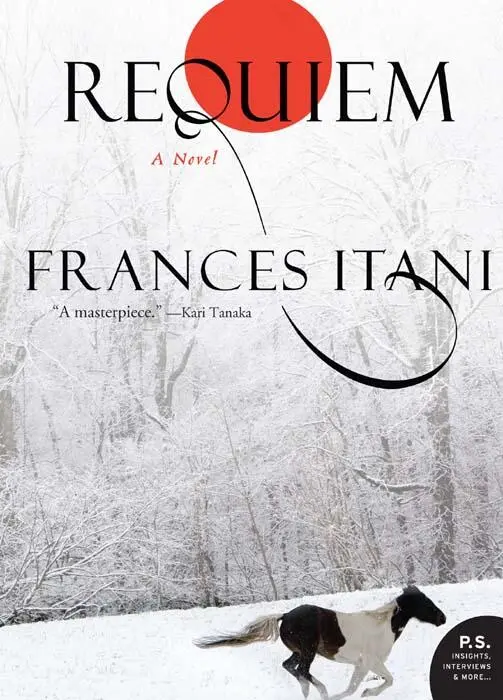
- Название:Requiem
- Автор:
- Издательство:A Phyllis Bruce Book
- Жанр:
- Год:2012
- Город:Toronto
- ISBN:978-1-44340-690-1
- Рейтинг книги:4 / 5. Голосов: 1
-
Избранное:Добавить в избранное
- Отзывы:
-
Ваша оценка:
Requiem: краткое содержание, описание и аннотация
Предлагаем к чтению аннотацию, описание, краткое содержание или предисловие (зависит от того, что написал сам автор книги «Requiem»). Если вы не нашли необходимую информацию о книге — напишите в комментариях, мы постараемся отыскать её.
delicately probes the complex adjustments we make to live with our sorrows…. [A] perfectly modulated novel.”
—
An extraordinary researcher and scholar of detail, Frances Itani—author of the best-selling novel
—excels at weaving breathtaking fiction from true-life events. In her new novel, she traces the lives, loves, and secrets in one Japanese-Canadian family during and after their internment in the 1940s.
In 1942, in retaliation for the attack on Pearl Harbor, the Canadian government removed Bin Okuma’s family from their home on British Columbia’s west coast and forced them into internment camps. They were allowed to take only the possessions they could carry, and Bin, as a young boy, was forced to watch neighbors raid his family’s home before the transport boats even undocked. One hundred miles from the “Protected Zone,” they had to form new makeshift communities without direct access to electricity, plumbing, or food—for five years.
Fifty years later, after his wife’s sudden death, Bin travels across Canada to find the biological father who has been lost to him. Both running from grief and driving straight toward it, Bin must ask himself whether he truly wants to find First Father, the man who made a fateful decision that almost destroyed his family all those years ago. With his wife’s persuasive voice in his head and the echo of their love in his heart, Bin embarks on an unforgettable journey into his past that will throw light on a dark time in history.
Requiem — читать онлайн бесплатно полную книгу (весь текст) целиком
Ниже представлен текст книги, разбитый по страницам. Система сохранения места последней прочитанной страницы, позволяет с удобством читать онлайн бесплатно книгу «Requiem», без необходимости каждый раз заново искать на чём Вы остановились. Поставьте закладку, и сможете в любой момент перейти на страницу, на которой закончили чтение.
Интервал:
Закладка:
I slump into a chair.
What did I think I was expecting?
I’m in the living room, drinking my third Scotch, thinking of the lousy meal I was served at the restaurant. And then I think of the Japanese food Kay used to prepare whenever Lena and Greg and I visited. Everything tasted a bit fishier, a bit saltier than the food we ate at home. Kay’s food tasted like childhood and looked like childhood. Even the stacks of prawns with their heads and beady eyes, though we never had prawns in the camp. And sushi , so many kinds, and green tea—homegrown—and tsukemono , the thin but crunchy pickles Mother and Kay used to prepare together. The smell of brine, shoyu , cucumber, some sort of mash made of rice bran, stone weights pressing it all down. There’s no aroma like it. Which sets me to wondering if the large crock that once stored them has been stowed somewhere in this Kamloops house. There might be a basement.
I find a door off the kitchen and steps going down. Small house, small basement. The ceiling is low. But there’s a workshop down here, and a workbench with a vise at one end, a chunk of wood clamped in its jaws. Tools are laid out neatly, the way I lay out my own brushes. A tall homemade stool has been pushed close to the bench.
Above the bench, at eye level, something hangs on the wall. Something vaguely, faintly recognizable. A piece of cardboard, boxboard, a faded pencil drawing nailed to the wall, the nail hammered through its top edge to hold it in place.
Two horses, or attempts at horses, one large, one small, the head of the smaller horse tucked under the neck of the larger. An alert eye, an animal ready to bolt. The head and nose of the smaller horse resemble the beak of a grotesque giant goose. A child’s drawing.
Yanked from my hand.
Disappeared, the day I was given away.
Kept more than fifty years.
I don’t bother to open the pullout. I lie on it in the living room and pile on the blankets. Basil, the hound who knows the scent of grief when it’s all around him, drags his mat over and settles at the end of the couch. I reach out a hand and rub the coarse coat of his back, the soft and silky part of his ears. The warmth of him. The life of him. He groans, and rolls over heavily, an animal who no longer wants the burden of memory.
CHAPTER 28
Lena woke and saw me standing beside her, looking down. She was lying on her back on the floor, on a small pink mat laid on top of our own carpet. Miss Carrie had seen her drive in, rolled up the mat and wheeled it over on her walker, insisting that Lena borrow it; it was her remedy for almost every ailment. A pillow supported Lena’s neck; a thin blanket was pulled up to her chin.
“You’re home,” she said. “Come and tell me about the fates. I was thinking about them. I want to hear them again.”
“I thought you were at the university all day.”
“No classes Friday afternoons, remember? I had a bit of a headache, a bit of dizziness, and decided to come home early. I’m glad it’s the end of the week. Who invented the week, anyway? Why does time have to be divided into days, weeks, months, the school year? Anyway, I’m home. And this mat is so comfortable, I don’t ever want to get up.”
It was November and I’d been to the National Gallery, and had stopped to see Nathan on the way back. Figure out a title , he said. If we’re planning to do a show, you have to come up with a title .
There was a book on the floor beside Lena. On top, a large bookmark with a message—BAN LAND MINES: NO PRODUCTION, NO EXPORT, NO USE, NO STOCKPILES. One of Lena’s causes. She was frequently recruited by others at the university who looked to her for support.
“Tell me about the fates,” she said again.
She looked tired, despite having had a nap. Tired, unfocused, something else I couldn’t put a name to.
I sat down on the carpet beside her.
“First Father,” I began, “took the red book down from the shelf. He read back to front, top to bottom. He always started with Hiroshi …”
“Hir-o-shi,” she said, interrupting. She slowed the syllables and stared at the ceiling, as if seeking approval for her pronunciation. Then she added, “Henry.”
“Because he was number-one son.”
“Skip to your fate,” she said. “Never mind the others. Yours is the one that makes me laugh.”
I leaned back against the chesterfield and thought, Laugh? When did laughter ever exist?
“First Father said, ‘Bin, you are youngest, number-two son, born in the year of the tiger. A tiger may be stubborn, but can chase away ghosts and protect.’“
“Tell me the end part,” she said, knowing already.
“‘But because your time of birth was at the cusp of the year of the rabbit … ‘“
“You are destined to be melancholy, and you will weep over nonsensical things.” She recited the rest, smiling. I ventured a hand over the familiar bones of her wrist and felt the pulse of my wife. It was rapid, too rapid, as if she’d been running in her sleep.
“Who were you not supposed to marry?” she said.
“First Father didn’t tell me that part. He probably didn’t think my marriage fate would be important.”
“But it is important. You chose me. Tiger chose dog.”
“Other way around. Dog chose tiger.”
“Is that the way it happened? Are you sure?”
“I’m sure,” I said. And wondered who had chosen whom. At the time it hadn’t seemed like choice. More like inevitability. It had seemed right. Was right. A good match. She was smiling again. I looked past her and through the living-room window. A child of the sky had taken a thick marker and looped a line of gloom around the base of each cloud.
“Do you remember,” she said, switching topics, “when we drove to the cabin on the Gatineau River? An hour’s drive from here.” She spoke as if it had been years ago instead of only a few weeks. “We took the cooler with us—the one with the green lid. I packed the oilcloth with the red-and-white squares, hoping there’d be a picnic table at the place.”
I continued where she left off.
“Another couple arrived, and stayed at the only other cabin. They were accompanied by two young girls: their daughter, Florence, and her friend Lise. There was a softness to the distant hills on the other side of the river. That was the view we saw from shore. The visual suggestion was one of a series of far-off valleys, each folded to the next, the muted wrappings of red and gold.”
“Say that again, will you?”
“Which part?”
“The visual suggestion. I want to hear you say it.”
A moment preserved.
We were both silent, and then she said, “That was the night you told me about the fates.”
“I remember how you laughed.”
“I’d never heard any of that before. You’d been holding on to secrets. What else haven’t you told me?”
“If I’d known the fates would amuse you so much, I’d have told you earlier.”
“I’m glad nobody ever tried to predict my fate,” she said. “I’d have been menaced. I am menaced. My head feels as if there are lines criss-crossing inside my skull. Slicing up my brain. Sorry,” she said. “Sorry for that unnecessary dark moment.”
Basil chose this moment to do a circuit through the room, dragging his mattress in his teeth. The past few days, he’d begun to lift the mattress out of his basket and drag it around, ensuring that he’d be seen.
Lena called him over for a pat.
“Come here, you outrage,” she said, and he dropped the mattress in the doorway between living and dining rooms. He took up position beside her. She tried to reach for him, but her arm wouldn’t move.
Читать дальшеИнтервал:
Закладка:
Похожие книги на «Requiem»
Представляем Вашему вниманию похожие книги на «Requiem» списком для выбора. Мы отобрали схожую по названию и смыслу литературу в надежде предоставить читателям больше вариантов отыскать новые, интересные, ещё непрочитанные произведения.





Обсуждение, отзывы о книге «Requiem» и просто собственные мнения читателей. Оставьте ваши комментарии, напишите, что Вы думаете о произведении, его смысле или главных героях. Укажите что конкретно понравилось, а что нет, и почему Вы так считаете.