Nicola Griffith - Hild
Здесь есть возможность читать онлайн «Nicola Griffith - Hild» весь текст электронной книги совершенно бесплатно (целиком полную версию без сокращений). В некоторых случаях можно слушать аудио, скачать через торрент в формате fb2 и присутствует краткое содержание. Город: New York, Год выпуска: 2013, ISBN: 2013, Издательство: Farrar, Straus and Giroux, Жанр: Историческая проза, на английском языке. Описание произведения, (предисловие) а так же отзывы посетителей доступны на портале библиотеки ЛибКат.
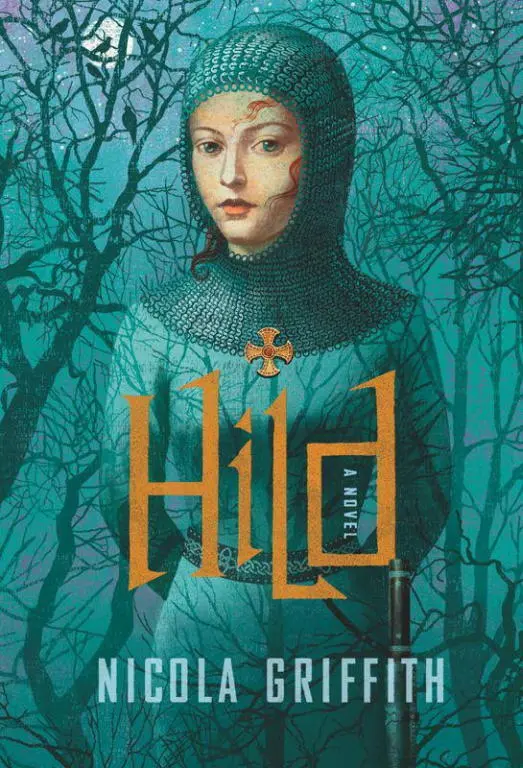
- Название:Hild
- Автор:
- Издательство:Farrar, Straus and Giroux
- Жанр:
- Год:2013
- Город:New York
- ISBN:978-0-374-28087-1
- Рейтинг книги:5 / 5. Голосов: 1
-
Избранное:Добавить в избранное
- Отзывы:
-
Ваша оценка:
Hild: краткое содержание, описание и аннотация
Предлагаем к чтению аннотацию, описание, краткое содержание или предисловие (зависит от того, что написал сам автор книги «Hild»). Если вы не нашли необходимую информацию о книге — напишите в комментариях, мы постараемся отыскать её.
But now she has only the powerful curiosity of a bright child, a will of adamant, and a way of seeing the world—of studying nature, of matching cause with effect, of observing her surroundings closely and predicting what will happen next—that can seem uncanny, even supernatural, to those around her.
Her uncle, Edwin of Northumbria, plots to become overking of the Angles, ruthlessly using every tool at his disposal: blood, bribery, belief. Hild establishes a place for herself at his side as the king’s seer. And she is indispensable—unless she should ever lead the king astray. The stakes are life and death: for Hild, for her family, for her loved ones, and for the increasing numbers who seek the protection of the strange girl who can read the world and see the future.
Hild is a young woman at the heart of the violence, subtlety, and mysticism of the early Middle Ages—all of it brilliantly and accurately evoked by Nicola Griffith’s luminous prose. Working from what little historical record is extant, Griffith has brought a beautiful, brutal world—and one of its most fascinating, pivotal figures, the girl who would become St. Hilda of Whitby—to vivid, absorbing life.
Hild — читать онлайн бесплатно полную книгу (весь текст) целиком
Ниже представлен текст книги, разбитый по страницам. Система сохранения места последней прочитанной страницы, позволяет с удобством читать онлайн бесплатно книгу «Hild», без необходимости каждый раз заново искать на чём Вы остановились. Поставьте закладку, и сможете в любой момент перейти на страницу, на которой закончили чтение.
Интервал:
Закладка:
The crowd roared and Cian handed the beer to the Loid, who drank and passed it to the Angle, and shouted, “Someone give me that lyre!” and someone else shouted, “Sing the bread song!” and they laughed some more.
Hild motioned for Gwladus and Morud. “Bring more food, and wood for the fire. Tell Coelfrith I said so.”
The next day, as a stream of important Anglisc, those with six or more spears to their name, swore their oaths to the king before witnesses—who included, at the Crow’s suggestion, for he had been baptised, Cian Boldcloak—Hild accepted a trickle of lesser folk, Anglisc and Loid, who came to her in ones and twos.
Lweriadd brought Morud. “Lady, has he served you well?”
“He has.”
“Then it would please me for you to take him with you when you leave.”
Morud then knelt, put Hild’s hand to his forehead, and swore the threefold oath: to keep faith until the sky fell on his head, until the earth opened and swallowed him, until the seas rose and drowned him. He was standing behind her stool on one side, and Gwladus on the other, when Saxfryth approached with her young son.
Saxfryth held out Hild’s ring. Hild folded the woman’s hand around it. “A gift.”
Saxfryth’s smile was brilliant but almost immediately extinguished by indecision and anxious looks at her son.
Hild sighed to herself. “I don’t know your boy’s name.”
“Ceadwin, lady.”
“A strong name for a strong lad.”
“He is strong, lady, very strong for his age.”
“How many winters has he?”
“Five, lady.”
“In two years he’ll be old enough to foster.”
“Yes, lady.”
“Does he have brothers?”
“Not yet, lady.”
“When he does, or when he is seven, whichever is sooner, you may send him to me, if you wish.”
“Lady!” She looked as though she might fly apart with joy, but instead pulled the boy to her and hugged him so hard he began to struggle. Eventually she recovered her wits enough to pick up her skirts in one hand and take the boy’s little fist in the other and hurry away, stopping every stride or two to turn and say thank you.
“Her husband won’t thank you,” Gwladus said as they watched her go. “You wait, she’ll kill that man this winter trying to get another son.”
“Anglisc, Gwladus. Morud needs the practice. From now on, Anglisc, both of you, until we leave this place. And Morud, you will do as Gwladus tells you.” She sat back on her stool, watching the now-distant figures of Saxfryth and the boy. “Five. Really. What am I, a wet nurse?”
“Here comes one,” Morud said in otter-splash but understandable Anglisc.
“Another,” said Hild. “Here comes another.”
This time it was the young man with the ancient sword.
He was too young and tightly strung for any greeting. He simply drew his sword, knelt, and offered it to her, hilt-first over his forearm. “I am Oeric, lady, and I would serve you.”
She touched his hand. He looked up. Brown eyes, tight and anxious. Fading pimples. Strong bone at brow and jaw. Older than Cian by a year or so, but not as tall. But then few were.
His brown tunic, restitched with sleeves and padded in an approximation of a warrior jacket, was faded and patched. He would never be able to afford the mail shirt to wear over it. A knuckle on his right hand looked as though it had been crushed at some point but he’d had no difficulty handling the sword. The blade, as Cian had said, was ancient. Perhaps his father’s father’s grandfather’s. Part of its edge, near the point, was missing and the wire inset in the grip black with age. The blade itself, though, was lovingly polished of hammer-folded snakesteel.
“Your sword, it has a name?”
“Clifer,” he said. Claw. But he didn’t offer a lineage, and Hild wondered if he’d found it somewhere or taken it from a dead man.
“How would you serve me, Oeric?”
He blinked. “Lady?”
“How would you serve me?”
“I have a sword…”
Hild nodded. A sword. What use did she have for a sword? “Are you hungry?” Of course he was hungry. He was a stripling. He could eat an ox and still have room for a sheep and a score of loaves. “Morud here will bring you a stool and Gwladus will find us something to eat and you will tell me of your family.”
“My mother is dead—”
“But first you will get off your knees.” She must ask Gwladus to find a mat or a fur to put before her stool so these people didn’t have to get down on the muddy grass.
He scrambled to his feet.
“And put the sword away before someone gets the wrong idea.”
He sheathed it—not with the unthinking ease of a gesith but with more skill than she’d expected.
Morud came back with a stool and placed it with ceremony opposite Hild. Clearly he also made some kind of face at Oeric, who glared at him.
Hild pointed to the stool. Oeric sat. He perched gingerly on the padded embroidered cushioning but relaxed quickly enough when no god flung a thunderbolt at him for soiling such fine work with his farm clothes.
Adaptable, at least. “You were telling me of your family.”
His father was Grim, son of Grim the Elder. His mother dead these six years. When his mother’s sister’s husband had gone away one day and not come back, the widowed Grim had married her. Grim had three more sons now and a daughter. He farmed a hide south of the Aire, mixed land, some barley, some oats. Pigs, of course, they couldn’t get by without the pigs, who ate their bodyweight in mast every autumn, and two milch cows. Their horse, though, had died this spring when the grass came so late. The cows’ milk had been late, too. Perhaps without Oeric to feed they might have enough for a colt next spring.
“Perhaps your father could swap Clifer for a mare in foal.”
“Clifer is mine! From my mother’s father, who had no sons.”
Gwladus brought a tray with bread, bowls of barley stew with beef shreds, and the beautiful cup Edwin had given Hild in Lindsey. The cup was half filled with mead. She gave Hild one bowl of stew, Oeric another. Oeric took a spoon from his pouch, remembered to check that Hild had a spoon, and waited for her to take the first mouthful. Manners and restraint. Hild had seen worse at Edwin’s board. She took a taste so that Oeric could begin. It needed more salt. “Does your father know you’re here?”
Oeric swallowed hastily. “I am of age!”
Hild gestured for him to keep eating. She applied herself to her own bowl. “Why?” she said, when half her stew was gone. “Why me? Why not swear to the king?”
“Would he have me?” They both knew the answer. Oeric had a sword but no mount, no mail, no men. “They say you’re powerful. That you see a man’s wyrd. That you’ve used that seax.”
Hild studied him. “And you would swear an oath?” An Anglisc oath, from a man with a sword.
“I would.”
It wasn’t usual. But neither was she. And this boy with his old, broken sword wouldn’t threaten her uncle.
She stood, and gestured for him to do likewise. She put her hand on his chest. “I am the king’s seer. I shine light on the way. I look into men’s hearts. Is your heart free to make an oath, Oeric son of Grim?”
“It is.”
His heart beat high but steady, and he met her gaze—blushing but not looking away.
She picked up the cup. “Oeric, son of Grim, I, Hild, daughter of Hereric Yffing and Breguswith Oiscinga, do swear on my oath, on this mead by this river under this tree, that I will be as your lord. I will protect you, feed you, defend your name and person while you are true.”
She took a sip and passed the cup to Oeric. He took it with both hands, shaking slightly, and she remembered the weight of Edwin’s feast cup that Modresniht long ago.
Читать дальшеИнтервал:
Закладка:
Похожие книги на «Hild»
Представляем Вашему вниманию похожие книги на «Hild» списком для выбора. Мы отобрали схожую по названию и смыслу литературу в надежде предоставить читателям больше вариантов отыскать новые, интересные, ещё непрочитанные произведения.



Обсуждение, отзывы о книге «Hild» и просто собственные мнения читателей. Оставьте ваши комментарии, напишите, что Вы думаете о произведении, его смысле или главных героях. Укажите что конкретно понравилось, а что нет, и почему Вы так считаете.