Nicola Griffith - Hild
Здесь есть возможность читать онлайн «Nicola Griffith - Hild» весь текст электронной книги совершенно бесплатно (целиком полную версию без сокращений). В некоторых случаях можно слушать аудио, скачать через торрент в формате fb2 и присутствует краткое содержание. Город: New York, Год выпуска: 2013, ISBN: 2013, Издательство: Farrar, Straus and Giroux, Жанр: Историческая проза, на английском языке. Описание произведения, (предисловие) а так же отзывы посетителей доступны на портале библиотеки ЛибКат.
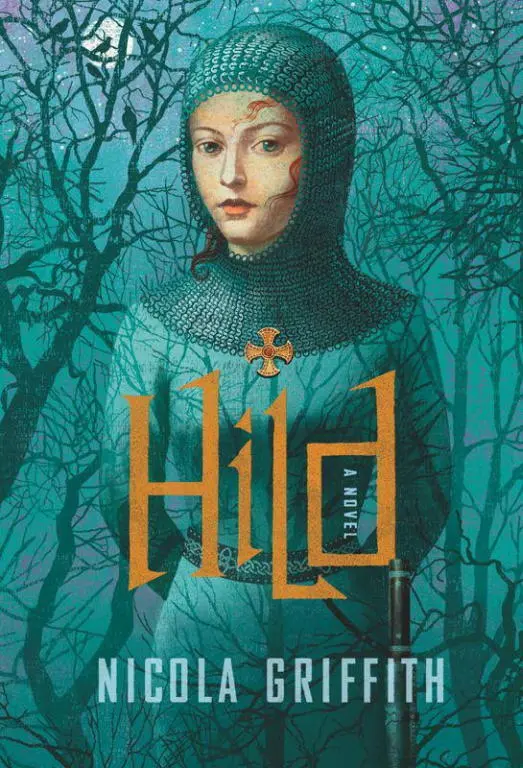
- Название:Hild
- Автор:
- Издательство:Farrar, Straus and Giroux
- Жанр:
- Год:2013
- Город:New York
- ISBN:978-0-374-28087-1
- Рейтинг книги:5 / 5. Голосов: 1
-
Избранное:Добавить в избранное
- Отзывы:
-
Ваша оценка:
Hild: краткое содержание, описание и аннотация
Предлагаем к чтению аннотацию, описание, краткое содержание или предисловие (зависит от того, что написал сам автор книги «Hild»). Если вы не нашли необходимую информацию о книге — напишите в комментариях, мы постараемся отыскать её.
But now she has only the powerful curiosity of a bright child, a will of adamant, and a way of seeing the world—of studying nature, of matching cause with effect, of observing her surroundings closely and predicting what will happen next—that can seem uncanny, even supernatural, to those around her.
Her uncle, Edwin of Northumbria, plots to become overking of the Angles, ruthlessly using every tool at his disposal: blood, bribery, belief. Hild establishes a place for herself at his side as the king’s seer. And she is indispensable—unless she should ever lead the king astray. The stakes are life and death: for Hild, for her family, for her loved ones, and for the increasing numbers who seek the protection of the strange girl who can read the world and see the future.
Hild is a young woman at the heart of the violence, subtlety, and mysticism of the early Middle Ages—all of it brilliantly and accurately evoked by Nicola Griffith’s luminous prose. Working from what little historical record is extant, Griffith has brought a beautiful, brutal world—and one of its most fascinating, pivotal figures, the girl who would become St. Hilda of Whitby—to vivid, absorbing life.
Hild — читать онлайн бесплатно полную книгу (весь текст) целиком
Ниже представлен текст книги, разбитый по страницам. Система сохранения места последней прочитанной страницы, позволяет с удобством читать онлайн бесплатно книгу «Hild», без необходимости каждый раз заново искать на чём Вы остановились. Поставьте закладку, и сможете в любой момент перейти на страницу, на которой закончили чтение.
Интервал:
Закладка:
As they rode west the rain eased. By the time they crossed Brid’s Dike the sky was torn into rags of blue and grey and darker grey, light grey tatters flying one way, dark another, and the sun bursting out like a child jumping from behind a tree and running away again. Hild threw her heavy cloak back from her shoulders. The world smelt like a just-ploughed field: rich, mysterious, waiting. She wanted to shout, or gallop, or set Cygnet at a wall.
A great cloud of birds rose violently from the wood tangling the low hills just to the north of their path. Cygnet pointed her ears, and Hild suddenly, fiercely, wanted to know what hawk they rose from, and what land lay beneath them.
Morud followed her gaze skyward. “It’ll be raining again by the time we get to Caer Loid.”
“Yes. But we’re not going to Caer Loid.” She pointed at the swirling birds—rooks, jays rising like smoke, and a puff of finches, catching the brief sunlight and gleaming like seeds flung from a thresher’s basket—and laughed. “We’re going there!” She kicked Cygnet into a gallop and after a moment she heard Cian galloping after her, and Morud running, and they were all laughing.
At the trees she slowed to a canter and bent low to Cygnet’s neck. Oak, ash, hawthorn, wild cherry, all growing in a tangle. Then a hornbeam, twisting low across a beck, and Hild kicked Cygnet lightly and lifted up, over, down, and on. Cygnet’s hooves drummed fast and steady, like Hild’s heart.
The drumming softened—the ground grew wet—and they burst into a little valley by a pollarded oak, thick and gnarled, and Hild reined Cygnet in. She walked her slowly around the oak while she blew.
It was an ancient pollard, as old as anything Hild had seen. As old as the one tree that connected the fates of the three realms. It reeked of wyrd. Her wyrd.
She looked north along a winding system of beck and bog and pond. Now that she was looking, she saw the thick, even growth of old willow coppice and what might, under the moss and fern, have been the straight edge of a deliberate channel at an angle to the beck.
Cian’s gelding trotted from the trees, Morud loping comfortably beside him.
“I’ll bet that was once a millrace,” she said, pointing. Someone’s home, once.
“Here?” Cian said. “Why? It’s a bog.”
“It wasn’t always,” said Morud. “Or so they say.” Hild gestured for him to go on. “They say that in the long ago, before even Coel Hen was king, when the redcrests owned the valley, it rained in the summers, it rained in the autumn, it rained through the winter. And the people grumbled but it wasn’t their land to leave. There was nowhere to go that other redcrests didn’t own. And the water rose. The fields turned to bog and the sheep retreated up the hills. The hooves of kine rotted, but there was no field left to plough, so they killed the kine. Ducks took the place of sheep, and heron the hawk. Then the redcrests left, and so did the people, looking for a place less wet.”
“Those birds weren’t rising from a heron. And look.” Hild pointed at the oak, where fern grew all about its roots. “And there.” She pointed along the banks of the beck, east and west, where saplings and nettles grew close to the water—“And up there”—to a pond, what perhaps had been a millmere. “The water is leaving.”
Cian slid from the saddle. His feet squelched. “There’s a lot still here.” His Anglisc sounded alien alongside the rush and runnel of the beck.
“It’s the rainiest season for years.”
“It’s a bog.”
The sun poured sudden and beechnut yellow into the valley. Spiderwebs glistened. A fish plopped. She knew there would be crayfish and frogs, newts and loach, mallards in the spring, and heron and kingfisher, and, on the hills north of the wooded mene, hare and hawk. To the south, a ridge ran alongside a crooked arm of the beck, and she imagined standing there, peregrines tilting on the wind overhead. She imagined standing there last month, swifts pouring overhead on their way south to the sun, and then in May, when they returned. She wanted to see the beck in spring, the frogs’ eggs grow tails, then legs, then leap onto the bank. She wanted to see the acorns grow as well as fall, wanted to see the pigs get fat, wanted it all, wanted it here.
“It’s beautiful,” said Hild, “and I will have it.”
At Caer Loid the weather turned dry and crisp and the farmers began to arrive for the king’s feast. A man and two sons, all with spears, the man with a sturdy linden shield and a seax with a worked-leather sheath. Ceadwulf and two ceorls, with his wife, Saxfryth, wearing Hild’s ring, and their son. From the steading Hild had warned to hide their priest, four men—one shorter and slighter than the others—all carrying spears. Two brothers armed with axes, with the kind of finger rings and cloak brooches unlikely to have been earned through farming.
Coelfrith, back only two days earlier, was kept busy every moment the sun shone. He would have preferred Pyr to handle the new arrivals but Pyr was half wealh, and who knew what the prideful newcomers might take as an insult, so he put Pyr in charge of the hunting parties and other provisioning details, and toured the growing encampment, listening. This farmer wanted a space in the bend of the river, but his neighbour had taken it—his neighbour who owed him a ram and hadn’t paid. That red-faced man pointed to a bruised boy: This starveling wealh had stolen two loaves and what were they to eat now? What was the king going to do about that? And many, many demanded to speak to the king: It was why they were here; it was their right.
Hild walked with Coelfrith, watching, learning, sometimes staying for a quiet word, sometimes sending Morud—who seemed to have attached himself to her—back with a message for the farmer to come to her wagon later. She conferred with Coelfrith over which man might be invited to break bread with the king; which might be best seen with others in a group; which to be ignored. And everywhere, the Crow’s priests, accompanied by Osric’s men, questioned the farmers, taking the information to the Crow and Stephanus, who wrote and wrote and wrote.
At night, Cian took a keg of ale, and Eadric or another hound, to the fires of the new arrivals and compared weapons, and drank and boasted and learnt things that Hild might not. Hild herself, accompanied by Gwladus, talked to Lweriadd; to Morud’s wary sister, Sintiadd; to Saxfryth. She left them ale or cheese. Occasionally they gave her a cloth full of elderberries or mushrooms or wildling apples.
In the morning, she and Cian broke bread in the cold clear sunlight, sitting on their little stools by the wagon.
Cian tore another chunk from his loaf and caught up more of the paste from the beautifully turned elm bowl on the table Gwladus had thought to bring with their stools.
“What is this? Is there more?”
“Just what you see. Saxfryth brought it for me, as a thank-you, she said. She wanted most particularly for the young gesith with the bold cloak to know that it was her recipe: the first puffballs sliced and fried in goose grease then chopped and packed in butter. When I tell her you liked it she’ll want you to visit, and she’ll push out her chest like a pouter pigeon and twirl her new ring so it gleams in the firelight, and tell you how very tall you are, how long your sword, and so very sharp!”
Gwladus, bringing more bread and a pot of honey, snorted.
They ate steadily. “There’s two bandits in from the Whinmoor,” he said.
“The ones with the axes?”
“The same. I told Coelfrith. He says it’s the king’s order to leave every man his weapon until the feast tonight.”
Hild wondered who would be the unlucky gesith honoured with the duty of standing watch over the blades away from all the drinking and boasting.
Читать дальшеИнтервал:
Закладка:
Похожие книги на «Hild»
Представляем Вашему вниманию похожие книги на «Hild» списком для выбора. Мы отобрали схожую по названию и смыслу литературу в надежде предоставить читателям больше вариантов отыскать новые, интересные, ещё непрочитанные произведения.




Обсуждение, отзывы о книге «Hild» и просто собственные мнения читателей. Оставьте ваши комментарии, напишите, что Вы думаете о произведении, его смысле или главных героях. Укажите что конкретно понравилось, а что нет, и почему Вы так считаете.