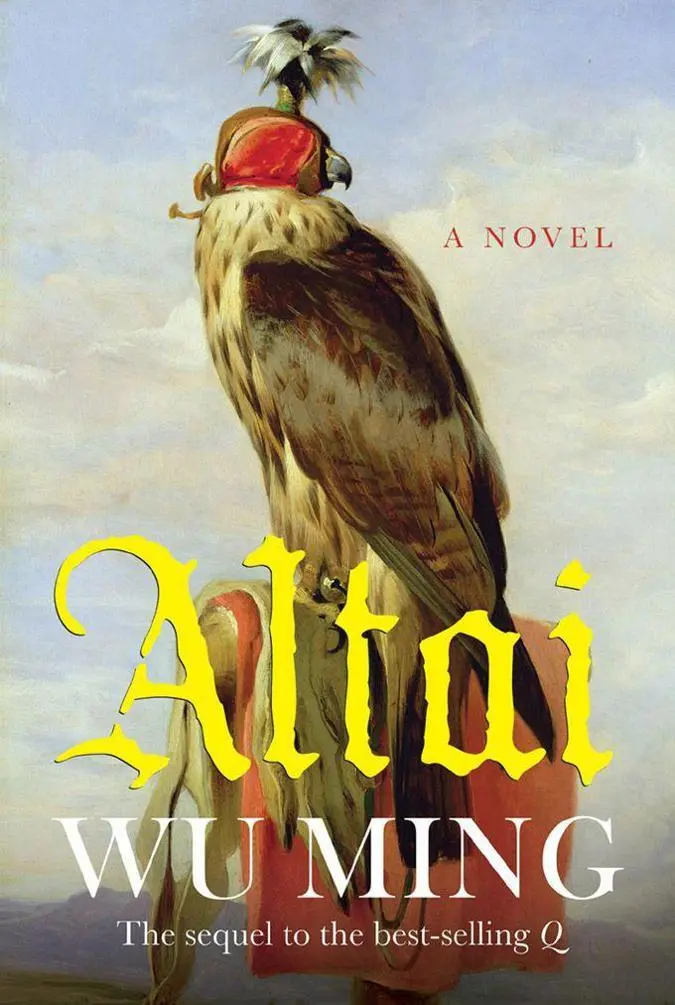
Wu Ming - Altai
Здесь есть возможность читать онлайн «Wu Ming - Altai» весь текст электронной книги совершенно бесплатно (целиком полную версию без сокращений). В некоторых случаях можно слушать аудио, скачать через торрент в формате fb2 и присутствует краткое содержание. Год выпуска: 2013, Издательство: Verso, Жанр: Историческая проза, на английском языке. Описание произведения, (предисловие) а так же отзывы посетителей доступны на портале библиотеки ЛибКат.
- Название:Altai
- Автор:
- Издательство:Verso
- Жанр:
- Год:2013
- ISBN:нет данных
- Рейтинг книги:3 / 5. Голосов: 1
-
Избранное:Добавить в избранное
- Отзывы:
-
Ваша оценка:
Altai: краткое содержание, описание и аннотация
Предлагаем к чтению аннотацию, описание, краткое содержание или предисловие (зависит от того, что написал сам автор книги «Altai»). Если вы не нашли необходимую информацию о книге — напишите в комментариях, мы постараемся отыскать её.
Through a series of deadly political games leading all the way to the Sultan’s palace in Constantinople, De Zante and his companions spiral headfirst toward a conflict in which the great empires of the Republic of Venice and the Ottomans threaten the very foundations of civilization.
Altai — читать онлайн бесплатно полную книгу (весь текст) целиком
Ниже представлен текст книги, разбитый по страницам. Система сохранения места последней прочитанной страницы, позволяет с удобством читать онлайн бесплатно книгу «Altai», без необходимости каждый раз заново искать на чём Вы остановились. Поставьте закладку, и сможете в любой момент перейти на страницу, на которой закончили чтение.
Интервал:
Закладка:
He stayed like that, with his hand on his beard, as if oppressed by that ancient injustice. Then he stirred himself, called for a bottle of raki and offered it to everybody, but of course Ismail and I were the only ones who accepted.
“This is no sganuffa ,” said Mimi Reis, after sipping the spirits. “It’s no trifle. And people who engage in this kind of thing aren’t easily satisfied. It’s a big risk. It’ll take a lot of money.”
“How much?” I asked.
Again that contrite expression. “Let’s say at least six thousand aspers.”
“Fine,” I replied firmly. I had Nasi’s mandate to offer the necessary sum. “Half in advance and half once the business is concluded.”
“No,” Mimi insisted. “I need all the money up front.”
I exchanged a worried glance with Ismail, and he spoke up: “You used to trust me.”
The Pugliese sighed. “It isn’t a matter of trust, my friend. It’s that Yossef Nasi is more exposed than a sheet in the sun. They’re preparing for war, everyone knows that he’s up to his neck in it, and I don’t want any problems. And then you know that ’u uacejiedde pisce ’u llejiette e ’u cula iave mazzate .” He stopped and translated for everyone: “The cock pisses the bed and the arse gets the kicking. I’m going to have to cover my arse. .” He spread his arms. “Payment up front or I can’t help you.”
I looked at Ismail. The old man had no intention of replying. I wondered if he was silent out of kindness or whether he thought the objection was reasonable.
As we took our leave I was still filled with doubt. The Pugliese kissed us all and said he would send someone to get the money from Scutari. “Right then, Ismail,” he said before he left us. “You’re about to unleash a whirlwind, and troubles are going to come pouring in. It’s better for the old boats to stay in the harbor.”
The old man looked at him with laughing eyes. “Thanks for the advice, my friend. But you know me: I only stay in the harbor as long as I absolutely have to. As-Salaam ’Alaykum .”
“ Wa ’Alaykum As-Salaam. Statt’ bun. Take care.”
28
It’s on moonless nights that misdeeds are done, when only the stars sparkle on the black cloak of the sky and the pilots choose their routes with their noses in the air, their hands firmly on the tiller. It was on a moonless night that Mimi Reis’s trap was sprung.
The merchant ship bound for Candia was passing calmly through the Cyclades when an alarm was raised on board. The black shadow of a sail had suddenly appeared from behind the island of Delos, on a collision course with the Cretan vessel. The bell on deck rang out, torches were waved, but the ghost ship pressed on until it struck the side of the merchantman, level with the prow, making it list to the left and spin on its own axis. Then it was clear to everyone that a major collision was unavoidable. The oarsmen were recalled to their benches, and the captain turned the ship’s tail and fled with sails unfurled.
The pirates’ slender galley, lighter and faster, pursued its quarry to Naxos. It was only at dawn, in view of the harbor, that it vanished again.
As Ashkenazi’s boat moored it was welcomed by the island’s militia and the keeper of the harbor, who in the name of the Duke of Naxos, that is to say Don Yossef Nasi, put the ship under the protection and custody of his master.
The captain’s protests were futile. The militiamen climbed on board and inspected the ship and its crew. Bernardo Traverso was missing from the lineup. After a long search, the Genoese was found in the hold, his breeches round his ankles, trying to stuff some rolls of paper into his rear orifice. Caught in flagrante , he commended his soul to the Holy Virgin and prayed on his knees to be spared. The keeper of the port took charge of the precious rolls of paper, but not before he had cleaned them of all traces of Genoese jitters. At last, along with a detailed report, he entrusted them to a messenger and sent them to Constantinople. A few days later, the letters of Marcantonio Barbaro, addressed to the Doge of Venice and the Council of Ten, were in the hands of Yossef Nasi.
I imagined that Nasi would send the proof of Ashkenazi’s betrayal to the Sultan in person. He didn’t, in fact. He knew he held the winning cards, but he also knew how to play them. He went not to the Sultan but instead to the Grand Vizier. He brought Sokollu proof of his personal secretary’s betrayal, having first taken the precaution of making the contents of the documents public. Thus he held Sokollu to his responsibilities, and linked him to his own conniving. I couldn’t say if it was a flash of genius or a premeditated move, but it certainly put the Grand Vizier in great difficulty.
The events of the following week marked the victory of Nasi and the decisive step toward war. Sokollu couldn’t keep Ashkenazi out of prison and had to use all his influence to save the Venetian doctor from the gallows. By so doing, he reinforced suspicions that he too had an agreement with La Serenissima. Selim was obliged to demonstrate his disapproval of that same Grand Vizier, and the advocates of war within the Divan were given a free hand to proceed with military operations against Cyprus.
Throughout this time, Nasi appeared strangely calm. Only his eyes gave away his excitement, his awareness that his plan was coming to fruition, one step at a time.
So it was that one day in early summer we all found ourselves in the big Roman hippodrome, which the Turks called Atmeydani, watching the Ottoman war machine get moving, to the sound of horns and drums.
29
The Sipahi noblemen passed in serried ranks, their horses’ steps perfectly synchronized, their lances pointed toward the sky, a forest of glittering pines. On the arm of every horseman was a round shield, and carved quivers and short, curved bows hung from their saddles. The Sultan’s six cavalry divisions reminded everyone that the Turks had conquered their empire on horseback. They had galloped down from the steppes of Asia, passing through the Middle East with the violence of barbarians. The Sipahi represented the true heart of Ottoman power.
But they were not the backbone of the army.
The march of the janissaries was a triumph of red and green; the pennants and standards of the regiments fluttered in the morning breeze; the halberds and arquebuses shone in the sun, sabers and hatchets clattered in their belts.
Instead of weapons, one squadron carried big drums, pipes, trumpets, bells and cymbals. The sounds they made enfolded the soldiers and spurred them on, like a magic shield and an invisible force, capable of repelling projectiles, laying enemy forces low and reducing Cypriot fortresses to rubble.
A marvelous spectacle. Nonetheless, I recalled what Ismail had said to me during the crossing to Bandirma. The means change the end. How would the new kingdom of Cyprus resist that vast military apparatus? I thought of the army of the twelve tribes of Israel, the Ark of the Covenant, the seven ram’s horns that had brought down the walls of Jericho. More than two thousand years later, Yossef Nasi was entrusting the conquest of the Promised Land to the Turkish imperial army, not one of whose soldiers was Jewish.
My people’s only contribution to this war was the uniforms of the janissaries, sewn by the Sephardim of Salonika. The men who wore them were Slavs, Albanians, Bosnians, Greeks, Bulgarians, Hungarians. The Turks had torn them from their families as children and brought them to the imperial barracks to receive a training worthy of the ancient Spartans. They had converted to Islam, under the iron control of the bektashi, the spiritual instructors who were now going with them into battle. Forced to remain celibate, they formed a solid fraternity, like an order of knights devoted to a single father: the Sultan. They were his children and his slaves. For him alone they passed along to the rhythm of the music.
Читать дальшеИнтервал:
Закладка:
Похожие книги на «Altai»
Представляем Вашему вниманию похожие книги на «Altai» списком для выбора. Мы отобрали схожую по названию и смыслу литературу в надежде предоставить читателям больше вариантов отыскать новые, интересные, ещё непрочитанные произведения.












Обсуждение, отзывы о книге «Altai» и просто собственные мнения читателей. Оставьте ваши комментарии, напишите, что Вы думаете о произведении, его смысле или главных героях. Укажите что конкретно понравилось, а что нет, и почему Вы так считаете.